What Size Solar Generator Do I Need for a CPAP? (2026 Guide)
Wondering what size solar generator do I need for a CPAP machine? Compare runtimes for 500Wh to 1500Wh units and find the best portable power station.
Affiliate disclosure: As an Amazon Associate I earn from qualifying purchases. We may earn a commission from purchases made through our links, at no extra cost to you.
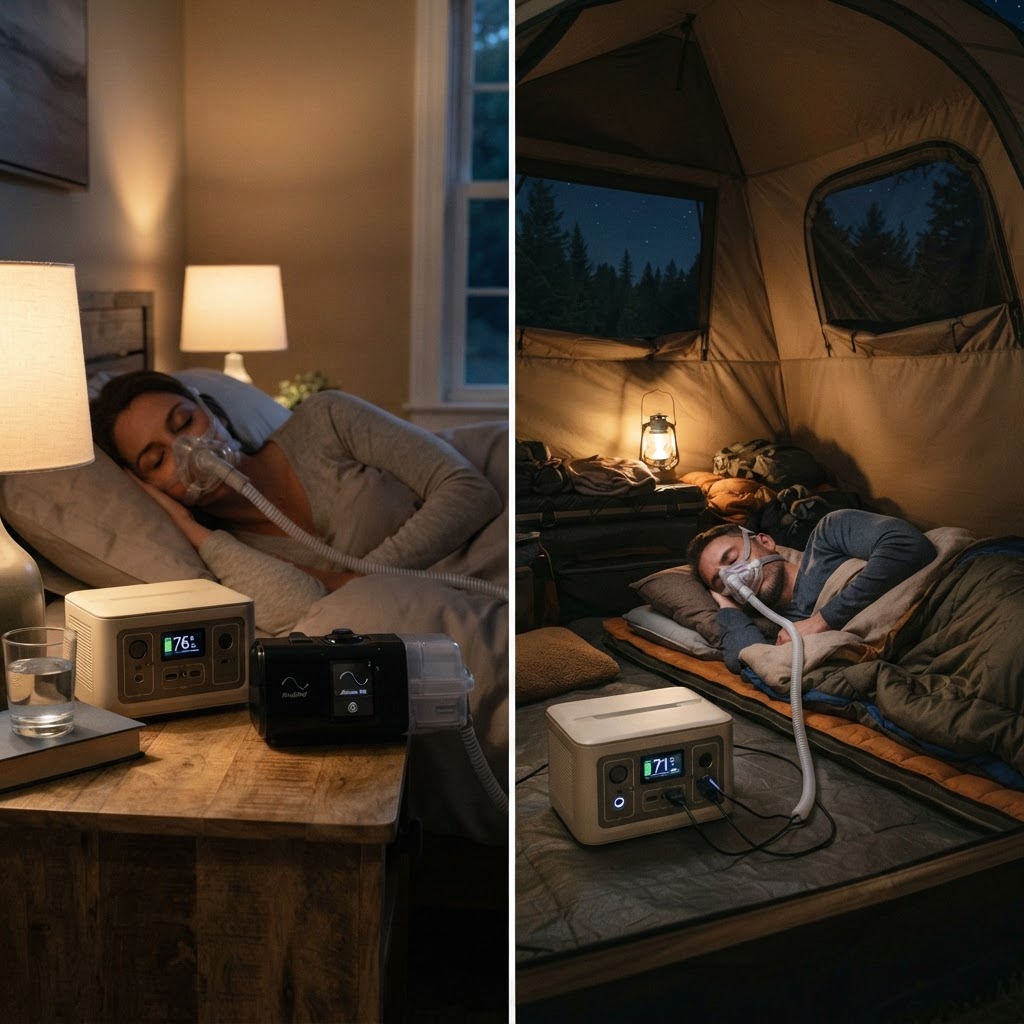
Top Picks This Round
Jackery Explorer 2000 Plus
The ultimate home emergency solution that provides multi-day security for CPAP users during extended grid outages.
- +Huge capacity for critical medical gear
- +Safe and stable LiFePO4 chemistry
- +Excellent build quality and durability
EcoFlow Delta 2 Max
This premium LFP power station offers whisper-quiet operation, ensuring your CPAP power source doesn't disturb your sleep.
- +Extremely quiet fan profiles
- +Fastest dual-charging in its class
- +Rated for 3000+ battery cycles
Bluetti AC200L
A massive 2048Wh powerhouse that allows van lifers to run their CPAP and high-wattage appliances for days on end.
- +Massive 2048Wh base capacity
- +High 2400W continuous AC output
- +Expandable with extra battery packs
Jackery Explorer 1000 v2
A refined version of a classic, providing enough capacity to run a standard CPAP for 3 to 5 nights without a recharge.
- +Fast wall charging via USB-C and AC
- +Reliable Pure Sine Wave inverter
- +Very user-friendly interface
The short answer: for most people asking what size solar generator do I need for a CPAP machine, I’d start at 500Wh to 800Wh for a safer one- to two-night buffer, around 1000Wh if you want several nights without recharging, and 1500Wh+ if this is serious home-outage backup. The exact size depends a lot on whether you run the humidifier and heated hose, and whether you power the CPAP through AC or a more efficient DC adapter.
I’d keep this simple: CPAP runtime is mostly a battery-capacity question, not a big-wattage question. Most CPAP machines don’t need huge surge power, but they do steadily sip power for 6 to 8 hours at a time, night after night. That means a small power station can work for one night, while a 1000Wh-class unit is where things start to feel comfortable instead of tight.
The other thing that trips people up is that a CPAP can be easy or hard to run depending on settings. Turn off the heated humidifier and heated tube, and many users can get much longer runtime than they expected. Leave all the heat features on, and your battery can disappear fast. If you’re shopping for emergency CPAP backup power or the best portable power station for CPAP camping, I’d rather see you buy a little more battery than end up one night short.
One note before I get into picks: I have not hands-on tested these models for this article. I’m basing these recommendations on manufacturer specs, official product documentation, and consistent patterns in verified customer reviews, with a CPAP-first focus on battery capacity, noise, charging options, and real-world practicality.
Quick Comparison
| Product | Best For | Key Spec | value tiers |
|---|---|---|---|
| Jackery Explorer 2000 Plus | Best for home backup | 2000Wh-class LiFePO4 capacity | Premium |
| EcoFlow Delta 2 Max | Best premium | Long-life LFP battery with quiet operation | Premium |
| Bluetti AC200L | Best for RV / van life | 2048Wh base capacity, 2400W AC output | Premium |
| Jackery Explorer 1000 v2 | Best overall | 1000Wh-class capacity with pure sine wave AC | Mid-range |
| EcoFlow River 2 Pro | Best for CPAP | 768Wh capacity with very fast recharging | Mid-range |
| Goal Zero Yeti 200X | Best ultra-portable | 187Wh compact fanless battery | Budget |
| Bluetti EB3A Portable Power Station | Best budget | 268Wh LiFePO4 battery with UPS mode | Budget |
1. Jackery Explorer 2000 Plus — Best for home backup
If your CPAP is a must-run medical device during outages, the Jackery Explorer 2000 Plus makes sense because it gives you a real cushion instead of just one anxious night. This is the kind of capacity I like for storm season, winter outages, or any situation where you don’t know when wall power is coming back. A 2000Wh-class station is a very different experience from a 300Wh or 500Wh box.
Compared with the EcoFlow Delta 2 Max and Bluetti AC200L, this one leans more toward home emergency use than everyday portability. It’s not the unit I’d grab for a quick weekend tent trip, but for keeping a CPAP running through extended outages, more capacity is the whole point. If you’re also thinking about adding solar later, it’s in the right size class for that kind of backup setup.
The trade-off is obvious: size, weight, and cost. You’re paying for peace of mind here, not packability. If you only need a simple overnight backup, this is more battery than most people need.
Pros:
- Very large capacity for critical overnight medical gear
- LiFePO4 chemistry is stable and built for long service life
- Strong overall fit, finish, and durability reputation
Cons:
- Heavy enough that wheels really matter
- Price per watt-hour is on the expensive side
2. EcoFlow Delta 2 Max — Best premium
The EcoFlow Delta 2 Max stands out to me for CPAP users who want a premium setup that still feels easy to live with. One thing that matters more than people expect is overnight noise. Since this unit is known for very quiet fan behavior, it’s easier to place in a bedroom without worrying that your backup battery will be the loudest thing in the room.
It also hits a nice middle ground between the Jackery Explorer 2000 Plus and the Jackery Explorer 1000 v2. You get much more breathing room than a 1000Wh-class unit, but without going all the way into the heaviest emergency-backup category. For someone using a CPAP every night and wanting fast recharge options between uses, the charging speed is a real practical advantage.
I would call this a premium comfort pick rather than the value pick. If you only need backup for a few camping nights a year, it’s probably more than you need. But if quiet operation, long battery life, and fast charging matter a lot, it’s a strong fit.
Pros:
- Very quiet fan profiles compared with a lot of rivals
- Exceptionally fast charging options in its class
- LFP battery is rated for 3000+ cycles
Cons:
- Higher upfront cost than mid-size alternatives
- Overkill for short, simple weekend use
3. Bluetti AC200L — Best for RV / van life
The Bluetti AC200L makes a lot of sense in an RV or van because it’s not just about CPAP runtime. In that setting, you usually want one box that can also support other loads without immediately feeling maxed out. Its 2048Wh base capacity is generous for CPAP use, and the 2400W continuous AC output gives it more headroom for the rest of your mobile setup.
Against the Jackery Explorer 2000 Plus, this one feels more like a multi-role living rig battery than a pure home-backup pick. Against the EcoFlow Delta 2 Max, it gives up some portability and refinement but brings very solid base capacity and expansion potential. If you sleep with a CPAP and spend a lot of nights off-grid in a van, that extra margin can be worth the bulk.
The downside is that you absolutely feel the size. In a small vehicle, every inch and every pound matters. If your only load is a CPAP, the Jackery Explorer 1000 v2 or EcoFlow River 2 Pro will be easier to carry and store.
Pros:
- Large 2048Wh starting capacity
- High 2400W continuous AC output for mixed-use setups
- Can grow with optional expansion batteries
Cons:
- Heavy enough to be a hassle outside an RV or van
- Takes up more floor space than smaller stations
4. Jackery Explorer 1000 v2 — Best overall
If I had to recommend one starting point to the average buyer, it would be the Jackery Explorer 1000 v2. A 1000Wh-class power station is the sweet spot where a CPAP setup stops feeling bare-minimum and starts feeling practical. For many users, this size can cover a few nights of use, especially if you run your machine without heat and use an efficient DC setup when possible.
Compared with the EcoFlow River 2 Pro, you’re getting a more comfortable buffer for multi-night use. Compared with the Jackery Explorer 2000 Plus or Bluetti AC200L, it’s much easier to handle and a lot easier on the budget. That balance is why it lands as best overall for me. It’s big enough to be useful, but not so big that it becomes a dedicated home appliance.
The main catch is that it’s still not small, and it doesn’t push solar input speeds as hard as some rivals. But for someone who wants dependable CPAP backup without diving into the biggest class of power stations, it’s an easy one to shortlist.
Pros:
- Fast wall charging through USB-C and AC
- Reliable pure sine wave inverter for sensitive electronics
- Simple, friendly controls and display
Cons:
- A bit heavier than some competing units
- Solar charging speeds are not class-leading
5. EcoFlow River 2 Pro — Best for CPAP
The EcoFlow River 2 Pro is the one I’d point to first for a buyer who mainly cares about CPAP use and doesn’t want to overspend. Its 768Wh capacity sits right in the middle of the range I usually recommend for one to two nights with margin, and the quick recharge matters if you’re topping it off every day at home, in a vehicle, or from limited solar.
Compared with the Jackery Explorer 1000 v2, you give up some total runtime, but you gain a lighter, easier package and very fast charging. Compared with the Bluetti EB3A, this is a much safer pick if you want more than a bare-bones overnight backup. For a lot of CPAP users, this is the practical middle ground between too small and more battery than they’ll realistically use.
I do think it makes more sense for CPAP-first buyers than for people wanting whole-campsite power. The fan noise under heavy charging or output is the main compromise, and its AC idle draw means using DC power for the CPAP is especially worth it when available.
Pros:
- Very fast recharge time compared with most rivals
- Good portability for the amount of battery you get
- Useful app control for checking status and settings
Cons:
- Fan noise can be noticeable at higher loads
- AC mode wastes a bit more power than some competitors
6. Goal Zero Yeti 200X — Best ultra-portable
The Goal Zero Yeti 200X is a niche pick, but I can see why some people want exactly this size. If you care more about portability than runtime, a 187Wh unit is easy to carry, easy to stash, and quiet enough to disappear into the background. For minimalist travel or a single-night emergency, that can be enough.
That said, I’d be careful here. This is much less forgiving than the EcoFlow River 2 Pro or Jackery Explorer 1000 v2. If your CPAP settings are power-hungry, or if you plan to use AC instead of a DC adapter, the runtime can shrink fast. I’d only look at this class if you already understand your machine’s real power draw and are comfortable with a narrow margin.
The silent, fanless design is a real plus for bedroom use. But capacity is king with CPAPs, and this simply doesn’t have much extra battery to spare.
Pros:
- Silent fanless design is nice beside the bed
- Small enough to fit in a pack or tight gear bin
- Well-finished, lead-free construction
Cons:
- Older lithium-ion chemistry instead of LFP
- 187Wh capacity is limiting for anything beyond one light-use night
7. Bluetti EB3A Portable Power Station — Best budget
If your main goal is affordable emergency CPAP backup power, the Bluetti EB3A is the budget option I’d start with. At 268Wh, it’s still a small station, but it gives you a bit more breathing room than the Goal Zero Yeti 200X, and the LiFePO4 chemistry is a nice upgrade in longevity at this price level.
Compared with the EcoFlow River 2 Pro, this is clearly the tighter-runtime choice. Compared with the Yeti 200X, it’s the better value for most buyers because you get more battery and a longer-life cell chemistry. If you’re planning to run a CPAP with a DC converter and no heated humidity, it can be a sensible overnight solution without spending much.
I would not frame this as the answer for multi-night trips unless you have a solid daytime recharge plan. But if you want a low-cost safety net for outages or the occasional night away, it’s one of the more realistic entry points.
Pros:
- Very affordable way to get started
- LiFePO4 cells should last through many charge cycles
- UPS mode adds backup convenience at home
Cons:
- 268Wh capacity is still limited
- Display can be a little hard to read at a glance
How I Picked These
For CPAP use, I care first about battery capacity in watt-hours, because that tells me how many nights you’re realistically buying. Rated watts matter too, but most CPAP machines are modest loads. A massive inverter doesn’t help much if the battery itself is too small.
I also pay attention to battery chemistry. LiFePO4 usually means longer cycle life and better long-term value, especially for a unit that might sit charged for emergencies and also get used for travel. Then I look at solar input and recharge speed, because a CPAP setup is much more useful if you can actually refill it between nights.
After that, it comes down to real-life stuff: portability, bedroom-friendliness, and value per watt-hour. A 60-pound station may be great for home backup or van life, but annoying for stairs, tent camping, or daily moving. Again, I haven’t personally tested these models here. These picks are based on manufacturer specs, official documentation, and repeat patterns in verified customer reviews.
Things to Watch Out For
1. Confusing watt-hours with watts
Watts tell you how much power a station can deliver at once. Watt-hours tell you how long it can keep delivering power. For CPAP use, watt-hours are usually the more important number.
2. Forgetting AC losses
If you plug your CPAP into the power station’s AC outlet, some energy gets lost in the inverter. A DC adapter often stretches runtime noticeably, which is a big deal when you’re trying to make one battery last all night.
3. Leaving the humidifier and heated hose on
Heat is what drains CPAP batteries fast. If runtime matters, turning off heated humidity and the heated tube can make a dramatic difference.
4. Overestimating solar recharge
Not every power station accepts high solar input, and real sunlight is rarely ideal all day. A small panel may help, but it may not fully refill your battery between nights unless conditions are good.
5. Believing advertised runtime without doing the math
Real-world runtime depends on your pressure settings, mask leaks, humidity, hose heat, inverter losses, and battery reserve. As a rough guide, a 500Wh battery may deliver around 350Wh to 425Wh through AC or somewhat more through DC, which is why how long will a 500Wh battery run a CPAP can range from roughly one night to parts of two nights depending on settings.
Frequently Asked Questions
What size solar generator do I need for one night of CPAP use?
The direct answer: around 250Wh to 500Wh can work for one night, but 500Wh+ is the safer target. Smaller units can do the job if you use DC power and turn off heated humidity, but they leave much less margin.
How long will a 500Wh battery run a CPAP?
The direct answer: for many setups, a 500Wh battery is roughly a one-night solution, and sometimes longer with heat off and DC power. If your CPAP uses more power because of humidification or heated tubing, it may only cover part of a second night.
Can I use a solar generator with a ResMed AirSense 11?
The direct answer: yes, in most cases you can run a ResMed AirSense 11 on a solar generator if the output matches the machine’s power needs. For running ResMed AirSense 11 on solar generator setups, a compatible DC solution is often more efficient than using the AC wall brick.
Should I power my CPAP from AC or DC?
The direct answer: DC is usually better for runtime when your machine supports it. AC is simpler, but the inverter overhead can waste enough energy to matter on smaller power stations.
What is the best portable power station for CPAP camping?
The direct answer: the best size for most campers is usually in the 500Wh to 1000Wh range. That’s why units like the EcoFlow River 2 Pro and Jackery Explorer 1000 v2 make more sense for most people than tiny emergency-only stations.
The Verdict
Best overall: Jackery Explorer 1000 v2. It lands in the sweet spot of enough battery for real CPAP use without jumping to oversized, home-backup-only weight. Check today’s prices on Amazon →
Best budget: Bluetti EB3A Portable Power Station. If you need a low-cost overnight backup and understand its limits, it’s one of the more sensible small-unit buys. Check today’s prices on Amazon →
Best premium: EcoFlow Delta 2 Max. It combines long-life LFP chemistry, strong runtime, and especially quiet operation in a way that fits bedroom backup really well. Check today’s prices on Amazon →
If you want my simplest sizing advice, here it is: buy at least 500Wh for basic overnight confidence, around 1000Wh for the least-regret option, and 2000Wh-class if your CPAP is part of a serious outage plan.
Related Guides
- Best 1000Wh Power Stations for Home Backup
- LiFePO4 vs NMC Batteries: Which Lasts Longer in a Power Station?
- How to Size a Solar Generator for an RV
- Best Portable Power Stations for Tent Camping and Quiet Overnight Use
All Featured Products
Jackery Explorer 2000 Plus
The ultimate home emergency solution that provides multi-day security for CPAP users during extended grid outages.
- +Huge capacity for critical medical gear
- +Safe and stable LiFePO4 chemistry
- +Excellent build quality and durability
EcoFlow Delta 2 Max
This premium LFP power station offers whisper-quiet operation, ensuring your CPAP power source doesn't disturb your sleep.
- +Extremely quiet fan profiles
- +Fastest dual-charging in its class
- +Rated for 3000+ battery cycles
Bluetti AC200L
A massive 2048Wh powerhouse that allows van lifers to run their CPAP and high-wattage appliances for days on end.
- +Massive 2048Wh base capacity
- +High 2400W continuous AC output
- +Expandable with extra battery packs
Jackery Explorer 1000 v2
A refined version of a classic, providing enough capacity to run a standard CPAP for 3 to 5 nights without a recharge.
- +Fast wall charging via USB-C and AC
- +Reliable Pure Sine Wave inverter
- +Very user-friendly interface
EcoFlow River 2 Pro
Offering a sweet spot of 768Wh capacity, this unit can charge from 0-100% in just 70 minutes, making it ideal for daily CPAP users.
- +Industry-leading charge speed
- +Lightweight for mid-range capacity
- +Comprehensive mobile app control
Goal Zero Yeti 200X
A sleek, fanless, and ultra-portable power station designed for backpackers and minimalists needing one night of CPAP power.
- +Completely silent fanless design
- +Fits easily into a hiking pack
- +High-quality lead-free construction
Bluetti EB3A Portable Power Station
A compact and budget-friendly unit using long-lasting LiFePO4 cells, perfect for overnight CPAP use with a DC converter.
- +Extremely affordable price point
- +LiFePO4 battery lasts 2,500+ cycles
- +Built-in UPS mode for backup
Frequently Asked Questions
What size solar generator do I need for one night of CPAP use?
Around 250Wh to 500Wh can work for one night, but 500Wh or more is the safer target. Smaller units can work with DC power and no heated humidity, but they leave less margin.
How long will a 500Wh battery run a CPAP?
For many setups, a 500Wh battery is roughly a one-night solution, and sometimes longer with heat off and DC power. Heated humidity and heated tubing can cut runtime enough that it may only cover part of a second night.
Can I use a solar generator with a ResMed AirSense 11?
Yes, in most cases you can run a ResMed AirSense 11 on a solar generator if the output matches the machine’s needs. A compatible DC setup is often more efficient than using the AC wall adapter.
Should I power my CPAP from AC or DC?
DC is usually better for runtime when your machine supports it. AC is simpler, but inverter losses can noticeably shorten runtime on smaller power stations.
What is the best portable power station size for CPAP camping?
For most campers, the sweet spot is about 500Wh to 1000Wh. That gives a better balance of portability and overnight margin than tiny emergency-only units.