Solar Generator Buying Guide: 2026 Whole House Backup
Expert 2026 solar generator buying guide for home backup. Compare top models for refrigerators and outages to find the most reliable power for your home.
Affiliate disclosure: As an Amazon Associate I earn from qualifying purchases. We may earn a commission from purchases made through our links, at no extra cost to you.
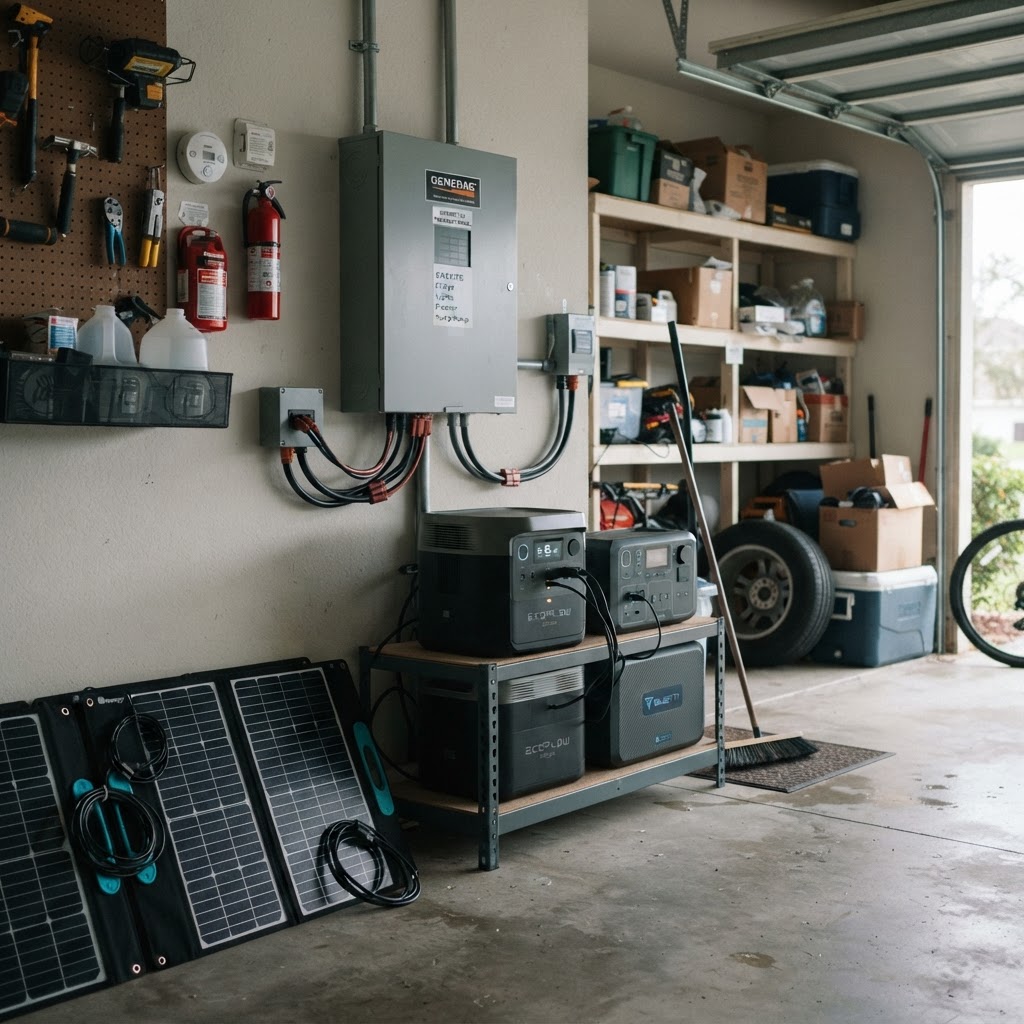
Top Picks This Round
Bluetti AC500 + B300S Home Battery Backup
A high-capacity modular system capable of reaching 18,432Wh, specifically engineered for long-duration grid outages and heavy appliance use.
- +Massive expandable modular capacity
- +Built-in heating for cold weather use
- +Reliable LiFePO4 battery chemistry
Goal Zero Yeti PRO 4000
An enthusiast-grade station featuring a rugged build and superior power management software for professional-level backup reliability.
- +Commercial-grade build quality
- +Exceptional 3000W solar input capacity
- +Industry-best customer support
EcoFlow Delta Pro 3
A cutting-edge 4000W output powerhouse with expandable capacity up to 12kWh, designed for seamless whole-home backup integration.
- +Industry-leading 4000W AC output
- +Ultra-fast X-Stream charging technology
- +Remarkably quiet 30dB operation
Anker SOLIX F3800 Portable Power Station
Features dual-voltage 120V/240V output in a single unit, making it the perfect companion for RV owners and EV emergency charging.
- +Direct 240V output for heavy loads
- +Integrated retractable handle and wheels
- +Direct EV charging capability
The short answer: the best solar generator buying guide advice for 2026 is to size for the loads you actually need during an outage, not the fantasy of running an entire house nonstop. For most people, a large expandable system like the EcoFlow Delta Pro 3 or Bluetti AC500 + B300S makes the most sense for home backup, while smaller stations are better for refrigerators, communications, lights, and short blackouts.
If you're shopping for portable power for outages 2026 style, especially heading into hurricane season, I think the biggest mistake is buying by marketing name instead of watt-hours, inverter output, and recharge speed. A "whole house" solar generator usually means whole-home support for selected circuits or critical appliances unless you're stepping up to a very large modular setup and planning your loads carefully.
I also want to be clear about how this guide is built. I have not hands-on tested these models for this page. These picks are based on manufacturer specs, official product documentation, retailer listings, and broad customer-feedback patterns where those line up. Seriously Suggested may earn a commission when you purchase through links on this page. This does not affect the price you pay or how products are ranked.
If you want one fast answer before we get into the details: for most homes, I would start with the EcoFlow Delta Pro 3 as the best overall balance of output, expansion, and ease of backup use. If your priority is longer-duration backup and modular growth, the Bluetti AC500 + B300S is the stronger home-first option.
Quick Comparison
| Product | Best For | Key Spec | value tiers |
|---|---|---|---|
| Bluetti AC500 + B300S Home Battery Backup | Best for home backup | Expandable modular capacity up to 18,432Wh | Premium |
| Goal Zero Yeti PRO 4000 | Best premium | Up to 3000W solar input | Premium |
| EcoFlow Delta Pro 3 | Best overall | 4000W AC output, expandable to 12kWh | Premium |
| Anker SOLIX F3800 Portable Power Station | Best for RV / van life | Single-unit 120V/240V output | Premium |
| Jackery Solar Generator 3000 Pro | Best for job sites | High-wattage portable power with rugged thermal design | Mid-range |
| Jackery Explorer 1000 v2 | Best budget | Fast 1-hour wall charging | Budget |
| EcoFlow River 3 | Best ultra-portable | 245Wh compact battery platform | Budget |
1. Bluetti AC500 + B300S Home Battery Backup — Best for home backup
If your goal is serious outage coverage rather than weekend convenience power, this is the model in the list that feels most purpose-built for home backup. Based on the listed specifications, the Bluetti AC500 + B300S can scale to a very large 18,432Wh, which matters a lot more than flashy charging claims when you're trying to keep a refrigerator, freezer, lights, routers, and a few comfort loads running through a long storm outage.
I like this pick most for people who think in terms of backup duration first. Compared with the EcoFlow Delta Pro 3, the Bluetti setup gives you a stronger modular path if you already know you want to grow into a larger battery bank. The trade-off is simplicity. This is not the one I would hand to a first-time buyer who wants to unbox, plug in, and forget about it.
Who should avoid it? Apartment dwellers, anyone tight on storage space, and buyers who want a lighter all-in-one unit. If you want a more straightforward premium setup, the Goal Zero Yeti PRO 4000 or EcoFlow Delta Pro 3 will feel easier to live with. But for the best solar generator for home backup when long runtimes matter, Bluetti earns its spot.
Pros:
- Huge modular capacity with room to expand well beyond basic outage needs
- Battery heating helps in colder conditions
- LiFePO4 chemistry is a strong fit for long-term backup use
Cons:
- Takes up meaningful floor space once you build it out
- Initial setup is more involved than simpler all-in-one units
2. Goal Zero Yeti PRO 4000 — Best premium
The Goal Zero Yeti PRO 4000 is the premium buy for people who care as much about polish, software, and support as they do raw battery numbers. Based on the listed specifications, its standout spec is up to 3000W of solar input, which is a big deal if you want faster daytime recovery after an outage.
This one makes sense for the buyer who wants a refined ecosystem and is willing to pay extra for it. Compared with the Bluetti AC500 + B300S, you're giving up some modular scale. Compared with the EcoFlow Delta Pro 3, you're often paying a brand premium for a more support-driven ownership experience instead of chasing maximum output per dollar.
I would skip it if value is your top priority or if you want the broadest expansion path for the money. In those cases, Bluetti and EcoFlow usually make the harder financial argument to ignore. But if you want a premium-feeling unit from a brand known for support, the Yeti PRO 4000 is an easy one to shortlist.
Pros:
- Rugged, commercial-feeling build
- Very strong 3000W solar charging capability
- Customer support reputation is a real selling point for cautious buyers
Cons:
- Usually costs more than some similarly capable rivals
- Heavier than some competing units in its class
3. EcoFlow Delta Pro 3 — Best overall
If I had to point most readers to one model first, it would be the EcoFlow Delta Pro 3. Based on the listed specifications, the combination of 4000W AC output and expansion up to 12kWh gives it a very practical balance for backup use. That's the sweet spot for people who want one unit that can start useful home loads now and still grow later.
What pushes it ahead is how balanced the package looks on paper. The Bluetti AC500 + B300S can be the better choice for bigger modular home systems, but the Delta Pro 3 is easier to picture in a normal household because it blends high output, fast charging, and quieter operation. If you want a solar generator for hurricane season and don't want to overcomplicate the setup, this is the model I would start pricing first.
The downside is portability. At 113 pounds, this is portable in the technical sense, not the casual sense. I would not pick it for frequent lifting, stairs, or a compact camper setup. For RV use, the Anker SOLIX F3800 is the better specialist. For budget shoppers, the Jackery Explorer 1000 v2 is a much more sensible entry point.
Pros:
- Class-leading 4000W AC output for demanding household loads
- Very fast wall charging through EcoFlow's X-Stream approach
- Listed quiet operation is attractive for indoor backup use
Cons:
- Very heavy for a unit marketed as portable
- Accessories and ecosystem add-ons can get expensive fast
4. Anker SOLIX F3800 Portable Power Station — Best for RV / van life
The Anker SOLIX F3800 is the pick here for RV and van users because it does something that matters immediately in that world: direct 240V output in a single unit. That makes it easier to support heavier loads without building a more complicated system around it, and that difference matters more in an RV than it does in a small suburban outage kit.
For home backup, I would still take the EcoFlow Delta Pro 3 first unless you specifically need the voltage flexibility Anker offers. But for mobile setups, the retractable handle, wheels, and direct EV charging ability make the F3800 feel more purpose-built than some home-leaning rivals. It sits between home backup and mobile heavy-use power in a way few stations do well.
Who should avoid it? Anyone sensitive to fan noise, and anyone who dislikes proprietary add-on parts. If you want a cleaner ecosystem for home power, EcoFlow and Bluetti are easier to compare against. If you mostly want a smaller emergency unit for a fridge and phones, the Jackery Explorer 1000 v2 is far more manageable.
Pros:
- Direct 240V output is a real advantage for heavier RV and mobile loads
- Built-in wheels and retractable handle help offset the size
- Can directly charge an EV in an emergency
Cons:
- Expansion relies on proprietary cables
- Fans can get loud when the unit is working hard
5. Jackery Solar Generator 3000 Pro — Best for job sites
The Jackery Solar Generator 3000 Pro makes the most sense for buyers who need high-output portable power in rougher working conditions. The manufacturer positions it around durability, heat management, and straightforward operation, and that combination matters on job sites where dust, vibration, and fast setup are normal.
Compared with the EcoFlow Delta Pro 3, you give up some of the whole-home backup appeal. Compared with the Anker SOLIX F3800, you get a simpler user experience but less of that heavy-load RV-style specialization. In other words, this is a practical workhorse if your power station needs to move between outage backup and real job-site use.
I would avoid it if your main concern is backup switchover speed for sensitive electronics, since the listed cons specifically call out that it does not offer an EPS/UPS mode under 20ms. For pure home outage use, I think Bluetti or EcoFlow are stronger picks. For work-focused reliability and simplicity, this Jackery has a clear lane.
Pros:
- Thermal design is better suited to hard-working environments
- Built to operate in more extreme conditions
- Very simple plug-and-play setup
Cons:
- Backup switchover is not ideal for highly sensitive gear
- Still a bulky unit to move around regularly
6. Jackery Explorer 1000 v2 — Best budget
If you want a practical first outage battery without spending premium money, this is the one I would start with. The Jackery Explorer 1000 v2 is the best budget pick here because it hits the basics that matter in a blackout: simple controls, fast wall charging, and enough capacity for smaller essential loads if you use it realistically.
This is not whole-house backup. It is targeted backup. Think refrigerator cycling, internet gear, lights, phone charging, maybe a few kitchen essentials for short stretches. If your real question is what size solar generator for refrigerator use, a unit in this class can work for many fridges for a limited number of hours, but runtime is always an estimate based on the fridge's actual cycling behavior and startup surge.
I would choose this over the EcoFlow River 3 if you want real outage utility, and I would choose it over the premium units if your budget is tight and your expectations are reasonable. But if you want to run multiple big appliances at once, skip ahead to EcoFlow or Bluetti. This Jackery is budget-smart, not miracle-sized.
Pros:
- Very easy interface for first-time buyers
- Strong value for the amount of usable emergency power
- Fast wall charging is handy before a storm arrives
Cons:
- AC outlet count is limited
- Solar charging is slower than some close rivals
7. EcoFlow River 3 — Best ultra-portable
The EcoFlow River 3 is the smallest and most specialized pick in this guide. With a listed 245Wh capacity, it is not here to run your kitchen. It is here for the truly essential stuff: phones, radios, laptops, lighting, modems, and in some setups a CPAP, depending on the machine's power draw and whether you use humidification.
I like this class of power station for hurricane season because it is easy to keep topped up, easy to store, and easy to grab fast. A lot of people don't need a giant battery first. They need dependable communications and light. Compared with the Jackery Explorer 1000 v2, this is much easier to carry but far less useful for appliance backup. Compared with every premium unit above, it is a different category entirely.
Do not buy it if you expect heat-producing appliances, long fridge runtime, or broad outage coverage. It simply is not built for that. Buy it if you want ultra-portable emergency power you will actually carry, charge, and use.
Pros:
- Small enough to stash in a backpack or storm kit
- Recharges very quickly
- App controls add convenience for light-duty backup
Cons:
- Not suitable for heat-based appliances
- 245Wh capacity is limiting for anything beyond core electronics
How I Picked These
I looked at the stuff that actually changes day-to-day ownership: usable battery capacity, inverter output, recharge speed, portability, and how believable the value is for the money. For home backup, watt-hours matter because they decide how long your essentials run. For tools, microwaves, pumps, or heavier kitchen loads, inverter output matters because the battery can be big and still fail if the AC ceiling is too low.
I also pay attention to battery chemistry when official documentation makes it clear. In general, LiFePO4 is attractive for frequent backup use because cycle life and long-term durability tend to be strong. Solar input matters more than a lot of buyers realize, too. A large battery that recharges slowly can be frustrating during multi-day outages, especially if weather windows are short.
Most important, I did not rank these by hype or commission. I ranked them by fit. A 1000-class unit can be the smart buy for a renter, and a huge modular system can be the right move for a homeowner protecting cold food, medical basics, and critical circuits through repeated storm outages.
Things to Watch Out For
1. Confusing Wh with W. Watt-hours tell you how much energy is stored. Watts tell you how much power can be delivered at one time. You need both numbers to make a smart choice.
2. Believing peak output is the same as continuous output. A station may briefly handle startup surge, but that does not mean it can run a heavy appliance continuously. Refrigerators, pumps, and tools can be tricky here.
3. Ignoring solar input limits. A large battery is only half the story. If solar recharge is slow, you may not recover enough energy each day during a long outage.
4. Overlooking inverter ceilings for tools and kitchen loads. A power station might run lights and electronics comfortably but still trip when you plug in a microwave, space heater, or high-draw saw. Heat-based appliances are especially demanding.
5. Treating advertised runtime as a promise. Runtime is always an estimate. Real-world results depend on inverter losses, appliance cycling, temperature, and how much reserve you keep. A refrigerator, for example, does not draw the same wattage every minute of the day.
Frequently Asked Questions
Can a solar generator really power a whole house?
Yes, but only in some cases. Most solar generators are best for critical circuits or selected appliances, while true whole-house support usually requires a large expandable system and careful load planning.
What size solar generator do I need for a refrigerator?
You usually want enough inverter headroom for the fridge's startup surge and enough battery capacity for its cycling runtime. In practice, a roughly 1kWh-class unit can cover some fridges for a short outage, but larger batteries are much safer for overnight or storm use.
Is LiFePO4 better for home backup?
Yes, often. LiFePO4 is generally preferred for frequent backup duty because long cycle life and thermal stability are strong advantages when those specs are officially listed.
How much solar input should I look for?
More is usually better if you expect multi-day outages. Higher solar input helps refill the battery faster during limited sun windows, which matters a lot more than flashy max-output claims in a prolonged blackout.
What is the best solar generator for hurricane season?
For most homes, a large expandable unit is the safer answer. The EcoFlow Delta Pro 3 is my best overall pick for balanced backup, while the Bluetti AC500 + B300S is stronger if long-duration modular capacity is your top priority.
The Verdict
Decision: Recommended for a specific use case.
For most homeowners who want serious portable backup without jumping straight into a fixed home battery project, the EcoFlow Delta Pro 3 is my top overall pick because it balances high output, expansion, and everyday usability better than anything else in this guide. Check today's prices on Amazon →
If you want the smartest lower-cost entry point, the Jackery Explorer 1000 v2 is the best budget pick because it covers the essentials without pretending to be whole-house backup. Check today's prices on Amazon →
If you want the premium buy and care about strong solar intake plus a polished ecosystem, the Goal Zero Yeti PRO 4000 is my premium pick. Check today's prices on Amazon →
My last bit of advice is simple: buy for the outage you are actually likely to face. If your goal is food preservation, communications, lights, and a bit of comfort during storm season, a well-sized power station is a smart tool. If your goal is running everything in the house exactly like normal, you need to size up fast and be honest about budget, space, and expectations.
Related Guides
- Best 1000Wh Power Stations for Refrigerator Backup
- LiFePO4 vs NMC Batteries: Which Is Better for Home Outages?
- How to Size a Solar Generator for CPAP, Fridge, and Wi-Fi
- EcoFlow Delta Pro 3 vs Bluetti AC500: Which Home Backup Setup Makes More Sense?
All Featured Products
Bluetti AC500 + B300S Home Battery Backup
A high-capacity modular system capable of reaching 18,432Wh, specifically engineered for long-duration grid outages and heavy appliance use.
- +Massive expandable modular capacity
- +Built-in heating for cold weather use
- +Reliable LiFePO4 battery chemistry
Goal Zero Yeti PRO 4000
An enthusiast-grade station featuring a rugged build and superior power management software for professional-level backup reliability.
- +Commercial-grade build quality
- +Exceptional 3000W solar input capacity
- +Industry-best customer support
EcoFlow Delta Pro 3
A cutting-edge 4000W output powerhouse with expandable capacity up to 12kWh, designed for seamless whole-home backup integration.
- +Industry-leading 4000W AC output
- +Ultra-fast X-Stream charging technology
- +Remarkably quiet 30dB operation
Anker SOLIX F3800 Portable Power Station
Features dual-voltage 120V/240V output in a single unit, making it the perfect companion for RV owners and EV emergency charging.
- +Direct 240V output for heavy loads
- +Integrated retractable handle and wheels
- +Direct EV charging capability
Jackery Solar Generator 3000 Pro
Built for durability, this high-wattage generator is designed to withstand the dust and vibrations of professional job sites.
- +Superior thermal heat dissipation
- +Works in extreme temperatures
- +Intuitive 'plug and play' operation
Jackery Explorer 1000 v2
A revamped classic that balances portability with enough power to run critical kitchen appliances during unexpected blackouts.
- +Simplified user-friendly interface
- +Excellent price-to-performance ratio
- +Rapid 1-hour wall charging
EcoFlow River 3
A ultra-compact and fast-charging unit ideal for maintaining communication devices and CPAP machines during localized outages.
- +Fits easily in a backpack
- +Full charge in under 60 minutes
- +Smart app control features
Frequently Asked Questions
Can a solar generator really power a whole house?
Sometimes, but usually only selected circuits or essential appliances. Most portable systems are best for critical backup unless you buy a large expandable setup and carefully manage loads.
What size solar generator do I need for a refrigerator?
You need enough inverter headroom for startup surge and enough battery capacity for cycling runtime. A roughly 1kWh-class unit may handle some fridges for a shorter outage, but larger batteries are better for overnight backup.
Is LiFePO4 better for home backup?
Often, yes. When officially listed, LiFePO4 is generally attractive for home backup because it tends to offer strong cycle life and durability.
How much solar input should I look for?
As much as your budget and setup allow for long outages. Higher solar input helps you recover battery capacity faster during limited sun windows.
What is the best solar generator for hurricane season?
For most homes, the EcoFlow Delta Pro 3 is the best overall balance, while the Bluetti AC500 + B300S is stronger for buyers who want a bigger modular home-backup path.