Jackery Explorer 2000 v2 vs Bluetti AC200L: 2026 Guide
Comparing Jackery Explorer 2000 v2 vs Bluetti AC200L. Discover the best 2000Wh station for charging speed and reliability. See our expert 2026 verdict.
Affiliate disclosure: As an Amazon Associate I earn from qualifying purchases. We may earn a commission from purchases made through our links, at no extra cost to you.
Top Picks This Round
Jackery Explorer 2000 Plus
A premium, high-output station that supports up to five add-on batteries, providing a professional-grade power solution for emergencies.
- +High 3000W AC continuous output
- +Support for 5 expansion batteries
- +Premium build and rugged casing
Anker SOLIX F2000 (PowerHouse 767)
Designed with a suitcase-style handle and rugged wheels, this unit is built for ultimate mobility in RV and camping scenarios.
- +Built-in wheels and handle
- +GaN technology for better efficiency
- +InfiniPower 10-year durability
Jackery Explorer 2000 v2
The 2024/2025 update to a classic, the v2 swaps to LiFePO4 cells and sheds significant weight while maintaining high output for off-grid living.
- +20% lighter than previous models
- +Long-lasting LiFePO4 battery
- +1.7 hour rapid AC charging
EcoFlow Delta 2 Max
Renowned for its whisper-quiet operation and incredibly fast X-Stream charging technology, making it ideal for indoor or campsite use.
- +Extremely quiet cooling fans
- +0-80% charge in only 43 minutes
- +Dual solar charging ports
The short answer: in a straight Jackery Explorer 2000 v2 vs Bluetti AC200L matchup, I’d steer most people to the Jackery Explorer 2000 v2 if they want a lighter, simpler, everyday 2kWh station, and to the Bluetti AC200L if they need more inverter headroom, faster high-input charging options, and room to expand later.
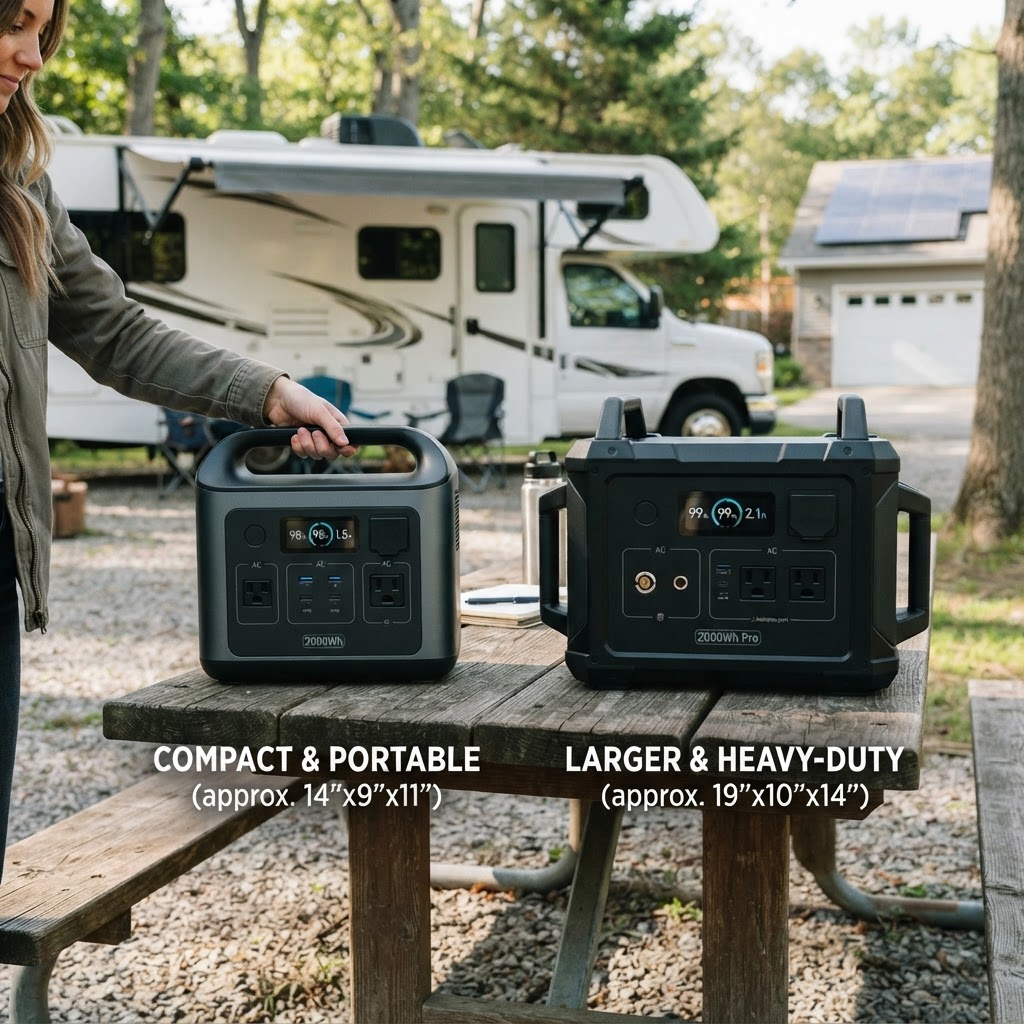
That’s really what this choice comes down to. The Jackery feels more like a grab-and-go power station for camping, outages, and general home use. The Bluetti feels more like a small backup system that just happens to still be portable. Both sit in the sweet spot for people who want real usable power without stepping up into something much bigger, pricier, and harder to move.
For this guide, I’m not pretending I ran a lab test bench. These picks are based on manufacturer specs, official product documentation, and verified customer-review patterns across the current 2kWh class. I’m also widening the lens a bit, because if you’re comparing the Jackery Explorer 2000 v2 and Bluetti AC200L, it helps to see where the other strong options fit too, especially if you’re also wondering about Jackery 2000 v2 vs 2000 Plus, Bluetti AC200L charging speed, or what the best 2000Wh portable power station 2026 field really looks like.
The good news is that this size class is finally mature. Most of the better models now give you enough output for fridges, coffee makers, microwaves, CPAPs, power tools, and a decent slice of emergency home backup. The bad news is that the wrong 2kWh station can still feel too heavy, too limited, or too expensive for what you actually need. So here’s how I’d sort them out.
Quick Comparison
| Product | Best For | Key Spec | value tiers |
|---|---|---|---|
| Jackery Explorer 2000 Plus | Best premium expandable | 3000W AC output and supports 5 expansion batteries | Premium |
| Anker SOLIX F2000 (PowerHouse 767) | Best for RV / van life | Built-in wheels, handle, and long-life design | Mid-range |
| Jackery Explorer 2000 v2 | Best overall | Lighter design, LiFePO4 battery, 1.7-hour AC charging | Mid-range |
| EcoFlow Delta 2 Max | Best for quiet operation | Very quiet fans and ultra-fast AC charging | Mid-range |
| Bluetti AC200L | Best for heavy duty appliances | 2400W AC output and expandable up to 8kWh | Mid-range |
| Ugreen PowerRoam 2200 | Best for job sites | 16 ports, fast charging, detachable trolley | Mid-range |
| Pecron E2000LFP | Best budget | 1920Wh LFP capacity at a lower entry price | Budget |
1. Jackery Explorer 2000 Plus — Best premium expandable
The Jackery Explorer 2000 Plus is the one I’d point to if you already know a basic 2kWh box won’t be enough long term. Its big advantage is simple: more output now, and much more storage later. With a 3000W AC inverter and support for up to five expansion batteries, it moves beyond weekend backup and into serious outage planning.
This is also the cleanest answer if you’re stuck on Jackery 2000 v2 vs 2000 Plus. The Explorer 2000 v2 is the easier station to carry and live with day to day, but the Explorer 2000 Plus is the better pick if you want one system to grow with you. If you run a microwave, portable AC, kettle, induction hob, or multiple appliances at once, the bigger inverter matters.
The trade-off is obvious: price and weight. Compared with the Bluetti AC200L, the Jackery 2000 Plus gives you that higher 3000W output and a premium feel, but the Bluetti is often the more value-focused way to get into expandable backup. I’d only pay up for the Jackery if you really want the higher output ceiling and know expansion is part of the plan.
Pros:
- Strong 3000W continuous AC output for heavier loads
- Can add up to five expansion batteries later
- Premium build with a rugged outer shell
Cons:
- The base unit is expensive before you add extra batteries
- Large and heavy enough that solo carrying is a chore
2. Anker SOLIX F2000 (PowerHouse 767) — Best for RV / van life
The Anker SOLIX F2000 earns its spot because mobility is not just about weight. For RV and van use, wheels and a proper pull handle can matter more than saving a few pounds on paper. If your station mostly moves from storage bay to picnic table to campsite hookup area, this design makes a lot of sense.
Compared with the Jackery Explorer 2000 v2, the Anker is bulkier, but it can be easier to move across pavement or hard-packed ground because you’re rolling it instead of deadlifting it. Compared with the Bluetti AC200L, it feels more tailored to travel and campsite use than to a semi-fixed home backup setup.
The catch is footprint. This is not the one I’d choose if you need to lift it in and out of a car trunk often. But for RV folks who want a more durable, suitcase-style station with a long-life reputation, it makes a strong case. It sits a little outside the pure Jackery Explorer 2000 v2 vs Bluetti AC200L debate, but it’s one of the few alternatives that genuinely solves a different problem.
Pros:
- Built-in wheels and handle make moving it much easier
- GaN design helps with efficiency and thermal management
- InfiniPower durability focus is a plus for frequent use
Cons:
- Takes up a lot of space physically
- Still heavy for this capacity class
3. Jackery Explorer 2000 v2 — Best overall
If you want the shortest version of my take, this is the one I’d recommend to the biggest number of people. The Jackery Explorer 2000 v2 fixes a lot of what held older big Jackery units back by trimming weight and moving to a long-life LiFePO4 battery. That matters more than flashy extras for most buyers, because a power station you can actually move and recharge easily is the one you’ll use.
In the Jackery Explorer 2000 v2 vs Bluetti AC200L decision, Jackery wins on simplicity and portability. It is about 20% lighter than earlier models in the line, charges fast on AC at around 1.7 hours, and avoids the “small backup system” vibe that heavier expandable units can have. If your use is camping, apartment backup, tailgating, CPAP support, or keeping the basics running during outages, that lighter build is a real advantage.
Where it gives ground to the Bluetti AC200L is expansion and raw system flexibility. There’s no official expansion battery support here, so what you buy is basically what you live with. Solar input is also limited to 1200W, which is fine for many people but less ambitious than some rivals. Still, for the best 2000Wh portable power station 2026 conversation, the Explorer 2000 v2 hits the most balanced middle ground I can see.
Pros:
- Noticeably lighter than older Jackery models
- Long-life LiFePO4 battery chemistry
- Rapid AC charging in about 1.7 hours
Cons:
- No official expansion battery path
- Solar input tops out at 1200W
4. EcoFlow Delta 2 Max — Best for quiet operation
The EcoFlow Delta 2 Max is the one I’d look at if the station will spend a lot of time indoors, in a tent-adjacent setup, or near where people sleep. Quiet fans sound like a minor detail until your battery is topping up in a small room at night. EcoFlow has built a strong reputation around fast charging, but the low-noise operation is what makes this model stand out to me.
Against the Jackery Explorer 2000 v2, EcoFlow gives you even more aggressive AC charging behavior and dual solar charging ports, which can be handy if you’re piecing together a flexible panel setup. Against the Bluetti AC200L, it is less about brute appliance power and more about user comfort, speed, and convenience.
The downsides are mostly value and accessories. You’re paying a bit more per watt-hour, and proprietary expansion cables are not my favorite thing to deal with. So I wouldn’t call it the best pure value pick, but if fan noise bothers you or you want one of the quickest wall-charging experiences in the class, it deserves a long look.
Pros:
- Cooling fans are impressively quiet
- Charges from 0 to 80% extremely fast
- Dual solar charging ports add setup flexibility
Cons:
- Expansion cables are proprietary and bulky
- Price per watt-hour is higher than some rivals
5. Bluetti AC200L — Best for heavy duty appliances
If your shortlist is basically down to Jackery Explorer 2000 v2 vs Bluetti AC200L, the Bluetti case is pretty straightforward. This unit is for people who care more about inverter muscle and system growth than about shaving weight. Its 2400W AC output gives it a stronger footing with heavier appliances, and its expansion path up to 8kWh makes it much more future-proof than the Jackery v2.
The Bluetti AC200L charging speed is also part of the appeal. Fast 2400W AC plus solar input means it can recover quickly when you have a solid charging window. That makes it attractive for outage planning, shed or garage use, and setups where the station is working hard rather than just tagging along for convenience. Compared with the Jackery Explorer 2000 v2, it asks more from you physically, but it can also do more.
The weight is the price you pay. At 62 lbs, this is not a station I’d want to carry around casually. And while Bluetti packs in strong features, app connectivity comments are more mixed than I’d like. On the Jackery vs Bluetti reliability 2026 question, I’d say Jackery tends to look a bit more straightforward and low-fuss based on review patterns, while Bluetti often wins buyers over with capability and expandability. If you want the more appliance-ready machine, I’d still pick the AC200L over the v2.
Pros:
- Stout 2400W AC output for more demanding appliances
- Expansion support up to 8kWh is a big long-term plus
- Very fast AC plus solar charging potential
Cons:
- Heavy at 62 lbs
- App connectivity can be a little finicky
6. Ugreen PowerRoam 2200 — Best for job sites
The Ugreen PowerRoam 2200 makes sense for people who care about ports, speed, and getting a heavy box from one work area to another without babying it. The detachable trolley is the standout feature here. Like the Anker, it is solving the problem of moving a large station in the real world, not just winning a spec sheet argument.
Compared with the Bluetti AC200L, the Ugreen feels more work-focused and port-rich, while Bluetti feels more like the stronger home-backup platform. Compared with the Jackery Explorer 2000 v2, Ugreen is less about light carry convenience and more about utility. If you’re powering chargers, small corded tools, lights, and assorted gear through a workday, the 16 output ports are genuinely useful.
The reason it doesn’t rank higher for most people is brand familiarity and solar quirks. Ugreen is better known in electronics than in the power-station space, and the solar controller being picky can be annoying if solar charging is a major part of your plan. Still, as a job-site option, it has a clearer identity than many me-too 2kWh boxes.
Pros:
- Detachable trolley makes transport easier
- Lots of output options with 16 total ports
- Internal charging is very fast
Cons:
- Not as established a name in this category
- Solar charging can be finicky with some setups
7. Pecron E2000LFP — Best budget
The Pecron E2000LFP is the one I’d bring up when somebody says, “I just want solid 2kWh power without paying for a polished app or premium branding.” At this end of the market, what matters is simple math: capacity, inverter output, battery chemistry, and cost. Pecron gets the basics right and keeps the price lower than the bigger brands.
Compared with the Jackery Explorer 2000 v2, you give up some refinement, charging speed, and overall polish. Compared with the Bluetti AC200L, you lose expansion ambition and some heavier-duty feel. But if your actual goal is to run essentials during outages, power a campsite, or keep a fridge and devices going for the least money possible, that trade can be worth it.
I wouldn’t buy this one for the app experience, and I wouldn’t buy it if ultra-fast charging is high on my list. I would buy it if value per watt-hour is the main thing driving the decision. For a budget-first shopper, this is the easiest recommendation in the group.
Pros:
- Hard to beat on price per watt-hour
- Uses dependable LiFePO4 battery chemistry
- Simple controls without extra fuss
Cons:
- No sophisticated mobile app
- Charges slower than the quickest rivals like EcoFlow
How I Picked These
I picked these the way I’d actually shop for a 2kWh station: by looking at what matters once the novelty wears off. First is the balance between watt-hours and inverter watts. A big battery is nice, but if the inverter ceiling is too low for your coffee maker, microwave, tool charger, or fridge startup surge, that stored energy is not as useful as it looks.
Battery chemistry matters too. In a plain LFP vs NMC power station comparison, I generally lean toward LiFePO4 for this size class because cycle life and daily-use durability matter more to me than chasing the absolute lightest possible pack. That’s especially true for home backup, RV use, and frequent charging. NMC still has a place when weight is the top priority, but for 2026 shopping, LFP is usually where I’d start.
Then I look at solar input, recharge speed, portability, and value per watt-hour. A 2kWh station that takes forever to refill can be frustrating in bad weather or short outage windows. And a “portable” model that’s too awkward to move is not portable in any meaningful sense. None of these picks are based on hands-on testing by this site; they’re based on manufacturer specs, official documentation, and verified customer-review patterns that show how these units fit real use.
Things to Watch Out For
- Confusing watt-hours with watts. Watt-hours tell you roughly how long the battery can run something. Watts tell you what it can run at one time. A 2kWh station with a weaker inverter may still struggle with a demanding appliance.
- Mixing up peak output and continuous output. Brands love to mention surge or peak numbers, but what matters day to day is continuous AC output. If you want to run tools, heaters, kitchen gear, or a fridge reliably, watch the continuous rating first.
- Assuming solar input is unlimited. This is a big one in the Jackery Explorer 2000 v2 vs Bluetti AC200L comparison. The Jackery’s 1200W solar input is decent, but the Bluetti is built for a more aggressive charging setup. More panel wattage on paper does not help if the station cannot accept it.
- Believing all “fast charging” claims mean the same thing. Some brands quote AC-only speed, others lean on combined AC plus solar figures. Bluetti AC200L charging speed looks strong, but always check what input method is being used for the advertised number.
- Expecting advertised runtime to match real life. Inverter losses, temperature, appliance cycling, and startup surges all eat into runtime. A 2000Wh-class station will not give you the full rated capacity as usable AC energy, so leave yourself a margin.
Frequently Asked Questions
Is the Jackery Explorer 2000 v2 or Bluetti AC200L better for home backup?
The direct answer: the Bluetti AC200L is better for heavier home backup use, while the Jackery Explorer 2000 v2 is better for simpler, lighter-duty backup. The Bluetti gives you more output and expansion room, but the Jackery is easier to move and easier for many people to live with.
Which charges faster, the Jackery Explorer 2000 v2 or Bluetti AC200L?
The direct answer: the Bluetti AC200L has the more aggressive high-input charging setup overall, while the Jackery Explorer 2000 v2 is still very fast on plain AC. In practice, both recharge quickly, but Bluetti has the edge if you plan to push AC plus solar charging hard.
Is the Jackery Explorer 2000 v2 expandable like the Jackery Explorer 2000 Plus?
The direct answer: no, the Jackery Explorer 2000 v2 does not have official expansion battery support like the Explorer 2000 Plus. If future battery growth matters, the 2000 Plus is the better Jackery path.
Is LiFePO4 better than NMC for a 2kWh power station?
The direct answer: for most people, yes, LiFePO4 is the better fit because it usually offers longer cycle life and better long-term durability. NMC can still help reduce weight, but in this class I usually prefer LFP for backup and regular use.
What can a 2kWh power station realistically run?
The direct answer: a good 2kWh station can usually handle fridges, lights, device charging, TVs, CPAPs, many kitchen appliances, and some power tools within the inverter limit. The real question is not just capacity, but whether the station’s continuous watt rating matches your appliance load.
The Verdict
If I had to pick one winner for most people, it’s the Jackery Explorer 2000 v2 because it balances weight, battery chemistry, recharge speed, and everyday usability better than anything else here. Check today’s prices on Amazon →
If I wanted the best budget option, I’d take the Pecron E2000LFP because it gives you the most straightforward value per watt-hour without pretending to be more than it is. Check today’s prices on Amazon →
If I wanted the premium pick, I’d choose the Jackery Explorer 2000 Plus because the 3000W inverter and real expansion path make it the strongest long-term system buy. Check today’s prices on Amazon →
And if your decision is strictly Jackery Explorer 2000 v2 vs Bluetti AC200L, my simple advice is this: pick Jackery for lighter, cleaner, grab-and-go power; pick Bluetti for heavier appliances and room to build a bigger backup setup later.
Related Guides
- Best 1000Wh Power Stations for Home Backup
- LiFePO4 vs NMC Batteries: Which Lasts Longer in a Power Station
- How to Size a Solar Generator for an RV
- Best Portable Power Stations for CPAP, Fridge, and Emergency Use
All Featured Products
Jackery Explorer 2000 Plus
A premium, high-output station that supports up to five add-on batteries, providing a professional-grade power solution for emergencies.
- +High 3000W AC continuous output
- +Support for 5 expansion batteries
- +Premium build and rugged casing
Anker SOLIX F2000 (PowerHouse 767)
Designed with a suitcase-style handle and rugged wheels, this unit is built for ultimate mobility in RV and camping scenarios.
- +Built-in wheels and handle
- +GaN technology for better efficiency
- +InfiniPower 10-year durability
Jackery Explorer 2000 v2
The 2024/2025 update to a classic, the v2 swaps to LiFePO4 cells and sheds significant weight while maintaining high output for off-grid living.
- +20% lighter than previous models
- +Long-lasting LiFePO4 battery
- +1.7 hour rapid AC charging
EcoFlow Delta 2 Max
Renowned for its whisper-quiet operation and incredibly fast X-Stream charging technology, making it ideal for indoor or campsite use.
- +Extremely quiet cooling fans
- +0-80% charge in only 43 minutes
- +Dual solar charging ports
Bluetti AC200L
A powerhouse performer with a massive 2400W AC inverter and industry-leading expansion capabilities for full home backup flexibility.
- +Sturdy 2400W AC output
- +Expandable up to 8kWh
- +Fast 2400W AC + Solar input
Ugreen PowerRoam 2200
Featuring a detachable trolley and PowerZip technology, this unit balances high wattage with industrial-grade durability for job sites.
- +Detachable trolley included
- +16 varied output ports
- +Very fast internal charging
Pecron E2000LFP
The price-to-performance king, offering a full 1920Wh of LFP capacity and 2000W output at a price that beats every major competitor.
- +Unbeatable price per Watt-hour
- +Reliable LiFePO4 chemistry
- +Simple, no-nonsense interface
Frequently Asked Questions
Is the Jackery Explorer 2000 v2 or Bluetti AC200L better for home backup?
The Bluetti AC200L is better for heavier home backup use, while the Jackery Explorer 2000 v2 is better for simpler, lighter-duty backup. The Bluetti gives you more output and expansion room, but the Jackery is easier to move and easier for many people to live with.
Which charges faster, the Jackery Explorer 2000 v2 or Bluetti AC200L?
The Bluetti AC200L has the more aggressive high-input charging setup overall, while the Jackery Explorer 2000 v2 is still very fast on plain AC. In practice, both recharge quickly, but Bluetti has the edge if you plan to push AC plus solar charging hard.
Is the Jackery Explorer 2000 v2 expandable like the Jackery Explorer 2000 Plus?
No, the Jackery Explorer 2000 v2 does not have official expansion battery support like the Explorer 2000 Plus. If future battery growth matters, the 2000 Plus is the better Jackery path.
Is LiFePO4 better than NMC for a 2kWh power station?
For most people, yes, LiFePO4 is the better fit because it usually offers longer cycle life and better long-term durability. NMC can still help reduce weight, but in this class LiFePO4 is usually the safer long-term bet for backup and regular use.
What can a 2kWh power station realistically run?
A good 2kWh station can usually handle fridges, lights, device charging, TVs, CPAPs, many kitchen appliances, and some power tools within the inverter limit. The real question is not just capacity, but whether the station’s continuous watt rating matches your appliance load.