Is EcoFlow Delta Pro 3 Worth It? 2026 Home Backup Review
Is the EcoFlow Delta Pro 3 worth it? Read our 2026 review of its 240V output and battery life for whole home backup. See why it beats the competition here!
Affiliate disclosure: As an Amazon Associate I earn from qualifying purchases. We may earn a commission from purchases made through our links, at no extra cost to you.
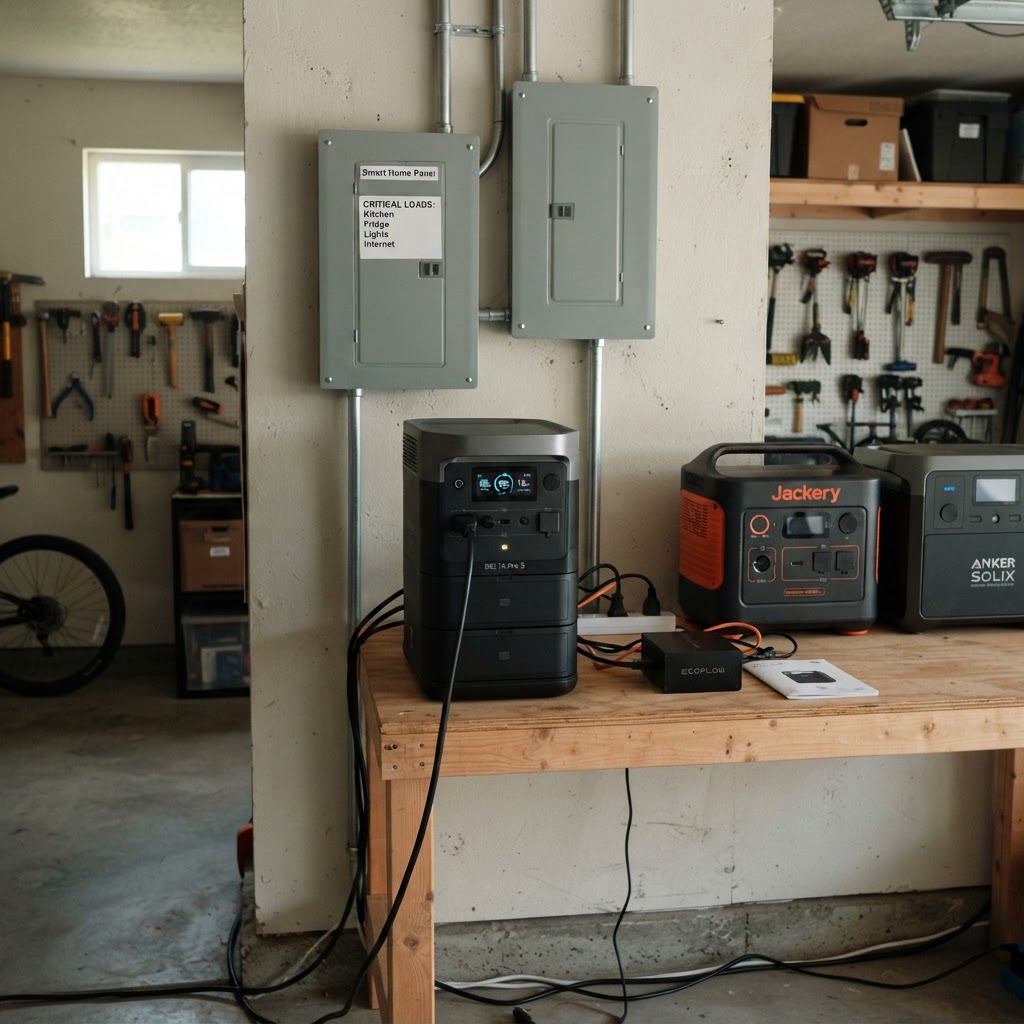
Top Picks This Round
EcoFlow DELTA Pro Ultra
A massive modular power system designed for long-term outages, offering up to 90kWh of expandable capacity.
- +Unmatched 7200W-21600W output
- +Stackable modular design
- +Solar input up to 5600W
EcoFlow DELTA Pro 3
The new standard for home backup, featuring 4000W output and 120V/240V capability in a single unit with LFP chemistry.
- +Native 120V/240V output
- +4000W AC output (8000W surge)
- +Quiet 30dB operation mode
Goal Zero Yeti PRO 4000
A ruggedized, high-output station built for harsh environments and demanding professional job site tools.
- +IPX4 weather resistance rating
- +High-density LFP cell tech
- +Heavy-duty build quality
Anker SOLIX F3800
A direct rival to the Delta series, providing 6000W of power and dual-voltage support for heavy appliances.
- +Direct EV charging port
- +Internal 120V/240V switching
- +User-friendly app interface
The short answer: Yes, the EcoFlow DELTA Pro 3 is worth it for a lot of people who want serious home backup without jumping all the way to a much larger modular system. If you’re asking is EcoFlow Delta Pro 3 worth it?, I’d say yes for most households that want native 120V/240V output, strong inverter headroom, and a simpler path than the pricier EcoFlow DELTA Pro Ultra.
Where I think people get stuck is this: the DELTA Pro 3 sits in that awkward zone between a portable power station and a true whole-home backup setup. It’s much more capable than the usual 2kWh to 3kWh class, but it’s still not magic. It can run a lot, and in the right setup it can cover key circuits very well, but it won’t replace a large permanent standby-style battery bank for every home.
For this guide, I’m not pretending I bench-tested every unit in a lab. I’m basing this on manufacturer specs, official product documentation, and verified customer-review patterns, then looking at what actually matters when you’re trying to keep a fridge cold, a well pump ready, or a few critical circuits alive during a real outage. If you’re shopping the whole home backup solar generator 2026 category, these are the models I’d compare first.
The EcoFlow DELTA Pro 3 stands out because it gives you native dual-voltage flexibility in one box, which is still a big deal. Against the Anker SOLIX F3800, it feels a little more balanced. Against the EcoFlow DELTA Pro Ultra, it’s cheaper and simpler. Against lighter units like the Jackery Explorer 3000 Pro, it’s way better suited to home backup, even if you’ll feel every bit of that extra weight when you move it.
Quick Comparison
| Product | Best For | Key Spec | value tiers |
|---|---|---|---|
| EcoFlow DELTA Pro Ultra | Best premium | 7200W-21600W output, modular expansion | Premium |
| EcoFlow DELTA Pro 3 | Best overall | Native 120V/240V, 4000W AC output | Premium |
| Goal Zero Yeti PRO 4000 | Best for job sites | Rugged LFP build with IPX4 rating | Premium |
| Anker SOLIX F3800 | Best for home backup | 6000W output with 120V/240V switching | Premium |
| Jackery Explorer 3000 Pro | Best for RV / van life | 64 lb weight and fast wall charging | Mid-range |
| BLUETTI AC200L | Best value mid-range | 2400W AC output, expandable 2048Wh platform | Mid-range |
| EcoFlow River 2 Pro | Best ultra-portable | 17.2 lb weight and 70-minute recharge | Budget |
1. EcoFlow DELTA Pro Ultra — Best premium
If money is not the main limiter, the EcoFlow DELTA Pro Ultra is the one that answers the question the DELTA Pro 3 can’t fully answer: what if I want a real whole-home-capable backup platform, not just a very powerful portable unit? This system starts in a different league. The output range, modular design, and huge expansion ceiling make it the better fit for long outages, larger homes, and people who want to scale capacity over time instead of living inside a single-box limit.
This is the clearest answer to the EcoFlow DELTA Pro 3 vs Delta Pro Ultra question. The DELTA Pro 3 is the simpler, more approachable choice. The Ultra is the heavier-duty platform. If you need to support more demanding 240V loads, add far more battery capacity, and lean harder into a semi-permanent home backup setup, the Ultra earns its premium tag. It also has much stronger solar headroom, which matters if you’re trying to recharge quickly during extended outages instead of babying your loads.
The trade-off is pretty obvious: cost and complexity. The DELTA Pro 3 is easier to justify because it feels like a very high-end power station. The Ultra starts to behave more like a modular home energy system, and for many buyers that means professional installation, extra planning, and a much higher starting bill.
Pros:
- Massive output ceiling from 7200W up to 21600W depending on configuration
- Modular stackable design makes long-term expansion much easier
- Very high solar input potential, up to 5600W
Cons:
- Home tie-in usually means professional installation, not a casual plug-and-play setup
- The starting cost is tough to swallow for most households
2. EcoFlow DELTA Pro 3 — Best overall
This is the one I’d point most people toward first. The EcoFlow DELTA Pro 3 hits a sweet spot that a lot of home users are actually looking for: enough output to run serious appliances, native 120V/240V support without building a giant stack, and LFP battery chemistry for long-term use. That last part matters. When people ask about EcoFlow DELTA Pro 3 battery life cycles, the big takeaway is that it uses LiFePO4 chemistry built for multi-thousand-cycle longevity, which is a lot more reassuring for regular backup use than older high-capacity NMC systems.
What makes it worth it is not that it beats every rival on every line item. It doesn’t. The Anker SOLIX F3800 gives you more raw output. The EcoFlow DELTA Pro Ultra scales much higher. The Jackery Explorer 3000 Pro is far easier to move. But the DELTA Pro 3 is the one that feels most balanced if you want a serious home backup power station that still behaves like one product instead of a full project.
The big selling point is EcoFlow DELTA Pro 3 240V output. Native dual-voltage capability opens the door to loads that smaller 120V-only stations simply can’t handle properly. For some homes that means well pumps, dryers in limited cases, or certain larger appliances, though you still need to check startup wattage and circuit requirements carefully. The weak spot is portability. At about 115 pounds, this is not the kind of unit you casually carry around. And once you start adding expansion batteries, the price gap between this and the Ultra gets smaller than some people expect.
Pros:
- Native 120V and 240V output from one unit
- Strong 4000W continuous AC output with 8000W surge headroom
- Very quiet low-noise mode around 30dB
Cons:
- At 115 pounds, it is genuinely tough to move
- Expansion batteries add capability, but they are expensive
3. Goal Zero Yeti PRO 4000 — Best for job sites
The Goal Zero Yeti PRO 4000 makes more sense on a rougher work site than in a value-driven home backup comparison. Its case for buyers is durability and environment tolerance more than raw spec dominance. If your power station is going to live in garages, trailers, mobile work setups, or ugly weather, the IPX4 rating and tougher build are meaningful advantages.
Compared with the EcoFlow DELTA Pro 3, the Yeti PRO 4000 is less exciting on paper for the money, especially when you look at charging speed. That’s the rub with this model. You are paying a premium for a more rugged identity, not necessarily for the strongest charging or the most aggressive spec sheet. For home users who mostly want blackout backup in a utility room, that premium may not be worth it.
Still, I get why some buyers land here. Heavy-duty construction can matter more than a faster recharge if the unit is going to be bounced around and exposed to more abuse. I just wouldn’t pick it over the DELTA Pro 3 for most homeowners unless job-site toughness is the main requirement.
Pros:
- IPX4 weather resistance gives it a real edge in rougher environments
- Uses high-density LFP cell technology for long service life
- Built with a more rugged, work-ready feel than many rivals
Cons:
- You pay a premium without getting the strongest value on specs
- Charging is slower than comparable EcoFlow options
4. Anker SOLIX F3800 — Best for home backup
If your main goal is home backup first and portability second, the Anker SOLIX F3800 is one of the strongest alternatives to the EcoFlow DELTA Pro 3. In some ways, it’s the more aggressive home-focused machine, especially with its 6000W output and built-in 120V/240V switching. For bigger appliances and heavier household loads, that extra inverter muscle matters.
This is the model I’d show people who say, “I don’t care if it’s bulky, I want the most home-ready box I can get before stepping into a much bigger modular system.” Against the DELTA Pro 3, the F3800 looks stronger on raw output. Against the DELTA Pro Ultra, it’s less expandable and less ambitious, but also less intimidating as a buy. The app experience is also one of the more approachable ones in this class, which matters more than people think during a stressful outage.
The trade-offs are size and solar flexibility. It’s bulky, and compared with the Ultra it does not give you the same solar-input ceiling or modular runway. So if you want a cleaner long-term path toward a larger solar-charged backup system, EcoFlow’s upper-end ecosystem still has an edge.
Pros:
- Direct EV charging port is a genuinely useful extra for some households
- Handles 120V and 240V switching internally
- The app is easy to navigate and less intimidating than some rivals
Cons:
- The shape and size make it a bulky unit to store and move
- Solar input options are not as expansive as the DELTA Pro Ultra platform
5. Jackery Explorer 3000 Pro — Best for RV / van life
The Jackery Explorer 3000 Pro is not the answer if your whole decision revolves around whether the EcoFlow DELTA Pro 3 is worth it for home backup. These are built for different people. The Jackery wins on portability in a way that matters every single trip. At 64 pounds, it’s still heavy, but it is dramatically easier to load, unload, and reposition than the DELTA Pro 3.
For RV and van life, that matters more than a spec-sheet flex. Fast wall charging is handy at campgrounds, and the lighter body makes it less of a chore when space is tight. The downside is clear: no native 240V output, and lower cycle-life expectations than LFP rivals. If you want a station you’ll cycle often for years, the chemistry gap matters. If you want a travel-friendly high-capacity box, the Jackery is easier to live with.
So I’d frame it this way: DELTA Pro 3 for home backup and heavier dual-voltage needs, Jackery Explorer 3000 Pro for mobility-focused off-grid travel. They overlap on capacity class more than they overlap on actual use case.
Pros:
- Much lighter than most rivals in this class at 64 pounds
- Very fast wall charging, often fully recharged in about 1.8 hours
- Cold-weather performance is a real plus for travel users
Cons:
- Battery cycle life is lower than the LFP competitors here
- It does not offer native 240V output
6. BLUETTI AC200L — Best value mid-range
The BLUETTI AC200L is the reality check in this lineup. Not everyone needs a giant dual-voltage backup beast, and not everyone should pay premium money for one. If you mainly want to cover fridges, freezers, electronics, fans, small kitchen loads, and some power tools, the AC200L gives you a lot of practical usefulness at a much friendlier tier.
Compared with the EcoFlow DELTA Pro 3, you are giving up a big chunk of output and the native 240V advantage. That means it’s not the same answer for well pumps, larger HVAC loads, or more demanding backup plans. But in value terms, it’s strong. A 2400W inverter and expandable platform cover a lot of normal life. For apartment outages, smaller homes, cabins, and basic emergency readiness, this is the point where cost and capability meet in a smarter way for many buyers.
If the DELTA Pro 3 feels like overbuying, the AC200L is the model I’d look at first. It is not as flashy, but it hits the core needs without dragging you into premium pricing.
Pros:
- LiFePO4 chemistry brings strong safety and long-term durability
- 2400W continuous AC output is enough for many real household loads
- Good mix of AC and DC ports for practical daily use
Cons:
- The screen can be hard to read in direct sunlight
- Fastest charging depends on using an external power brick
7. EcoFlow River 2 Pro — Best ultra-portable
The EcoFlow River 2 Pro is the opposite end of the conversation from the DELTA Pro 3, and that’s exactly why it belongs here. Sometimes people searching for a big home backup unit really just need to keep phones, routers, CPAP machines, lights, laptops, and a few essentials alive during short outages. If that’s you, the DELTA Pro 3 is probably overkill.
The River 2 Pro is the kind of station you actually grab with one hand and move where you need it. That changes how often you’ll use it. The fast recharge time is also a real practical advantage, especially if you need quick turnaround between outages or day trips. But capacity is the limiting factor, and there’s no getting around it. This is not a fridge-for-days machine, and it’s definitely not a 240V backup solution.
Against the BLUETTI AC200L, it gives up a lot of power but wins hard on portability. Against the DELTA Pro 3, it’s not even the same category of problem-solving. Buy this when compact backup matters more than total runtime.
Pros:
- Recharges from 0 to 100% extremely fast, in about 70 minutes
- Very easy to move at only 17.2 pounds
- LFP battery is built for long service life, often framed as up to 10 years
Cons:
- Not suitable for large high-wattage appliances
- Capacity is too small for serious home-backup duty
How I Picked These
I looked at these the same way I’d look at my own backup options at home or for a trip: first at usable capacity, then at inverter strength, then at how annoying the unit is going to be to live with. Watt-hours tell you roughly how long it can run things. Rated watts tell you what it can run in the first place. You need both numbers to mean something together.
I also put a lot of weight on battery chemistry. LiFePO4 matters here because these larger backup stations are expensive enough that cycle life should be part of the buying decision. If you plan to use the station regularly, not just park it for emergencies, long cycle life is a real advantage over older chemistries.
After that, I look at solar input, expandability, portability, and value per watt-hour. A station can look cheap until you realize its solar charging is limited, or it can look powerful until you remember it weighs over 100 pounds. I have not hands-on tested these units for this site; these picks are based on manufacturer specs, official product documentation, and verified customer-review patterns, with an eye toward real use at home, on the road, or at camp.
Things to Watch Out For
- Confusing watt-hours with watts. Watt-hours are your fuel tank. Watts are the size of the engine. A big battery with a weak inverter still may not run the appliance you care about.
- Shopping by surge output instead of continuous output. Peak numbers look nice in ads, but continuous inverter rating is what decides whether a power station can keep a load running.
- Ignoring solar input limits. A unit may technically support solar charging, but slow solar input can make it frustrating during multi-day outages. Bigger systems usually recover faster.
- Assuming 240V solves everything. Native 240V is useful, but you still need to check starting wattage, circuit needs, and whether your transfer setup matches the load you want to run.
- Believing advertised runtime without doing the math. Real-world runtime depends on inverter losses, battery reserve behavior, and how steady the load is. Always assume less than the clean headline number.
Frequently Asked Questions
Is the EcoFlow DELTA Pro 3 enough for whole-home backup?
Yes, for some homes and no for others. It is strong enough for many essential circuits and some 240V loads, but a larger modular system like the EcoFlow DELTA Pro Ultra makes more sense for bigger homes or longer outages.
Does the EcoFlow DELTA Pro 3 have native 240V output?
Yes, it does. That native 120V/240V output is one of the main reasons the DELTA Pro 3 stands out from smaller power stations that only offer 120V.
How long will the EcoFlow DELTA Pro 3 battery last?
The direct answer: its LFP battery chemistry is built for long service life and multi-thousand-cycle use. In plain terms, it is a much better fit for regular backup duty than older high-capacity stations with shorter cycle-life expectations.
EcoFlow DELTA Pro 3 vs DELTA Pro Ultra: which is better?
The direct answer: the DELTA Pro 3 is better for most people, while the DELTA Pro Ultra is better for bigger budgets and bigger backup plans. Choose the Pro 3 for simpler dual-voltage backup, and the Ultra for maximum scaling, output, and long-outage flexibility.
Can the DELTA Pro 3 run a well pump or air conditioner?
Yes, potentially, but it depends on the appliance’s running draw and startup surge. The DELTA Pro 3 has far more headroom than smaller stations, but you still need to check the exact electrical requirements before assuming it will handle a specific load.
The Verdict
Top overall pick: EcoFlow DELTA Pro 3. It hits the best balance of native 240V capability, strong inverter output, and practical home-backup usability without jumping to a truly massive system. Check today’s prices on Amazon →
Best budget pick: EcoFlow River 2 Pro. If you just need compact outage coverage for small essentials, it is a far smarter buy than overspending on capacity you will never use. Check today’s prices on Amazon →
Premium pick: EcoFlow DELTA Pro Ultra. If your goal is the biggest, most scalable backup platform in this group, it is the clear step up from the DELTA Pro 3. Check today’s prices on Amazon →
Related Guides
- EcoFlow DELTA Pro 3 vs DELTA Pro Ultra: Which Backup System Makes More Sense?
- Best 240V Power Stations for Home Backup in 2026
- LiFePO4 vs NMC Batteries: Which Lasts Longer in a Solar Generator?
- How to Size a Solar Generator for Home Backup Without Overbuying
All Featured Products
EcoFlow DELTA Pro Ultra
A massive modular power system designed for long-term outages, offering up to 90kWh of expandable capacity.
- +Unmatched 7200W-21600W output
- +Stackable modular design
- +Solar input up to 5600W
EcoFlow DELTA Pro 3
The new standard for home backup, featuring 4000W output and 120V/240V capability in a single unit with LFP chemistry.
- +Native 120V/240V output
- +4000W AC output (8000W surge)
- +Quiet 30dB operation mode
Goal Zero Yeti PRO 4000
A ruggedized, high-output station built for harsh environments and demanding professional job site tools.
- +IPX4 weather resistance rating
- +High-density LFP cell tech
- +Heavy-duty build quality
Anker SOLIX F3800
A direct rival to the Delta series, providing 6000W of power and dual-voltage support for heavy appliances.
- +Direct EV charging port
- +Internal 120V/240V switching
- +User-friendly app interface
Jackery Explorer 3000 Pro
A refined, lighter high-capacity station that balances power with the mobility needed for remote travel.
- +Lightest in its class (64 lbs)
- +Fast 1.8-hour wall charging
- +Excellent cold-weather performance
BLUETTI AC200L
The workhorse of the mid-range market, offering 2400W AC output and a 2048Wh capacity that is easily expanded.
- +Industry-leading LiFePO4 safety
- +2400W continuous AC power
- +Multiple DC output options
EcoFlow River 2 Pro
A highly portable solution for keeping small electronics and medical devices running during short outages.
- +Charges 0-100% in 70 minutes
- +Ultra-lightweight (17.2 lbs)
- +LFP battery lasts 10 years
Frequently Asked Questions
Is the EcoFlow DELTA Pro 3 enough for whole-home backup?
Yes, for some homes and no for others. It can cover many essential circuits and some 240V loads, but larger homes or longer outages are better served by a more scalable system like the EcoFlow DELTA Pro Ultra.
Does the EcoFlow DELTA Pro 3 have native 240V output?
Yes. Native 120V/240V output is one of the DELTA Pro 3’s biggest advantages over smaller 120V-only power stations.
How long will the EcoFlow DELTA Pro 3 battery last?
Its LFP battery chemistry is built for long service life and multi-thousand-cycle use. That makes it a stronger fit for regular backup duty than older high-capacity stations with shorter cycle-life expectations.
EcoFlow DELTA Pro 3 vs DELTA Pro Ultra: which is better?
The DELTA Pro 3 is better for most buyers, while the DELTA Pro Ultra is better for larger budgets and more demanding whole-home backup plans. Pick the Pro 3 for simpler dual-voltage backup, and the Ultra for maximum expansion and output.
Can the DELTA Pro 3 run a well pump or air conditioner?
Yes, potentially, but it depends on the appliance’s running wattage and startup surge. You need to confirm the exact electrical requirements before assuming any power station can handle that load.