EcoFlow Delta 3 Plus vs Jackery Explorer 1000 v2: 2026 King?
Compare the EcoFlow Delta 3 Plus vs Jackery Explorer 1000 v2. Discover charging speeds, noise levels, and value for 2026. Read our expert review now!
Affiliate disclosure: As an Amazon Associate I earn from qualifying purchases. We may earn a commission from purchases made through our links, at no extra cost to you.
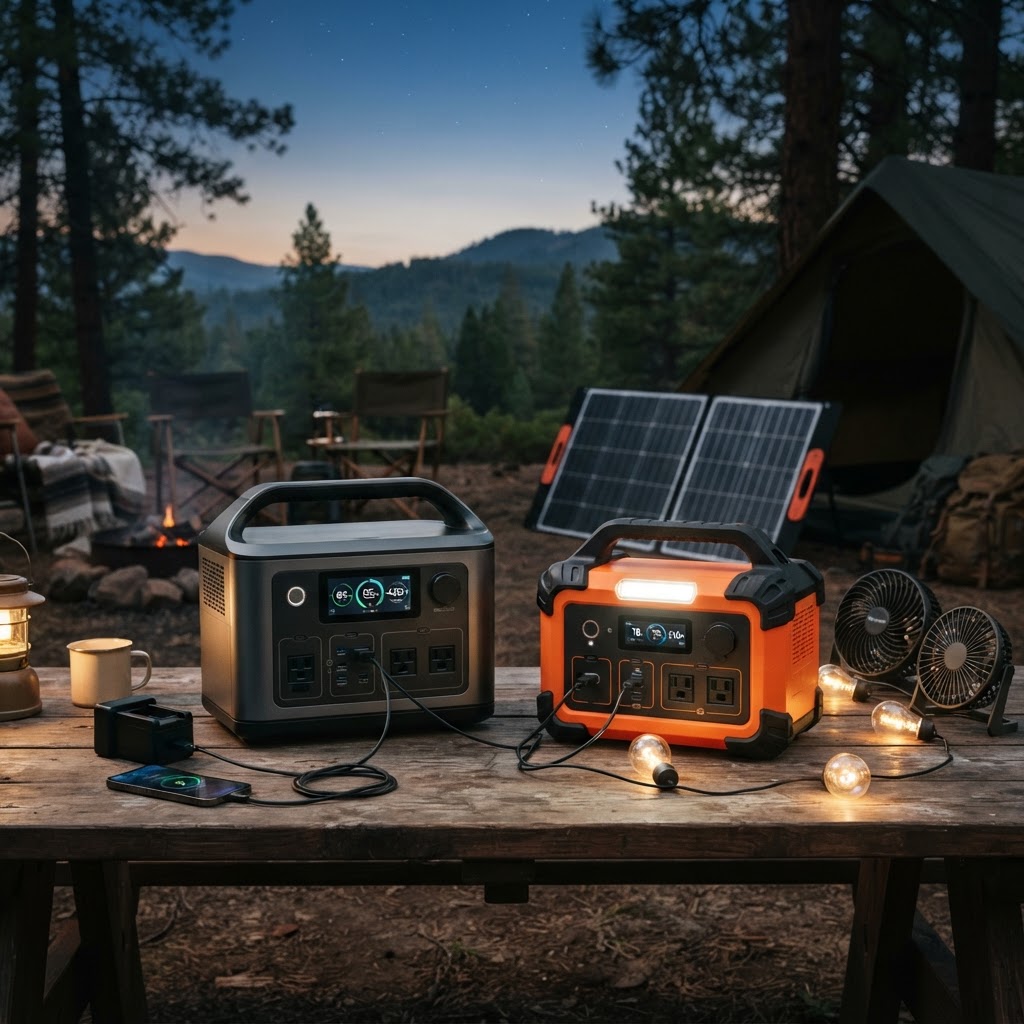
Top Picks This Round
Jackery Explorer 2000 Plus
The premium choice for home emergency power, offering 2042Wh and the ability to link two units for 4000W output.
- +Massive 3000W AC output (6000W surge)
- +Foldable handle and wheels for easy transport
- +Supports up to 5 extra battery modules
EcoFlow DELTA 2 Max
A high-capacity 2048Wh workhorse that remains portable enough for van life while powering heavy appliances.
- +Dual solar charging up to 1000W total
- +Expandable up to 6kWh with extra batteries
- +Quiet 30dB operation during low-power use
EcoFlow DELTA 3 Plus
The current gold standard for mid-range power stations, featuring 1024Wh capacity and industry-leading 1500W AC charging speeds.
- +Record-breaking 56-minute full AC charge
- +10ms UPS grade switchover for electronics
- +Advanced LiFePO4 cells rated for 3000+ cycles
Jackery Explorer 1000 v2
A streamlined, ultra-efficient redesign of the classic 1000 series, offering 1070Wh in a smaller, lighter frame.
- +Emergency Charge mode boosts speed to 1 hour
- +Lighter and more compact than the previous 1000 Plus
- +Extremely quiet operation under 30dB
Shoppers looking for the best 1kWh power station 2026 usually end up at the same crossroads: ecoflow delta 3 plus vs jackery explorer 1000 v2. The reason is simple. These are two of the strongest mid-range options for buyers who want enough capacity for camping, blackout backup, road trips, and daily device charging without jumping to a much heavier 2kWh class.
The tricky part is that the winner depends on what matters most to you. EcoFlow pushes charging speed, UPS-grade responsiveness, and a very aggressive feature set for the size. Jackery answers with a quieter, simpler, more compact design that fits the needs of many campers better. And if neither feels quite right, several nearby alternatives deserve a serious look before you spend.
This guide is editorial analysis based on manufacturer specifications, official product documentation, and verified customer-review patterns rather than hands-on testing by our team. Prices change frequently, so this article uses value tiers and positioning more than fixed pricing.
Quick-Look Comparison Table
| Product | Price | Best For |
|---|---|---|
| Jackery Explorer 2000 Plus | Premium | Scalable home emergency backup |
| EcoFlow DELTA 2 Max | Premium | Van life and heavy solar input |
| EcoFlow DELTA 3 Plus | Upper mid-range | Fastest-charging 1kWh all-rounder |
| Jackery Explorer 1000 v2 | Mid-range | Quiet camping and easy portability |
| Anker SOLIX C1000 | Mid-range value | Rugged travel and frequent use |
| Pecron E1500LFP | Value-focused mid-range | Maximum capacity per dollar |
| Bluetti AC180 | Budget-friendly | Higher-output appliances for less |
1. Jackery Explorer 2000 Plus — Scalable emergency backup
The Jackery Explorer 2000 Plus is not the direct answer to ecoflow delta 3 plus vs jackery explorer 1000 v2, but it matters because many buyers start at 1kWh and realize they actually need more runtime for outages. With 2042Wh capacity, 3000W AC output, and the option to add up to five extra battery modules, this is the step-up choice for people who want a serious home backup platform rather than a compact weekend unit.
Its design is clearly aimed at heavier-duty use. The foldable handle and wheels help offset the size, and the ability to link two units for even more output makes it much more flexible than smaller fixed-capacity models. If your priority is running more appliances for longer, the Explorer 2000 Plus does something the 1kWh class simply cannot: it gives you room to grow instead of forcing an early upgrade.
The tradeoff is obvious. It takes up much more cargo space, and its premium positioning can look expensive unless you find a sale. For campers with compact vehicles, it can be overkill. For storm prep, small cabins, or high-demand backup, it is one of the most capable Jackery options in this lineup.
Pros:
- Massive 3000W AC output (6000W surge)
- Foldable handle and wheels for easy transport
- Supports up to 5 extra battery modules
Cons:
- Very large footprint for smaller vehicles
- Expensive relative to capacity without sales
2. EcoFlow DELTA 2 Max — Solar-heavy van-life capacity
The EcoFlow DELTA 2 Max is the better comparison if you like EcoFlow's software and charging philosophy but want to move above the 1kWh class. Its 2048Wh capacity lands in the sweet spot for van life, mobile work, and longer outages, while dual solar charging up to 1000W total gives it a clear advantage for people who spend real time off-grid.
What makes this model stand out is balance. It is large enough to power demanding loads for much longer than the EcoFlow DELTA 3 Plus, but still portable enough to move in and out of a vehicle. Expandability to 6kWh also makes it more future-proof than fixed units like the Jackery Explorer 1000 v2. If your buying decision keeps drifting from camping toward true daily off-grid use, the DELTA 2 Max starts to make more sense.
The downside is that you pay for that flexibility in both cost and weight. Around 50 pounds is still movable, but not the kind of unit you casually carry far from the car. Buyers who only need a portable power station for camping 2026 may be better served by a lighter 1kWh model.
Pros:
- Dual solar charging up to 1000W total
- Expandable up to 6kWh with extra batteries
- Quiet 30dB operation during low-power use
Cons:
- High price point for the 2kWh entry level
- Heavy at 50 lbs, requires two hands
3. EcoFlow DELTA 3 Plus — Fastest-charging 1kWh all-rounder
If your shortlist begins and ends with ecoflow delta 3 plus vs jackery explorer 1000 v2, the EcoFlow DELTA 3 Plus has the strongest argument for the overall win. Its headline feature is the 56-minute full AC charge, which is among the most compelling reasons people searching for an ecoflow delta 3 plus review keep landing here. For anyone who tops off before a trip, charges during a short weather window, or wants less downtime between uses, that speed is not a gimmick. It changes how convenient the unit feels in daily life.
The rest of the package backs that up. You get 1024Wh capacity, 10ms UPS-grade switchover for sensitive electronics, and LiFePO4 cells rated for 3000+ cycles. That combination makes it unusually versatile. It works for camping, apartment backup, office gear, networking equipment, and general household use without feeling specialized in only one direction.
Where the DELTA 3 Plus gives ground is refinement under heavy load. The cooling fans are noticeable, so it is not the first pick for buyers obsessed with quiet nighttime use. The EcoFlow app also requires cloud registration, which some users dislike. But if you want the most complete feature set in the 1kWh class and a real contender for the best 1kWh power station 2026, this is the benchmark.
Pros:
- Record-breaking 56-minute full AC charge
- 10ms UPS grade switchover for electronics
- Advanced LiFePO4 cells rated for 3000+ cycles
Cons:
- Cooling fans are noticeable under high load
- EcoFlow app requires cloud registration
4. Jackery Explorer 1000 v2 — Quiet, compact camping power
The Jackery Explorer 1000 v2 is the cleaner choice for buyers who want simplicity, low noise, and a lighter form factor. Its 1070Wh capacity slightly edges the DELTA 3 Plus on stored energy, and the redesigned chassis is lighter and more compact than the older Jackery 1000 Plus approach. For road trips and camp setups where every inch of cargo space matters, that is a meaningful advantage.
One of the biggest reasons people compare it so closely with EcoFlow is charging behavior. The jackery 1000 v2 solar charging speed is respectable for a streamlined unit, but the single solar input capped at 400W tells you exactly who this is for: someone who wants straightforward solar support, not a heavy off-grid solar build. Its Emergency Charge mode reaching about one hour on AC power is impressive, while the under-30dB operation makes it easier to live with inside a tent-adjacent setup, camper, or bedroom during an outage.
The limitation is growth. There is no expansion port like the Plus series, so what you buy is what you keep. That makes the Explorer 1000 v2 a sharper fit for weekend camping and grab-and-go backup than for long-term energy systems. If quiet operation matters more than absolute charging speed, it is the strongest alternative to EcoFlow in this comparison.
Pros:
- Emergency Charge mode boosts speed to 1 hour
- Lighter and more compact than the previous 1000 Plus
- Extremely quiet operation under 30dB
Cons:
- Lacks the battery expansion port of the Plus model
- Single solar input limited to 400W
5. Anker SOLIX C1000 — Rugged value with fast charging
The Anker SOLIX C1000 deserves attention from anyone comparing the EcoFlow and Jackery favorites because it competes on the two things that drive most purchases: charge time and durability. With 1056Wh capacity and HyperFlash charging to full in 58 minutes, it sits very close to the EcoFlow DELTA 3 Plus on convenience while often undercutting premium-feature rivals on value.
Its physical design is a major selling point. The drop-proof unibody construction makes more sense for frequent movers, tailgaters, work-truck users, and families who are rougher on gear. SurgePad support for devices up to 2400W also broadens the list of appliances it can handle in short bursts, which matters more than raw capacity in many real-world situations.
The tradeoff is portability polish. Fixed handles are sturdy but less space-efficient in packed trunks, and Anker's app is generally seen as less feature-rich than EcoFlow's. Still, if you want something that feels built for repeated travel and everyday abuse, the SOLIX C1000 is one of the most compelling alternatives in the mid-range class.
Pros:
- HyperFlash technology reaches 100% in 58 minutes
- SurgePad handles devices up to 2400W
- Ultra-durable drop-proof unibody construction
Cons:
- Fixed handles make it harder to pack in tight trunks
- App interface is slightly less feature-rich than EcoFlow
6. Pecron E1500LFP — Maximum watt-hours per dollar
The Pecron E1500LFP is the wildcard on this list because it disrupts the value math. Instead of offering roughly 1kWh like the EcoFlow DELTA 3 Plus or Jackery Explorer 1000 v2, it gives you 1536Wh for pricing that often overlaps with smaller competitors. If your main question is not brand prestige but how much runtime you can buy per dollar, Pecron makes a strong case.
It also brings practical utility features that budget shoppers care about, including six AC outlets and solar input up to 700W. That makes it especially attractive for basic home backup, outdoor events, or tool charging where capacity matters more than app polish or compact styling. In plain terms, this is the option for buyers who would rather have more battery than a prettier box.
The compromises are exactly where you would expect them. The industrial design is less refined, and customer-support response times have a weaker reputation than the better-known premium brands. But if you want long runtime first and aesthetics second, the E1500LFP is one of the strongest value plays in this entire category.
Pros:
- Unbeatable overall value ratio
- Six AC outlets for powering multiple tools
- Supports 700W max solar input
Cons:
- Industrial design is less aesthetic than Jackery
- Customer support response times are slower
7. Bluetti AC180 — Higher output on a budget
The Bluetti AC180 is the budget-conscious pick for buyers who care more about output headroom than shaving every pound. With 1800W continuous AC output and 1152Wh capacity, it is a strong choice for users who expect to run more demanding appliances than many 1kWh-class units comfortably support. That makes it relevant for blackout prep, backyard events, and some small power-tool scenarios.
It also has a few practical quality-of-life advantages. Efficient DC output benefits phone, tablet, and mobile-device charging, while the silent charging mode is useful for nighttime use. For someone shopping for a portable power station for camping 2026 but also wanting more serious household utility, the AC180 splits the difference better than many compact-focused rivals.
The main downside is portability. It is heavier than the Jackery Explorer 1000 v2 by several pounds, so it is less appealing if you carry it often. Solar input is capped at 500W, which is decent but not class-leading. Still, for output-per-dollar, Bluetti remains a very competitive buy.
Pros:
- Highly efficient DC output for mobile devices
- Lifting handles integrated into the chassis
- Silent charging mode for nighttime use
Cons:
- Heavier than the Jackery 1000 v2 by several pounds
- Solar charging input is capped at 500W
Buyer's Guide: How to Choose
Capacity vs. Output
Battery capacity tells you how long a unit can run devices, while AC output tells you what it can run at all. A 1kWh power station is ideal for laptops, routers, CPAP machines, lights, cameras, and some fridge support, but high-draw appliances care more about output rating than battery size alone. If you need to run more demanding loads, the Bluetti AC180, EcoFlow DELTA 2 Max, or Jackery Explorer 2000 Plus may fit better than a lighter camping-focused model.
Charging Speed and Solar Input
Fast wall charging matters if you use your station often or top it up right before leaving home. That is why the EcoFlow DELTA 3 Plus and Anker SOLIX C1000 stand out so strongly. Solar input matters more for off-grid stays. The jackery 1000 v2 solar charging speed will satisfy casual solar users, but its 400W cap is less appealing for people trying to recover energy quickly over short daylight windows.
Portability and Noise
For camping, tailgating, and small vehicles, size, handle design, and fan noise are often more important than extra features. The Jackery Explorer 1000 v2 is one of the easiest recommendations for buyers who want low-noise operation and a compact footprint. The EcoFlow DELTA 3 Plus offers more aggressive performance, but its fans are more noticeable under heavier loads. That difference can matter a lot in quiet campsites or bedrooms.
Battery Life, Expandability, and Use Case
Most buyers today should prioritize LiFePO4 chemistry for longer cycle life, especially if the unit will be used weekly rather than stored for emergencies only. Expandability is another dividing line. Models like the Jackery Explorer 2000 Plus and EcoFlow DELTA 2 Max are better long-term platforms, while the Jackery Explorer 1000 v2 is intentionally simpler. Our recommendations here are based on published specs and customer-review patterns, so the best choice comes down to how you actually plan to use the battery, not which brand markets hardest.
Frequently Asked Questions
Which is better: EcoFlow DELTA 3 Plus or Jackery Explorer 1000 v2?
For most buyers, the EcoFlow DELTA 3 Plus wins on features, AC recharge speed, and UPS-style versatility. The Jackery Explorer 1000 v2 is the better pick if you prioritize quieter operation, simpler ownership, and a more camping-friendly form factor.
Is the Jackery Explorer 1000 v2 good for solar charging?
Yes, but it is aimed at moderate solar use rather than aggressive off-grid recovery. Its single solar input capped at 400W is fine for many campers, though more solar-focused buyers may want a model with higher input ceilings.
Is the EcoFlow DELTA 3 Plus worth it for home backup?
Yes, especially for apartment backup, networking gear, office equipment, and short outages where fast recharging matters. For longer blackout runtime, stepping up to a 2kWh class model makes more sense.
What is the best portable power station for camping 2026?
If quiet operation and packability matter most, the Jackery Explorer 1000 v2 is one of the strongest camping picks. If you want faster recharge and broader all-purpose use, the EcoFlow DELTA 3 Plus is harder to beat.
Should I buy a 1kWh or 2kWh power station?
Choose 1kWh if you want easier portability and mostly run smaller electronics, lights, and short-duration appliances. Choose 2kWh if you need longer outage coverage, heavier daily loads, or plan to build a more serious solar and backup setup.
Final Verdict
For the broadest range of buyers, the EcoFlow DELTA 3 Plus is the top overall pick. In the head-to-head of ecoflow delta 3 plus vs jackery explorer 1000 v2, EcoFlow offers the stronger mix of recharge speed, modern battery longevity, and UPS-ready utility. It feels like the most complete answer for shoppers hunting the best 1kWh power station 2026.
The Jackery Explorer 1000 v2 is the runner-up and the smarter choice for buyers who care more about quiet operation, lighter travel use, and simpler setup than about squeezing every last feature from the category. If your budget is tight, also keep the Bluetti AC180 and Pecron E1500LFP on your shortlist. If your needs are growing beyond camping into serious outage coverage, jump straight to the EcoFlow DELTA 2 Max or Jackery Explorer 2000 Plus.
Check today's best prices on Amazon →
Related Guides
- Best 1000Wh Power Stations for Home Backup
- LiFePO4 vs NMC Batteries: Which Lasts Longer
- How to Size a Solar Generator for an RV
- Best Portable Solar Panels for Fast Off-Grid Charging
All Featured Products
Jackery Explorer 2000 Plus
The premium choice for home emergency power, offering 2042Wh and the ability to link two units for 4000W output.
- +Massive 3000W AC output (6000W surge)
- +Foldable handle and wheels for easy transport
- +Supports up to 5 extra battery modules
EcoFlow DELTA 2 Max
A high-capacity 2048Wh workhorse that remains portable enough for van life while powering heavy appliances.
- +Dual solar charging up to 1000W total
- +Expandable up to 6kWh with extra batteries
- +Quiet 30dB operation during low-power use
EcoFlow DELTA 3 Plus
The current gold standard for mid-range power stations, featuring 1024Wh capacity and industry-leading 1500W AC charging speeds.
- +Record-breaking 56-minute full AC charge
- +10ms UPS grade switchover for electronics
- +Advanced LiFePO4 cells rated for 3000+ cycles
Jackery Explorer 1000 v2
A streamlined, ultra-efficient redesign of the classic 1000 series, offering 1070Wh in a smaller, lighter frame.
- +Emergency Charge mode boosts speed to 1 hour
- +Lighter and more compact than the previous 1000 Plus
- +Extremely quiet operation under 30dB
Anker SOLIX C1000
Built like a tank with InfiniPower technology, this 1056Wh unit is designed to last over a decade of daily use.
- +HyperFlash technology reaches 100% in 58 minutes
- +SurgePad handles devices up to 2400W
- +Ultra-durable drop-proof unibody construction
Pecron E1500LFP
A high-value, high-capacity unit providing 1536Wh of LiFePO4 power for the price of most 1kWh competitors.
- +Unbeatable overall value ratio
- +Six AC outlets for powering multiple tools
- +Supports 700W max solar input
Bluetti AC180
A powerhouse of efficiency and stability, offering 1800W continuous output and 1152Wh capacity.
- +Highly efficient DC output for mobile devices
- +Lifting handles integrated into the chassis
- +Silent charging mode for nighttime use
Frequently Asked Questions
Which is better: EcoFlow DELTA 3 Plus or Jackery Explorer 1000 v2?
The EcoFlow DELTA 3 Plus is the stronger overall pick for fast charging, UPS-style use, and feature depth. The Jackery Explorer 1000 v2 is better if you value quieter operation and a more compact camping-friendly design.
Is the Jackery Explorer 1000 v2 good for solar charging?
Yes, for moderate solar use. Its 400W single-input ceiling is solid for casual camping but less ideal for heavier off-grid solar recovery.
Is the EcoFlow DELTA 3 Plus worth it for home backup?
Yes, especially for short outages, networking gear, office equipment, and apartment backup. For much longer runtime, a 2kWh-class unit is a better fit.
What is the best portable power station for camping 2026?
The Jackery Explorer 1000 v2 is one of the best camping-focused choices because it is quiet and compact. The EcoFlow DELTA 3 Plus is better if recharge speed and all-purpose versatility matter more.
Should I buy a 1kWh or 2kWh power station?
Buy 1kWh for portability and lighter loads like electronics, lights, and short appliance use. Buy 2kWh for longer outages, heavier daily use, and more serious solar setups.