Best Solar Generators for Home Backup: 2026 Guide
Discover the best solar generators for home backup during the 2026 hurricane season. Keep your refrigerator running and power your home without gas.
Affiliate disclosure: As an Amazon Associate I earn from qualifying purchases. We may earn a commission from purchases made through our links, at no extra cost to you.
Top Picks This Round
EcoFlow Delta Pro Ultra
The ultimate whole-home backup solution featuring a massive 6kW inverter capable of running 240V heavy-duty appliances during extended outages.
- +6kW continuous power output
- +Expandable up to 90kWh capacity
- +Integrated 240V support for HVAC
Zendure SuperBase V6400
The first home backup system using semi-solid state battery technology for higher energy density and improved safety in emergency conditions.
- +Semi-solid state battery safety
- +Motorized wheels for easy transport
- +Dual voltage 120V/240V support
Bluetti AC500 + B300S Home Battery Backup
A modular power powerhouse with a 5000W pure sine wave inverter that handles surges from refrigerators and sump pumps with ease.
- +Impressive 5000W power rating
- +Self-heating battery for cold climates
- +Modular design for custom capacity
Bluetti EP500Pro Solar Power Station
A massive 5.1kWh all-in-one cabinet-style generator on wheels, providing long-term security for critical medical equipment and home essentials.
- +Massive 5100Wh internal capacity
- +Movable cabinet-style design
- +Seamless UPS backup functionality
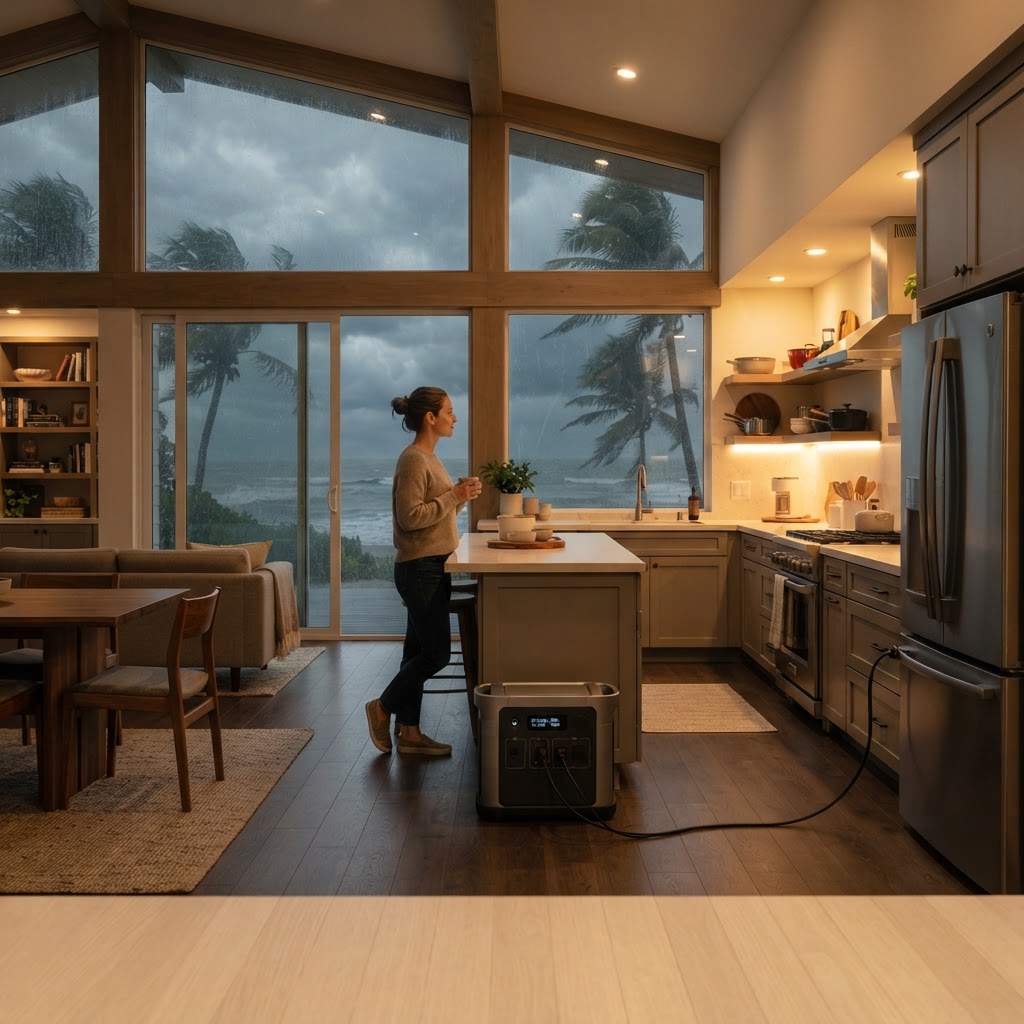
When a hurricane forecast shifts from “watch” to “warning,” backup power stops being a convenience and becomes part of your home emergency plan. The best solar generators for home backup can keep cold food safe, power phones and medical devices, run lights overnight, and in some cases support 240V appliances like well pumps or central HVAC without fuel storage, engine noise, or constant refueling.
This guide focuses on the models that make the most sense for hurricane season 2026, from portable units that can deliver backup power for a refrigerator during outage conditions to expandable systems built as a whole house solar generator setup. Our recommendations are based on editorial analysis of manufacturer specifications, official product documentation, and verified customer-review patterns. We have not hands-on tested these products, and prices change frequently, so think in terms of value tiers rather than fixed numbers.
If you want an emergency power supply for home use that matches your risk level, home size, and must-run appliances, start with the quick comparison below and then use the buyer’s guide to narrow your pick.
Quick-Look Comparison Table
| Product | Price | Best For |
|---|---|---|
| EcoFlow Delta Pro Ultra | Premium | Whole-home 240V backup during long outages |
| Zendure SuperBase V6400 | Premium | Safer high-capacity backup with easier mobility |
| Bluetti AC500 + B300S Home Battery Backup | Upper mid-range to premium | Modular backup for refrigerators, sump pumps, and expansion |
| Bluetti EP500Pro Solar Power Station | Premium | All-in-one home essentials backup with UPS capability |
| Anker SOLIX F3800 | Upper mid-range | Plug-and-play 240V home backup value |
| Jackery Explorer 3000 Pro | Mid-range | Fast deployment when a storm is hours away |
| EcoFlow Delta 2 Max | Mid-range | Refrigerator backup and essential circuits on a tighter budget |
1. EcoFlow Delta Pro Ultra — Best whole-home 240V backup
The EcoFlow Delta Pro Ultra is the strongest overall pick if your goal is the best solar generators for home backup with true whole-home ambitions. Its 6kW continuous output and integrated 240V support put it in a different class than standard portable power stations. For hurricane-prone households that need to support large loads such as HVAC, well pumps, electric dryers on limited use, or multiple kitchen circuits, this is the unit that most closely resembles a serious standby alternative without going to a permanent gas generator.
If you are specifically looking for an EcoFlow Delta Pro Ultra review-style summary, the core advantage is simple: high output plus major expandability. Capacity can scale up dramatically, which matters when outages stretch from hours into days. That makes it a leading choice for larger homes, households with medical equipment, or families who want a battery backup for home power outages that can grow over time instead of becoming obsolete after one bad storm season.
The tradeoff is weight and installation complexity. This is not the model you casually move from a closet to the kitchen. It makes the most sense for buyers ready to plan their circuits and, if needed, work with a professional for home integration.
Pros:
- 6kW continuous power output
- Expandable up to 90kWh capacity
- Integrated 240V support for HVAC
Cons:
- Extremely heavy unit weight
- Requires professional installation for home tie-in
2. Zendure SuperBase V6400 — Best for advanced battery safety
The Zendure SuperBase V6400 stands out because it brings semi-solid state battery technology into the home backup conversation. During hurricane season, safety, storage stability, and energy density matter just as much as watt-hours on a spec sheet. If you want a high-capacity emergency power supply for home use and you prioritize battery chemistry innovation, this is one of the most interesting premium options available.
Its dual-voltage 120V/240V support also gives it real utility beyond phones and lamps. You can build a serious storm-response setup around this model for refrigerators, freezers, communication gear, power tools, and selected heavy appliances. The motorized wheels are not a gimmick either; when a unit is this large, being able to reposition it without wrestling dead weight can be a real advantage before or after a storm.
The main caution is brand maturity. Zendure has less long-term service history than some competitors in this category, and the app experience appears less polished based on customer feedback patterns. Buyers comfortable with newer tech may still find the feature set compelling.
Pros:
- Semi-solid state battery safety
- Motorized wheels for easy transport
- Dual voltage 120V/240V support
Cons:
- Newer brand with less service history
- App interface can be unintuitive
3. Bluetti AC500 + B300S Home Battery Backup — Best modular backup for critical appliances
The Bluetti AC500 + B300S Home Battery Backup is one of the smartest choices for households that want strong surge handling and a flexible upgrade path. With a 5000W inverter and modular architecture, it is particularly well suited for the appliances that matter most during hurricane outages: refrigerators, chest freezers, sump pumps, routers, lighting circuits, and some portable AC units.
For readers mainly concerned about backup power for refrigerator during outage scenarios, this Bluetti setup makes a strong case. Refrigerators and pumps can create startup surges that smaller power stations struggle with. The AC500 platform is built for those more demanding real-world loads, while the B300S battery modules let you tailor runtime to your outage history and budget.
The downside is usability. Modular systems give you flexibility, but they also add cable complexity and physical setup effort. If you live alone or expect to move the system often, the heavier stackable parts can be less convenient than an all-in-one design.
Pros:
- Impressive 5000W power rating
- Self-heating battery for cold climates
- Modular design for custom capacity
Cons:
- Complex cable management
- Heavy components are hard to stack alone
4. Bluetti EP500Pro Solar Power Station — Best all-in-one cabinet backup
The Bluetti EP500Pro Solar Power Station is the model to consider if you want a large-capacity backup solution without assembling a separate inverter-and-battery stack. Its 5100Wh internal capacity and cabinet-style design make it feel more like a mobile home energy appliance than a typical solar generator. For hurricane season, that simplicity has real value: fewer components to connect, fewer decisions to make under pressure.
This unit is especially appealing for people protecting a shortlist of essential loads rather than trying to power the whole house. Think medical devices, a refrigerator, internet equipment, fans, lights, and charging stations. The UPS functionality is also useful where power quality is unstable before a full outage hits, helping critical electronics transition more smoothly.
Compared with more expandable systems, the EP500Pro gives up some solar input flexibility and scaling headroom. But for buyers who want a substantial battery backup for home power outages in one integrated unit, it remains one of the strongest all-in-one options in this class.
Pros:
- Massive 5100Wh internal capacity
- Movable cabinet-style design
- Seamless UPS backup functionality
Cons:
- Very large physical dimensions
- Lower solar input ceiling than modular units
5. Anker SOLIX F3800 — Best plug-and-play 240V value
The Anker SOLIX F3800 hits a sweet spot for buyers who want 240V capability without stepping all the way into the cost and complexity of the most premium whole-home systems. It offers 3.84kWh of onboard capacity, dual 120V/240V output, and a design that is easier to understand for first-time buyers building a serious storm-prep plan.
This is the model we would point most readers toward if they want a practical whole house solar generator starting point for selective loads rather than a fully maxed-out installation. It is particularly compelling for homes that need to support a fridge, freezer, microwave, lighting, communications gear, and perhaps a well-defined 240V load. The direct EV charging port is a niche feature, but for EV owners during evacuation season, it adds flexibility that few competitors offer.
The main limitation is expansion cost. While the core unit is strong for the money, building a longer-duration system with add-on batteries becomes significantly more expensive. Even so, the F3800 remains one of the best-balanced options for buyers who want strong output, long-life LiFePO4 chemistry, and manageable setup.
Pros:
- Direct EV charging port
- LiFePO4 battery with 10-year lifespan
- Easy plug-and-play home backup
Cons:
- Expansion batteries are expensive
- Large footprint requires dedicated space
6. Jackery Explorer 3000 Pro — Best fast-deploy portable backup
The Jackery Explorer 3000 Pro is the best fit for buyers who value speed and portability over modular expansion. When a storm path changes suddenly and you need to move backup power where it is needed most, lighter weight matters. In that situation, Jackery’s easier handling can be more important than squeezing out the last bit of output on paper.
Its rapid wall charging is another major hurricane-season advantage. If utilities are still up a few hours before landfall, being able to top off quickly is a practical edge. This makes it a strong choice for apartment dwellers, smaller homes, and anyone who needs a quiet emergency power supply for home use that can shift between kitchen, bedroom, and garage without much friction.
The compromise is long-term scalability. The battery is not expandable, so you need to be realistic about runtime, especially for refrigeration and cooling. Still, for short to moderate outages and quick deployment, the Explorer 3000 Pro is one of the cleanest solutions available.
Pros:
- Lightest weight in its class
- Rapid 1.8-hour wall charging
- Excellent whisper-quiet operation
Cons:
- Non-expandable battery capacity
- Fewer AC outlets than competitors
7. EcoFlow Delta 2 Max — Best mid-range refrigerator backup
The EcoFlow Delta 2 Max is the easiest recommendation for shoppers who need the best solar generators for home backup at a more attainable mid-range price. It does not offer 240V output, so it is not aimed at central HVAC or large well pumps. What it does offer is strong efficiency, fast charging, and enough practical output for the loads most families care about first: refrigerators, internet gear, lights, fans, CPAP machines, and device charging.
For readers whose top concern is backup power for refrigerator during outage events, this is one of the strongest values in the category. EcoFlow positions it as capable of running a full-size refrigerator for extended periods on a single charge, and the fast X-Stream charging system helps you refill quickly when grid power returns or when solar conditions improve after the storm passes.
The Delta 2 Max is also one of the easiest units to recommend for townhomes, condos, and smaller single-family homes where storage space matters. It lacks the raw heavy-appliance capability of the top-tier systems, but for many households it covers the essential loads that determine whether an outage is merely inconvenient or genuinely disruptive.
Pros:
- Industry-leading X-Stream charge speed
- Dual solar charging capability
- Highly portable for the power output
Cons:
- No 240V output for large appliances
- Fans can be loud under heavy load
Buyer’s Guide: How to Choose
Match the generator to your must-run appliances
The biggest mistake buyers make is shopping by battery size alone. Start with the devices you truly need during a hurricane outage: refrigerator, freezer, sump pump, modem/router, medical equipment, lights, fans, microwave, or portable AC. Then look at both running watts and startup surge. A refrigerator may draw modest power once running, but the startup surge is what often trips undersized units. If you need 240V appliances, your shortlist narrows quickly to models like the EcoFlow Delta Pro Ultra, Zendure SuperBase V6400, Bluetti AC500, or Anker SOLIX F3800.
Think about runtime, not just output
Power output tells you what a unit can run at once. Capacity tells you how long it can run it. For a true battery backup for home power outages, both numbers matter. If your outages usually last four to eight hours, a mid-range unit may be enough. If you routinely face multi-day hurricane outages, prioritize expandability and solar recharge options. That is where modular systems and high solar input ceilings become more valuable than compact convenience.
Choose between portability and permanence
Some buyers need a mobile power station they can roll to the kitchen or loan to a neighbor. Others want a semi-permanent home backup platform tied into selected circuits. Portable all-in-one units like the Jackery Explorer 3000 Pro and EcoFlow Delta 2 Max are easier to deploy fast. Larger systems like the Delta Pro Ultra or AC500 are better for planned backup architecture. If your goal is a whole house solar generator setup, be honest about whether you are ready for the size, weight, and installation steps involved.
Budget for the full system
The sticker price is only part of the picture. You may also need transfer equipment, extra batteries, solar panels, heavy-duty extension cords, or dedicated storage space. Premium systems make sense when outage costs are high, such as spoiled food, flooded basements, interrupted remote work, or medical risk. Mid-range units are often the better value when you only need an emergency power supply for home essentials and can rotate appliances rather than run everything at once.
Frequently Asked Questions
Can a solar generator run a refrigerator during a hurricane outage?
Yes, many of the models above can handle a refrigerator, but startup surge matters as much as battery size. The Bluetti AC500, Anker SOLIX F3800, EcoFlow Delta Pro Ultra, and EcoFlow Delta 2 Max are especially relevant for refrigerator backup.
What size solar generator do I need for home backup?
That depends on whether you want to power one refrigerator and a few lights or selected home circuits including 240V loads. Small essentials setups may be covered by a mid-range unit, while whole-home or multi-day hurricane use usually requires a larger expandable platform.
Is a whole house solar generator realistic for hurricane season?
Yes, but only certain models qualify in practice. Systems with 240V support, high inverter output, and expandable battery capacity are the realistic path for whole-home backup, and they often require more planning than portable units.
Are solar generators better than gas generators for storms?
They are quieter, require no fuel storage, and can be used indoors because they produce no exhaust. Gas generators still have advantages for unlimited runtime if fuel is available, but battery systems are far simpler for indoor-safe, low-maintenance backup.
Should I buy an expandable model or an all-in-one unit?
Choose expandable if your outage history is long or you expect your needs to grow. Choose all-in-one if you want simpler setup, fewer cables, and a more straightforward backup plan for essential loads.
Final Verdict
If you want the strongest overall recommendation for hurricane season 2026, the EcoFlow Delta Pro Ultra is the top pick. It offers the best path to serious 240V home backup, large-scale expansion, and real whole-home potential for buyers who need more than just lights and phone charging.
The best runner-up is the Anker SOLIX F3800. It is easier to approach, still supports 240V use cases, and delivers one of the best value-to-capability balances for homeowners who want substantial backup without jumping to the highest-cost system on the list.
If your budget is lower and your biggest concern is keeping food cold and essentials online, the EcoFlow Delta 2 Max is the smartest mid-range buy. Check today’s best prices on Amazon →
Related Guides
- Best 1000Wh Power Stations for Home Backup
- LiFePO4 vs NMC Batteries: Which Lasts Longer for Backup Power?
- How to Size a Solar Generator for a Refrigerator and Freezer
- Portable Power Station vs Gas Generator for Hurricane Preparedness
All Featured Products
EcoFlow Delta Pro Ultra
The ultimate whole-home backup solution featuring a massive 6kW inverter capable of running 240V heavy-duty appliances during extended outages.
- +6kW continuous power output
- +Expandable up to 90kWh capacity
- +Integrated 240V support for HVAC
Zendure SuperBase V6400
The first home backup system using semi-solid state battery technology for higher energy density and improved safety in emergency conditions.
- +Semi-solid state battery safety
- +Motorized wheels for easy transport
- +Dual voltage 120V/240V support
Bluetti AC500 + B300S Home Battery Backup
A modular power powerhouse with a 5000W pure sine wave inverter that handles surges from refrigerators and sump pumps with ease.
- +Impressive 5000W power rating
- +Self-heating battery for cold climates
- +Modular design for custom capacity
Bluetti EP500Pro Solar Power Station
A massive 5.1kWh all-in-one cabinet-style generator on wheels, providing long-term security for critical medical equipment and home essentials.
- +Massive 5100Wh internal capacity
- +Movable cabinet-style design
- +Seamless UPS backup functionality
Anker SOLIX F3800
A robust and reliable 3.84kWh power station designed for easy home integration with dual 120V/240V output and EV charging capabilities.
- +Direct EV charging port
- +LiFePO4 battery with 10-year lifespan
- +Easy plug-and-play home backup
Jackery Explorer 3000 Pro
The lightest and most portable large-capacity solar generator, perfect for quick deployment when a hurricane hits.
- +Lightest weight in its class
- +Rapid 1.8-hour wall charging
- +Excellent whisper-quiet operation
EcoFlow Delta 2 Max
A highly efficient mid-range generator that can run a full-size refrigerator for over 14 hours on a single charge.
- +Industry-leading X-Stream charge speed
- +Dual solar charging capability
- +Highly portable for the power output
Frequently Asked Questions
Can a solar generator run a refrigerator during a hurricane outage?
Yes. Several models in this guide can power a refrigerator, but you need enough inverter output for startup surge and enough battery capacity for the runtime you want.
What size solar generator do I need for home backup?
It depends on your must-run appliances. A smaller setup may cover a fridge, lights, and internet, while whole-home or 240V backup usually requires a larger expandable system.
Is a whole house solar generator realistic for hurricane season?
Yes, but only with higher-output models that support 240V appliances and battery expansion. These systems often need more planning and sometimes professional installation.
Are solar generators better than gas generators for storms?
Solar generators are quieter, indoor-safe, and require no gasoline storage. Gas generators can run longer if fuel is available, but battery systems are easier to use and maintain.
Should I choose an expandable model or an all-in-one unit?
Expandable systems are better for long outages and growing energy needs. All-in-one units are simpler to set up and easier for essential-load backup.