Best Solar Generator Under $1,000: 2026 2000Wh Value Guide
Compare the best solar generator under $1,000 for 2026. Review top-rated 2000Wh LiFePO4 power stations for affordable home backup and save on your setup.
Affiliate disclosure: As an Amazon Associate I earn from qualifying purchases. We may earn a commission from purchases made through our links, at no extra cost to you.
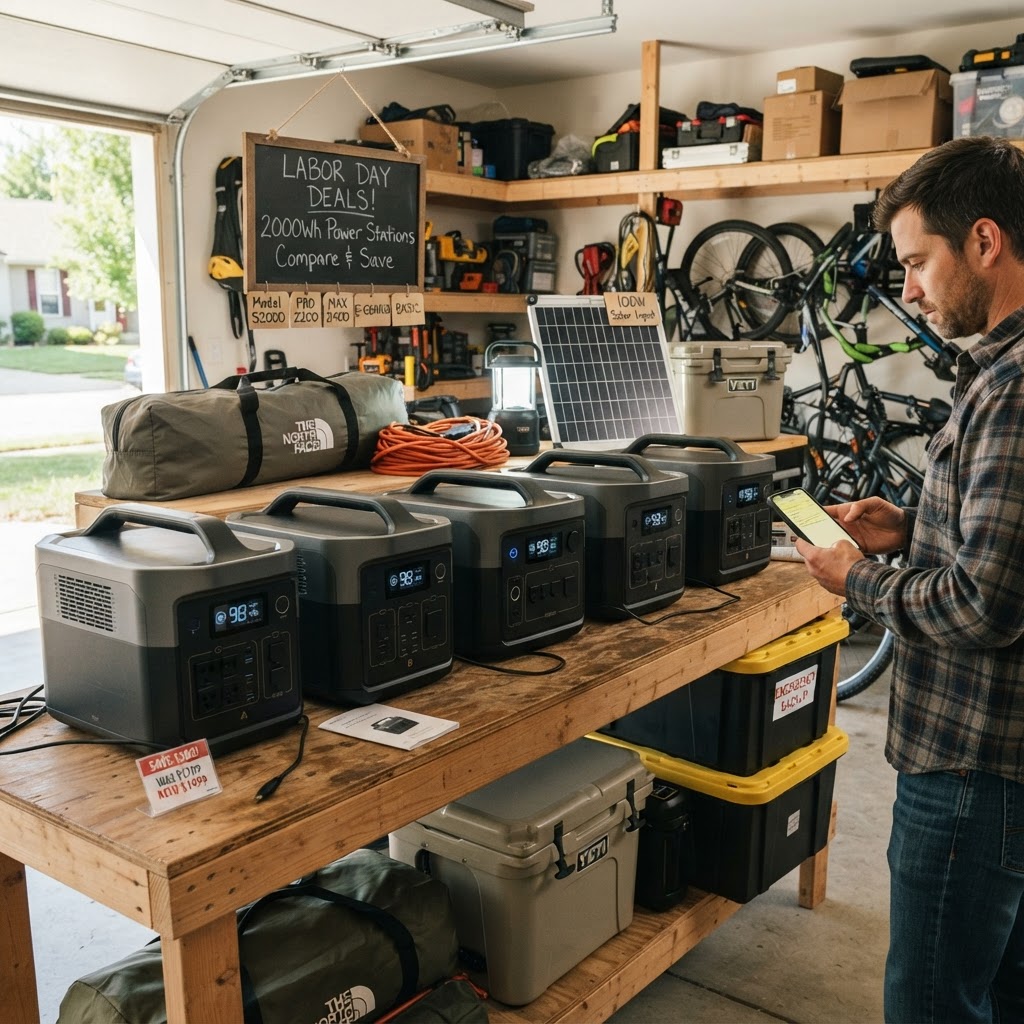
Top Picks This Round
Bluetti AC200P Portable Power Station
The legendary workhorse of the industry, featuring ultra-stable LiFePO4 cells and a massive array of 17 output ports for any off-grid scenario.
- +Massive amount of output ports
- +Proven long-term reliability
- +Dual wireless charging pads
Pecron E2000L Portable Power Station
A powerhouse of efficiency, offering 2048Wh of LiFePO4 safety at a price point that makes it the best value-to-capacity ratio on the market.
- +Industry-leading price per Wh
- +Expandable up to 8000Wh
- +Very quiet operation
ALLPOWERS R2500 Solar Generator
A modern, high-capacity unit featuring advanced app control and a 2500W inverter that can power almost any household appliance during a blackout.
- +Impressive 2500W AC inverter
- +Smart WiFi/Bluetooth app control
- +Reliable UPS transition mode
Zendure SuperBase Pro 2000
Designed for those who need power on the move, this suitcase-style generator features industrial-grade wheels and 4G connectivity.
- +Built-in wheels and handle
- +4G/GPS tracking features
- +Fast 1800W AC charging
The short answer: if you want the best solar generator under $1,000 with around 2000Wh of capacity in 2026, the Pecron E2000L Portable Power Station is the value pick I’d point most people to, while the Oukitel P2001 Solar Generator is the cheapest real 2kWh-class option and the Dabbsson DBS2300 Plus is the premium play if you want the most battery for the money.
Shopping this price range gets confusing fast, because “2000Wh” units can behave very differently once you look at inverter size, charging speed, battery chemistry, and how portable they really are. Some are better for RV use, some make more sense as affordable home backup batteries, and some only look like a deal until you notice weak solar input or a loud cooling system.
For this Labor Day value guide, I focused on the sweet spot a lot of buyers care about: big enough to run serious gear, still cheap enough to stay under four figures, and based on current manufacturer specs, official documentation, and verified customer-review patterns rather than marketing fluff. If you’ve been comparing a cheap 2000Wh power station against older big-name models, or generally trying to find the best solar generator for the money 2026 has to offer, this list should narrow it down quickly.
One quick note before we get into the picks: a lot of people search things like Pecron F2000 vs Bluetti when what they really want to know is whether they should buy the cheaper high-capacity upstart or the proven legacy model. That same value-vs-track-record question shows up clearly here with the Pecron E2000L Portable Power Station and Bluetti AC200P Portable Power Station.
Quick Comparison
| Product | Best For | Key Spec | value tiers |
|---|---|---|---|
| Bluetti AC200P Portable Power Station | RV / van life | LiFePO4 battery with 17 output ports | Premium |
| Pecron E2000L Portable Power Station | Overall value | 2048Wh LiFePO4, expandable to 8000Wh | Mid-range |
| ALLPOWERS R2500 Solar Generator | Home backup | 2500W AC inverter with app control | Premium |
| Zendure SuperBase Pro 2000 | Ultra-portable | Built-in wheels and fast 1800W AC charging | Premium |
| Dabbsson DBS2300 Plus | Premium features | 2330Wh capacity with semi-solid state battery | Premium |
| Oukitel P2001 Solar Generator | Budget buy | True 2000Wh class with 2-hour recharge | Budget |
| FOSSiBOT F2400 Portable Power Station | Job sites | 2400W continuous output with cable storage | Budget |
1. Bluetti AC200P Portable Power Station — Best for RV / van life
The Bluetti AC200P Portable Power Station is still one of the easiest recommendations for people building out a simple RV or van setup because it covers a lot of little real-world needs in one box. The big selling point here is not just capacity. It’s the sheer number of ways you can use it day to day. Seventeen output ports means fewer compromises when you’re juggling a fridge, laptop, lights, fans, a router, and all the random small stuff that tends to pile up in mobile living.
Compared with the Pecron E2000L Portable Power Station, the Bluetti feels more old-school: proven, stable, and less flashy. That matters if you care more about a known track record than squeezing every last watt-hour per dollar. I’d also take the Bluetti over the ALLPOWERS R2500 Solar Generator for someone living with the unit daily in a camper, because port selection and long-term reputation can matter more than app tricks or a bigger inverter.
The trade-off is portability. This thing is heavy, and unlike the Zendure SuperBase Pro 2000, it doesn’t solve that with wheels. AC charging is also slower than newer rivals, so if fast turnaround matters, the Oukitel or Zendure make more sense. But if your use case is steady off-grid living instead of quick grab-and-go backup, the AC200P still earns its place.
Pros:
- Huge spread of output options for running a lot of gear at once
- Long-standing reputation for reliability over time
- Dual wireless charging pads are genuinely handy in a van or camper
Cons:
- Very heavy, with no built-in wheels to help move it
- AC charging is slower than newer competitors in this class
2. Pecron E2000L Portable Power Station — Best overall
If I were helping most people buy a cheap 2000Wh power station without buying junk, the Pecron E2000L Portable Power Station would be my default answer. It hits the balance I want to see under this budget cap: 2048Wh of LiFePO4 capacity, very strong value per watt-hour, quiet operation, and room to grow later if your power needs increase. That expandability up to 8000Wh is a big deal, because a lot of sub-$1000 units are dead ends once you outgrow them.
This is the model that best fits the phrase best solar generator for the money 2026. Against the Bluetti AC200P Portable Power Station, the Pecron gives you the stronger value story. Against the Dabbsson DBS2300 Plus, it gives up some raw capacity but comes from a more straightforward value angle. And compared with the Oukitel P2001 Solar Generator, it costs a bit more but feels like the more flexible long-term buy.
The weak spot is that the solar input tops out at 700W, which is decent but not class-leading if you’re trying to recharge aggressively from panels alone. The bulky external brick is also less elegant than an all-in-one charging setup. Even so, for mixed use at home, on the road, or for blackout prep, this is the one I’d call best overall.
Pros:
- Outstanding value per watt-hour in this price range
- Can expand far beyond its base capacity if needed later
- Runs quietly, which matters indoors and overnight
Cons:
- The external charging brick is bulky and awkward to pack
- 700W solar input is good, but not especially aggressive for a 2kWh unit
3. ALLPOWERS R2500 Solar Generator — Best for home backup
The ALLPOWERS R2500 Solar Generator makes the most sense for buyers who care first about blackouts and household loads. Its 2500W inverter is one of the strongest reasons to choose it, because inverter ceiling matters just as much as battery size once you start talking microwaves, coffee makers, sump pumps, or other high-draw appliances. A lot of 2kWh stations look similar on paper until you hit that wall.
Compared with the Bluetti AC200P Portable Power Station, this one is less about lots of output ports and more about heavier home-duty capability. Compared with the FOSSiBOT F2400 Portable Power Station, it feels more home-oriented because of the smart app features and reliable UPS transition mode. If you want one unit parked near your office, modem, or fridge and ready to kick in during outages, this is a strong fit.
That said, I would not call it the cleanest value on the board. Support complaints come up often enough that I’d keep that in mind, and the screen being hard to read outdoors makes it less pleasant for camping or yard use than some others. Still, among affordable home backup batteries under this cap, it stands out because usable inverter power matters.
Pros:
- 2500W inverter gives it real flexibility for household appliances
- WiFi and Bluetooth app control adds convenience for backup setups
- UPS transition mode is useful for basic outage protection
Cons:
- Customer support has a slower reputation than I’d like
- Display can be frustrating to read in bright sunlight
4. Zendure SuperBase Pro 2000 — Best ultra-portable
The Zendure SuperBase Pro 2000 is the oddball in this group in a good way. Most 2kWh power stations are portable only in the technical sense that you can lift them. Zendure took a different route with built-in wheels and a suitcase-style handle, which makes a huge difference if you’re moving it through parking lots, event spaces, campsites, or between floors at home.
I’d choose this over the Bluetti AC200P Portable Power Station if mobility is the whole point, because the Bluetti’s weight becomes a chore fast. I’d also take it over the Oukitel P2001 Solar Generator for frequent transport, even though the Oukitel is cheaper, simply because moving a heavy box by hand gets old. The fast 1800W AC charging is another real advantage when you need a quick turnaround.
The downside is complexity. This is not the pick I’d hand to somebody who just wants a simple battery with obvious controls. Proprietary adapters for some solar setups are another nuisance if you like mixing and matching panels. So while I like the concept a lot, it’s best for the buyer who values mobility enough to tolerate a more complicated interface.
Pros:
- Built-in wheels and handle make transport far easier than most 2kWh units
- 4G and GPS features add security and remote-location awareness
- Very fast AC recharging cuts downtime
Cons:
- The interface can feel more complicated than it needs to be
- Some solar setups need proprietary adapters, which is annoying
5. Dabbsson DBS2300 Plus — Best premium
The Dabbsson DBS2300 Plus is the premium option here because it gives you the most battery capacity under this budget ceiling while also leaning into newer battery tech. At 2330Wh, it edges past a lot of the “2000Wh” crowd, and that extra buffer does matter in real use. A fridge overnight, a CPAP setup, or a day of working through an outage gets easier when you are not operating right on the margin.
What makes it premium instead of just “big” is the semi-solid state angle and the strong 15ms UPS spec. Compared with the ALLPOWERS R2500 Solar Generator, which is also good for backup, the Dabbsson makes a compelling case if your priority is battery reserve and safer thermal behavior. Compared with the Pecron E2000L Portable Power Station, it costs more for that added capacity and newer design approach rather than pure value.
The hesitation is brand maturity. Bluetti has a longer history, and that matters to some buyers. The Dabbsson is also not especially light, so this is not the model I’d pick for regular carrying. But if you want the biggest energy reserve in this list and are comfortable with a newer name, it’s a strong premium buy.
Pros:
- Highest capacity in this roundup while staying under the budget cap
- Semi-solid state battery design adds an extra layer of safety appeal
- Fast 15ms UPS response is useful for backup duty
Cons:
- Newer brand without the long history of Bluetti or other established names
- Heavier than some other units in the 2kWh class
6. Oukitel P2001 Solar Generator — Best budget
The Oukitel P2001 Solar Generator is the one I’d look at first if your main goal is getting into the 2kWh class as cheaply as possible without dropping into a tiny inverter or suspiciously vague specs. It’s usually the easiest path to a real large-capacity station, which is why it earns the budget slot in this guide.
The fast recharge time is the key reason I like it more than a lot of bargain-bin alternatives. A two-hour full recharge means the station is much easier to live with, especially if you’re topping up from wall power before a storm or between uses. Compared with the Pecron E2000L Portable Power Station, you give up some refinement and expandability. Compared with the Zendure SuperBase Pro 2000, you lose portability niceties. But on basic dollars-per-capacity, it’s a hard one to ignore.
Just know where the savings show up. The fans are loud, so I wouldn’t put this near a bed if sensitive noise is a problem, and the app is pretty basic. If you can live with that, the Oukitel is one of the clearest answers to “what’s the best solar generator under $1,000 if I just need a lot of battery cheap?”
Pros:
- Very aggressive pricing for a true 2000Wh-class unit
- Fast wall charging makes it easy to top off quickly
- Build feels solid for a budget-focused model
Cons:
- Cooling fans are noticeably loud
- The app works, but it is pretty bare-bones
7. FOSSiBOT F2400 Portable Power Station — Best for job sites
The FOSSiBOT F2400 Portable Power Station is the most job-site-friendly option here because it pairs a high 2400W continuous output with fast 1100W AC input and a design that’s clearly meant for practical abuse instead of showroom looks. If your power station needs to run tools, compressors, or high-draw equipment, rated output matters more than cosmetic polish.
Compared with the ALLPOWERS R2500 Solar Generator, the FOSSiBOT feels more stripped down and work-oriented. Compared with the Bluetti AC200P Portable Power Station, it’s less about lifestyle convenience and more about raw usable power for demanding loads. I also like that the built-in cable storage is not just a gimmick; on a cluttered site or in a work truck, little design choices like that actually help.
The catch is that it’s very heavy, and the industrial styling won’t win over buyers who want a cleaner home backup unit. But if your version of off-grid power involves tools instead of laptops, the FOSSiBOT has one of the clearest identities in the group.
Pros:
- 2400W continuous output is well suited to tools and other demanding loads
- Fast 1100W AC charging helps reduce downtime between jobs
- Built-in cable storage is genuinely practical
Cons:
- The unit is extremely heavy to move around
- Utility-first design feels less refined than more polished rivals
How I Picked These
I didn’t build this list around brand hype or spec-sheet chest beating. For a 2kWh-class station, I care first about the balance between capacity in watt-hours and usable inverter output in watts. A battery can look big on paper and still disappoint if the inverter ceiling is too low for the appliances you actually want to run.
I also give extra weight to LiFePO4 chemistry because it generally offers better cycle life and thermal stability than older NMC-based designs. For buyers looking at affordable home backup batteries or frequent off-grid use, that matters more than a flashy app. Solar input wattage matters too, because a “solar generator” that takes forever to refill from panels can be frustrating in the field.
Portability and value per watt-hour were the other big filters. Some units are cheap but awkward, some are polished but overpriced, and some are only “portable” if you never move them. These picks are based on manufacturer specs, official product documentation, and consistent review patterns from verified buyers, not on any claim that this site personally tested them.
Things to Watch Out For
- Confusing Wh with W: watt-hours tell you how much energy is stored; watts tell you how much power the inverter can deliver at once. You need both numbers to make a smart choice.
- Peak output versus continuous output: some brands advertise a big surge number, but your tool, kettle, or microwave cares about continuous inverter rating once startup is over.
- Solar input bottlenecks: a big battery paired with modest solar input can take a long time to refill from panels, especially in less-than-perfect weather.
- Assuming every 2kWh unit runs heavy appliances: capacity alone does not guarantee you can run heaters, induction cooktops, or demanding tools. The inverter rating is the real gatekeeper.
- Believing ideal runtime claims: real-world runtime is always lower than the raw math because of inverter losses, battery reserve behavior, and how appliances cycle on and off.
Frequently Asked Questions
What is the best solar generator under $1,000 right now?
Yes: for most people, the Pecron E2000L Portable Power Station is the best all-around buy under this budget. It gives you real 2kWh-class LiFePO4 capacity, strong value per watt-hour, and expansion potential without obvious deal-breaking trade-offs.
Is 2000Wh enough for home backup?
Yes: 2000Wh is enough for light home backup, especially for fridges, lights, routers, laptops, and short appliance runs. No: it is not whole-home backup, and heavy heating loads will drain it quickly.
Can these solar generators run a refrigerator?
Yes: most of the models here can run a standard refrigerator as long as the startup surge stays within the inverter’s limits. The safer picks for that job are the units with stronger inverter ratings, like the ALLPOWERS R2500 Solar Generator and FOSSiBOT F2400 Portable Power Station.
Which one charges the fastest from the wall?
Yes: among these picks, the Zendure SuperBase Pro 2000 stands out for fast 1800W AC charging, and the Oukitel P2001 Solar Generator is also a quick charger with its roughly 2-hour refill claim. Fast AC charging matters if you use the station often between outages or trips.
Are LiFePO4 batteries better for a solar generator?
Yes: LiFePO4 is usually the better fit for a solar generator because it tends to last longer and handle heat more calmly than older NMC designs. That is a big reason so many value-focused buyers now prioritize it over smaller weight savings.
The Verdict
Best overall: Pecron E2000L Portable Power Station — the best blend of capacity, quiet operation, expandability, and value in this roundup.
Best budget: Oukitel P2001 Solar Generator — the cheapest straightforward path to a real 2kWh-class station without dropping too far in usefulness.
Best premium: Dabbsson DBS2300 Plus — the biggest battery reserve here, with a premium tilt toward newer battery tech and strong backup specs.
If you’re shopping Labor Day deals, I’d start with those three, then move to Bluetti if you want a proven RV-friendly layout or Zendure if portability is the whole mission. Check today’s prices on Amazon →
Related Guides
- Best 1000Wh Power Stations for Home Backup
- LiFePO4 vs NMC Batteries: Which Lasts Longer in a Solar Generator?
- How to Size a Solar Generator for an RV or Van
- Best Portable Power Stations for CPAP, Fridges, and Blackouts
All Featured Products
Bluetti AC200P Portable Power Station
The legendary workhorse of the industry, featuring ultra-stable LiFePO4 cells and a massive array of 17 output ports for any off-grid scenario.
- +Massive amount of output ports
- +Proven long-term reliability
- +Dual wireless charging pads
Pecron E2000L Portable Power Station
A powerhouse of efficiency, offering 2048Wh of LiFePO4 safety at a price point that makes it the best value-to-capacity ratio on the market.
- +Industry-leading price per Wh
- +Expandable up to 8000Wh
- +Very quiet operation
ALLPOWERS R2500 Solar Generator
A modern, high-capacity unit featuring advanced app control and a 2500W inverter that can power almost any household appliance during a blackout.
- +Impressive 2500W AC inverter
- +Smart WiFi/Bluetooth app control
- +Reliable UPS transition mode
Zendure SuperBase Pro 2000
Designed for those who need power on the move, this suitcase-style generator features industrial-grade wheels and 4G connectivity.
- +Built-in wheels and handle
- +4G/GPS tracking features
- +Fast 1800W AC charging
Dabbsson DBS2300 Plus
Utilizing cutting-edge semi-solid state battery technology, this unit offers 2330Wh of capacity in a safer and more thermally stable package.
- +Highest capacity under $1,000
- +Semi-solid state safety
- +Excellent 15ms UPS speed
Oukitel P2001 Solar Generator
The ultimate budget king that provides a true 2000Wh capacity and super-fast 1100W AC recharging for under .
- +Extremely competitive pricing
- +Fast 2-hour full recharge
- +Solid build quality
FOSSiBOT F2400 Portable Power Station
Built for tough environments with a high 2400W AC output, this unit is designed to handle heavy-duty tools and high-draw appliances easily.
- +High 2400W continuous output
- +Fast 1100W AC input speed
- +Convenient built-in cable storage
Frequently Asked Questions
What is the best solar generator under $1,000 right now?
For most people, the Pecron E2000L Portable Power Station is the best all-around buy under this budget because it balances 2048Wh LiFePO4 capacity, value, and expandability.
Is 2000Wh enough for home backup?
Yes for light backup like a fridge, lights, router, and laptops; no for whole-home backup or long runs of heavy heating appliances.
Can these solar generators run a refrigerator?
Yes, most can run a standard refrigerator if the startup surge stays within the inverter limits, with stronger inverter models being the safer picks.
Which one charges the fastest from the wall?
The Zendure SuperBase Pro 2000 is the standout for fast 1800W AC charging, and the Oukitel P2001 is also notably quick with its roughly 2-hour refill claim.
Are LiFePO4 batteries better for a solar generator?
Yes, LiFePO4 is usually the better fit because it tends to last longer and handle heat more safely than older NMC-based designs.