Best Solar Generator for RV Induction Cooking: 2026 Picks
Find the best solar generator for RV induction cooking in 2026. Compare high-wattage units like EcoFlow & Anker for off-grid cooking. Read our reviews!
Affiliate disclosure: As an Amazon Associate I earn from qualifying purchases. We may earn a commission from purchases made through our links, at no extra cost to you.
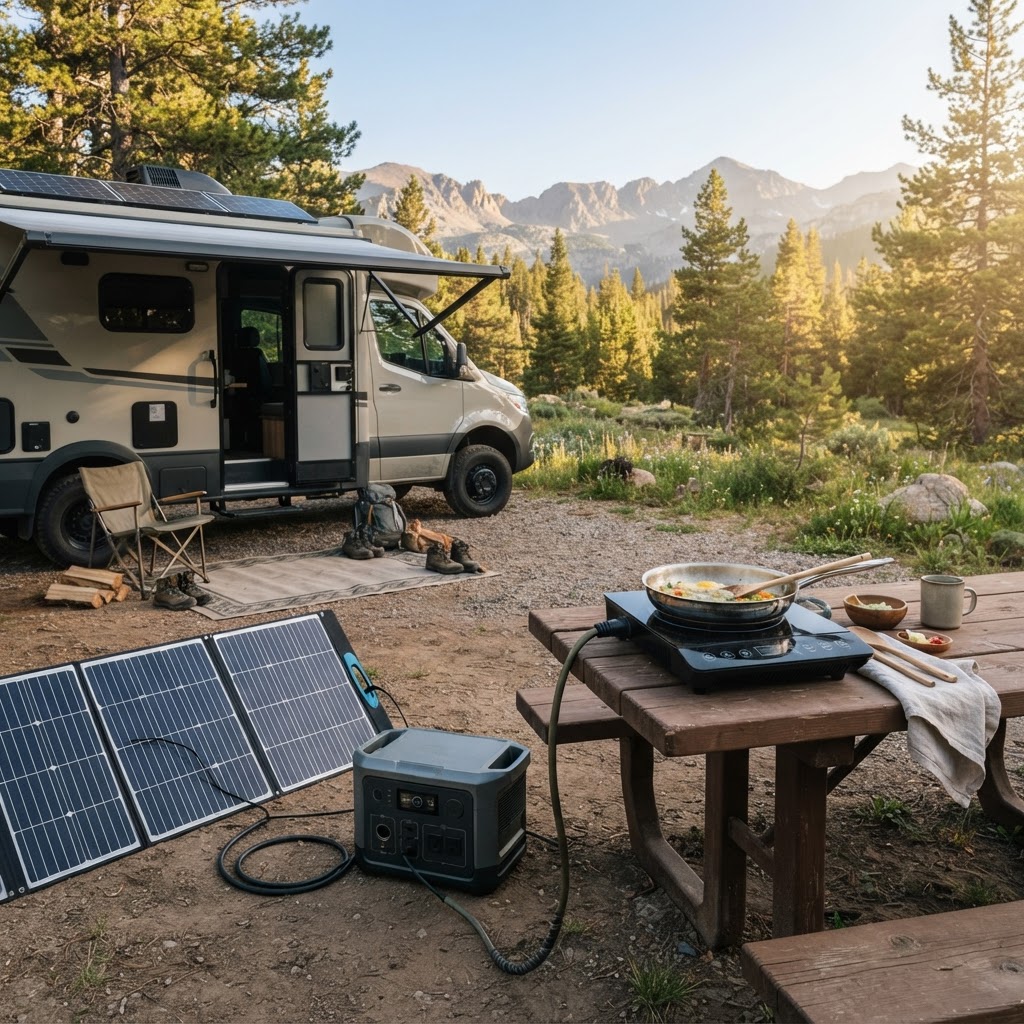
Top Picks This Round
EcoFlow DELTA Pro 3
The gold standard for off-grid power, featuring a massive 4000W AC output that can handle multiple induction burners and appliances simultaneously.
- +4000W AC output with X-Core 3.0
- +Ultra-quiet 30dB operation
- +120V/240V output for heavy appliances
Anker SOLIX F3800
A powerhouse designed for the modern electric RV, delivering 6000W of output power to run dual-burner induction cooktops and AC units easily.
- +Massive 6000W power output
- +NEMA 14-50 port for RV plug-in
- +Easy-to-move suitcase design
Bluetti AC300 + B300 System
A modular system that allows you to separate the battery from the inverter, making it easier to install and manage weight distribution in an RV.
- +3000W inverter handles all burners
- +Modular design for flexible storage
- +Dual charging (Solar + AC) up to 5400W
Jackery Explorer 3000 Pro
Combines high-capacity energy storage with an incredibly user-friendly interface and fast solar charging for a seamless off-grid cooking experience.
- +3000W continuous AC output
- +Fast 3.5-hour solar recharge
- +Excellent cold-weather performance
The short answer: if you want the best solar generator for rv induction cooking, I’d start with the EcoFlow DELTA Pro 3 because it has the cleanest mix of high continuous output, real RV-friendly flexibility, and enough headroom to run an induction cooktop without feeling like you’re right on the edge all the time.
Induction cooking in an RV is one of those upgrades that sounds simple until you start sizing power for it. A single burner can pull a lot more than a coffee maker or TV, and once you add a microwave, air fryer, or rooftop AC into the same day, a small power station stops looking cheap and starts looking frustrating.
That’s why I look at these units a little differently than I would for basic camping. For an off-grid cooking solar setup, watts matter just as much as watt-hours. You need enough inverter muscle to start and hold the load, and enough battery capacity to cook more than one quick meal before you’re hunting for shore power again.
One quick note before I get into the picks: this roundup is based on manufacturer specs, official product documentation, and verified customer-review patterns. I’m not going to pretend every model here was personally bench-tested for this article. The goal is simple: help you narrow down the right kit for how you actually cook and camp.
Quick Comparison
| Product | Best For | Key Spec | value tiers |
|---|---|---|---|
| EcoFlow DELTA Pro 3 | Best overall | 4000W AC output, 120V/240V | Premium |
| Anker SOLIX F3800 | Best premium | 6000W output, NEMA 14-50 RV port | Premium |
| Bluetti AC300 + B300 System | Best for home backup | 3000W inverter, modular battery system | Premium |
| Jackery Explorer 3000 Pro | Best for ease of use | 3000W output, fast solar recharge | Mid-range |
| Bluetti Elite 200 V2 | Best for RV / van life | 2600W constant output, 6000+ cycles | Mid-range |
| EcoFlow DELTA 2 Max | Best ultra-portable | 2048Wh capacity, 50 lb weight | Mid-range |
| Pecron E2000LFP | Best budget | 2000W inverter, expandable to 8kWh | Budget |
1. EcoFlow DELTA Pro 3 — Best overall
The EcoFlow DELTA Pro 3 is the one I’d point most RV cooks toward first because it solves the main induction problem the cleanest: sustained output. With 4000W AC output, it gives you room for an induction burner plus the normal background stuff in an RV without forcing constant load babysitting. That matters more than people think. Running a cooktop is easy on paper; running a cooktop while the fridge cycles and someone plugs in something else is where weaker setups get annoying.
It also stands out because it isn’t just a big battery with a big inverter. The 120V/240V capability gives it more long-term usefulness than a lot of competitors. If your setup grows, or you want a unit that can pull double duty for heavier home backup loads too, this one feels less like a one-trick cooking box and more like a serious power hub.
The trade-off is obvious: size and price. It’s over 110 pounds, so this is not the unit I’d want to lift in and out of a van every weekend. Compared with the Bluetti Elite 200 V2 for van life, the DELTA Pro 3 gives you way more power headroom, but it asks for a lot more floor space and budget. If you cook often and want fewer compromises, that trade is worth it.
Pros:
- 4000W AC output gives real breathing room for induction cooking and other RV loads.
- Runs very quietly, with operation rated around 30dB.
- 120V/240V output adds flexibility for heavier appliances and broader backup use.
Cons:
- Heavy at more than 110 pounds, so portability is limited.
- It sits firmly in premium-price territory.
2. Anker SOLIX F3800 — Best premium
If you want sheer output more than anything else, the Anker SOLIX F3800 is the monster in this list. At 6000W, it’s the kind of unit that makes RV induction cooking feel normal instead of managed. Dual-burner induction, microwave, and other big loads become a lot more realistic here than they do on smaller 2kWh-class stations.
The NEMA 14-50 port is a big deal for RV owners because it makes this feel purpose-built instead of adapted. A lot of big power stations can technically support RV use, but the F3800 speaks that language more directly. If you’re building around a modern electric RV setup or want one box that can support more than just cooking, this is the strongest premium option here.
The downside is that big capability comes in a very big package. Yes, the suitcase-style design helps, but it’s still a large unit. It’s also not the one I’d choose if your solar array is modest, because slower charging on lower-wattage solar can leave you waiting longer than you’d like. Compared with the EcoFlow DELTA Pro 3, this one gives you more raw output; compared with it, the EcoFlow is easier to justify if you don’t need every last watt.
Pros:
- Massive 6000W output handles heavy cooking loads with room to spare.
- Built-in NEMA 14-50 port makes RV plug-in much more straightforward.
- Suitcase-style form helps a little with moving a very large unit around.
Cons:
- The physical size is substantial and takes planning in an RV.
- Solar charging feels slower if you’re feeding it with a smaller panel setup.
3. Bluetti AC300 + B300 System — Best for home backup
The Bluetti AC300 + B300 System makes the most sense for someone who wants RV cooking power but also sees this setup as part of a larger home backup plan. The 3000W inverter is strong enough for induction cooking, and the modular layout gives you more flexibility than an all-in-one box if you care about weight distribution, storage, or future expansion.
That modular design is the whole story here. In an RV, separating the battery and inverter can actually be useful because you’re not forced to wrestle one giant block into place. At home, it can be easier to build around too. If your use case is half road trip, half emergency backup, the AC300+B300 is more adaptable than something like the Jackery Explorer 3000 Pro.
The catch is that modular also means messier. You’re dealing with multiple components and more cabling, which not everyone wants. If you prefer a simple grab-and-go induction cooktop battery backup, the Jackery is easier. If you want a cleaner single-box experience, the EcoFlow DELTA Pro 3 also feels more streamlined.
Pros:
- 3000W inverter is enough for most RV induction burners and kitchen loads.
- Modular layout gives you more flexibility for storage and setup.
- Very strong combined charging potential with solar and AC together.
Cons:
- You need multiple components, so it’s not as simple as an all-in-one unit.
- The extra cables can make the setup feel cluttered.
4. Jackery Explorer 3000 Pro — Best for ease of use
The Jackery Explorer 3000 Pro is the one I’d recommend to someone who wants a 3000W portable power station for RV use without a lot of learning curve. It has enough output for serious cooking, the interface is simple, and Jackery’s approach is usually easier for first-time buyers to live with day to day than a more modular or more technical system.
Its fast solar recharge is a real advantage for camping season. If your cooking style is a hot breakfast, light lunch, and one bigger dinner, faster recovery during the day matters. That’s what keeps a mid-sized system comfortable instead of stressful. It also has a reputation for solid cold-weather behavior, which matters if your RV season stretches into shoulder months.
The main compromise is battery chemistry trade-off against some rivals. Compared with the Bluetti Elite 200 V2, the Jackery gives you more output but not the same long-cycle-life appeal. Compared with the EcoFlow DELTA 2 Max, it feels more like a full-time cooking platform, but it’s less portable. This is the pick for the person who wants capable power with less fiddling.
Pros:
- 3000W continuous AC output is enough for most induction cooking setups.
- Fast solar recharge helps a lot on multiday trips.
- Handles colder conditions better than some competitors.
Cons:
- Lower cycle life than the LiFePO4-heavy competition.
- The cooling fans are noticeable when the unit is working hard.
5. Bluetti Elite 200 V2 — Best for RV / van life
The Bluetti Elite 200 V2 for van life is the durability pick. If you live on the road full time, or close to it, battery cycle life stops being a nice bonus and starts becoming part of the value equation. With 6000+ cycles and a compact footprint, this one makes a lot of sense for people who cook often but don’t want a giant station eating up half a storage bay.
The 2600W constant output is enough for a lot of single-burner induction setups, especially if you’re not trying to run everything else at the same time. That’s the key distinction. This isn’t the same class as the EcoFlow DELTA Pro 3 or Anker SOLIX F3800 for raw muscle, but it’s a much easier fit in tight RV and van layouts. For many solo travelers and couples, that balance is the sweet spot.
The limitation is capacity. At 2kWh, you need to be realistic about runtime. This is better described as a smart daily-use cooking station than a huge reserve tank. Compared with the EcoFlow DELTA 2 Max, I’d lean Bluetti for harder everyday use because of the cycle life and packaging. Compared with the Jackery Explorer 3000 Pro, I’d lean Jackery if you want more output overhead and simpler power abundance.
Pros:
- Very long 6000+ cycle life is a strong match for full-time RV and van use.
- 2600W constant AC output is enough for many single-burner induction cooktops.
- Compact footprint works better in tighter living spaces.
Cons:
- 2kWh capacity is limiting if you cook a lot or use several appliances.
- Expansion batteries push the total cost up quickly.
6. EcoFlow DELTA 2 Max — Best ultra-portable
The EcoFlow DELTA 2 Max is for people who want to bring induction cooking along without committing to a huge power box. At about 50 pounds, it’s in a very different portability class from the big premium stations above. If you move your gear in and out of the RV often, or you split time between the camper, the garage, and weekend tailgates, that matters.
Its 2048Wh capacity means you still need to think in terms of a lighter-duty off-grid cooking solar setup. A single burner, short cook sessions, and good recharge opportunities fit this unit well. EcoFlow’s fast charging helps keep it practical, and X-Boost can help with higher-wattage spikes, though I still wouldn’t buy any power station based on boosted-mode claims alone for serious cooking loads.
Compared with the Bluetti Elite 200 V2, this one is easier to haul around. Compared with the Jackery Explorer 3000 Pro, it gives up some heavy-use comfort in exchange for much better portability. For weekend RVers who want induction now and then, not three meals a day, it lands in a useful middle ground.
Pros:
- X-Boost helps it tolerate some higher-wattage appliance demands.
- About 50 pounds is genuinely manageable for one person.
- Very fast charging is one of its biggest practical advantages.
Cons:
- 2048Wh internal capacity is modest for frequent electric cooking.
- The AC outlet count is a bit limited.
7. Pecron E2000LFP — Best budget
The Pecron E2000LFP is the value play here. If your budget is tight but you still want an induction cooktop battery backup that can support light RV cooking, this is the one that makes the most sense. You’re getting a 2000W pure sine wave inverter and expansion potential without having to jump straight into premium-brand pricing.
The important thing is setting expectations correctly. At 2000W, this is not the station I’d choose for a demanding dual-burner setup or for running a bunch of other loads at the same time. But for a modest induction burner, careful power management, and occasional off-grid meals, it can absolutely be workable. That’s what makes it a legitimate budget entry instead of just a compromise box.
Compared with the EcoFlow DELTA 2 Max, the Pecron gives up polish and charging speed but can be easier on the wallet. Compared with the Bluetti Elite 200 V2, it’s less refined and less compact, but the overall value story is attractive. If you’re cost-sensitive and willing to manage your loads, it’s the cheapest sensible way into this category.
Pros:
- Strong price-to-performance value for buyers on a tighter budget.
- 2000W pure sine wave inverter is enough for lighter induction use.
- Expandable capacity leaves room to grow later.
Cons:
- The app experience is pretty basic.
- AC charging is slower than many better-known rivals.
How I Picked These
For RV induction cooking, I care about a few things more than fancy app screenshots. First is the relationship between battery capacity in watt-hours and inverter output in watts. A big battery with a weak inverter is frustrating, and a huge inverter with too little battery feels impressive for ten minutes and then empty.
I also pay attention to battery chemistry. LiFePO4 usually makes more sense for people who camp often or live on the road because the cycle life is better, even if the unit is heavier. NMC can still be fine, especially if portability matters more than years of daily use, but I wouldn’t ignore chemistry when you’re spending this much.
Solar input matters too. If you’re building an off-grid cooking solar setup, recharge speed changes the whole ownership experience. A station that cooks one meal well but takes forever to refill on modest solar can feel limiting fast. I also looked at portability, RV practicality, and value per watt-hour and per watt of inverter power.
And to be clear, these picks are based on manufacturer specs, official documentation, and verified customer-review patterns, not hands-on testing for this roundup. I’d rather say that plainly than dress it up.
Things to Watch Out For
1. Confusing watt-hours with watts. Watt-hours tell you how long the battery may last. Watts tell you whether it can run the induction cooktop at all. You need both numbers to make a smart call.
2. Falling for peak output instead of continuous output. Induction cooking is not just a quick startup spike. What matters most is the unit’s continuous AC rating, because that’s the number it has to hold while you’re actually cooking.
3. Ignoring solar input limits. Two stations with similar battery sizes can feel completely different off-grid if one accepts much more solar. Slow recharge can turn a cooking setup into a once-a-day setup.
4. Forgetting the inverter ceiling for everything else. If your cooktop uses 1800W and your station is rated for 2000W, you don’t really have much room left for the fridge cycling, a kettle, or a microwave. That’s why 3000W-class units are often more comfortable for RV use.
5. Believing advertised runtime without thinking about real meals. Cooking on high burns through battery faster than people expect. A unit that looks huge on paper can feel smaller once you’re boiling water, sautéing dinner, and charging devices in the same evening.
Frequently Asked Questions
Can a solar generator run an RV induction cooktop?
Yes, if it has enough continuous AC output. In practice, I’d want at least around 2000W for lighter single-burner use and closer to 3000W or more for a more relaxed RV cooking setup.
How big of a battery do I need for RV induction cooking?
Around 2kWh is the minimum I’d consider for occasional use. If you cook daily or want to run other appliances too, a larger battery or expandable system will feel a lot less restrictive.
Is a 3000W portable power station for RV cooking enough?
Yes, for most single-burner and many practical RV kitchen setups, 3000W is enough. It gives you better headroom than 2000W-class units when the cooktop is running alongside your normal RV loads.
Is the Bluetti Elite 200 V2 good for van life?
Yes, especially if compact size and long battery life matter more than maximum capacity. The Bluetti Elite 200 V2 for van life makes sense for frequent use in tight spaces, but you do need to be realistic about its 2kWh class runtime.
Can I recharge these power stations fast enough with solar alone?
Yes, but it depends heavily on the station’s solar input limit and the size of your panel array. For regular off-grid cooking, faster solar acceptance usually matters almost as much as battery size.
The Verdict
Top overall pick: EcoFlow DELTA Pro 3. It has the best balance of sustained power, RV-friendly flexibility, and enough output headroom to make induction cooking feel easy instead of managed. Check today’s prices on Amazon →
Best budget pick: Pecron E2000LFP. It’s the most affordable way into light RV induction cooking if you’re willing to watch your loads and accept fewer niceties. Check today’s prices on Amazon →
Premium pick: Anker SOLIX F3800. If maximum output and RV plug-in convenience matter more than size or price, this is the heavy-hitter of the bunch. Check today’s prices on Amazon →
Related Guides
- How to Size a Solar Generator for an RV
- Best 3000W Portable Power Stations for RV Camping
- LiFePO4 vs NMC Batteries: Which Lasts Longer in a Power Station?
- Best Expansion Battery Systems for Long Off-Grid Stays
All Featured Products
EcoFlow DELTA Pro 3
The gold standard for off-grid power, featuring a massive 4000W AC output that can handle multiple induction burners and appliances simultaneously.
- +4000W AC output with X-Core 3.0
- +Ultra-quiet 30dB operation
- +120V/240V output for heavy appliances
Anker SOLIX F3800
A powerhouse designed for the modern electric RV, delivering 6000W of output power to run dual-burner induction cooktops and AC units easily.
- +Massive 6000W power output
- +NEMA 14-50 port for RV plug-in
- +Easy-to-move suitcase design
Bluetti AC300 + B300 System
A modular system that allows you to separate the battery from the inverter, making it easier to install and manage weight distribution in an RV.
- +3000W inverter handles all burners
- +Modular design for flexible storage
- +Dual charging (Solar + AC) up to 5400W
Jackery Explorer 3000 Pro
Combines high-capacity energy storage with an incredibly user-friendly interface and fast solar charging for a seamless off-grid cooking experience.
- +3000W continuous AC output
- +Fast 3.5-hour solar recharge
- +Excellent cold-weather performance
Bluetti Elite 200 V2
Built with automotive-grade LFP cells, this unit offers an industry-leading 6,000+ cycle life, making it the most durable choice for full-time van life.
- +6000+ battery charge cycles
- +2600W constant AC output
- +Compact footprint for tight RV spaces
EcoFlow DELTA 2 Max
Lightweight and versatile, this unit uses X-Boost technology to run appliances up to 3400W, perfect for weekend warriors with single burners.
- +X-Boost handles high-wattage spikes
- +Weighs only 50 lbs
- +Industry-leading 0-80% charge speed
Pecron E2000LFP
The ultimate value play for budget-conscious RVers, offering 2000W of power and expandable capacity at a fraction of the cost of big-name brands.
- +Incredible price-to-performance ratio
- +2000W pure sine wave inverter
- +Expandable up to 8kWh
Frequently Asked Questions
Can a solar generator run an RV induction cooktop?
Yes, if it has enough continuous AC output. Around 2000W can work for lighter single-burner use, while 3000W or more feels more comfortable in a real RV setup.
How big of a battery do I need for RV induction cooking?
Around 2kWh is the minimum I’d look at for occasional cooking. For daily use or multiple appliances, a larger or expandable system is the safer bet.
Is a 3000W portable power station for RV cooking enough?
Yes. A 3000W unit is usually enough for most single-burner induction cooking setups and gives you better headroom for normal RV loads.
Is the Bluetti Elite 200 V2 good for van life?
Yes. Its compact size and 6000+ cycle battery make it a strong fit for van life, though the 2kWh capacity means you need to manage runtime carefully.
Can I recharge these power stations fast enough with solar alone?
Yes, but it depends on both the power station’s solar input limit and your panel array size. Higher solar input makes a big difference for regular off-grid cooking.