Best Portable Power Station for Oxygen Concentrator (2026)
Ensure reliable backup power for medical devices at home. Compare the best portable power station for oxygen concentrator use in our 2026 emergency guide.
Affiliate disclosure: As an Amazon Associate I earn from qualifying purchases. We may earn a commission from purchases made through our links, at no extra cost to you.
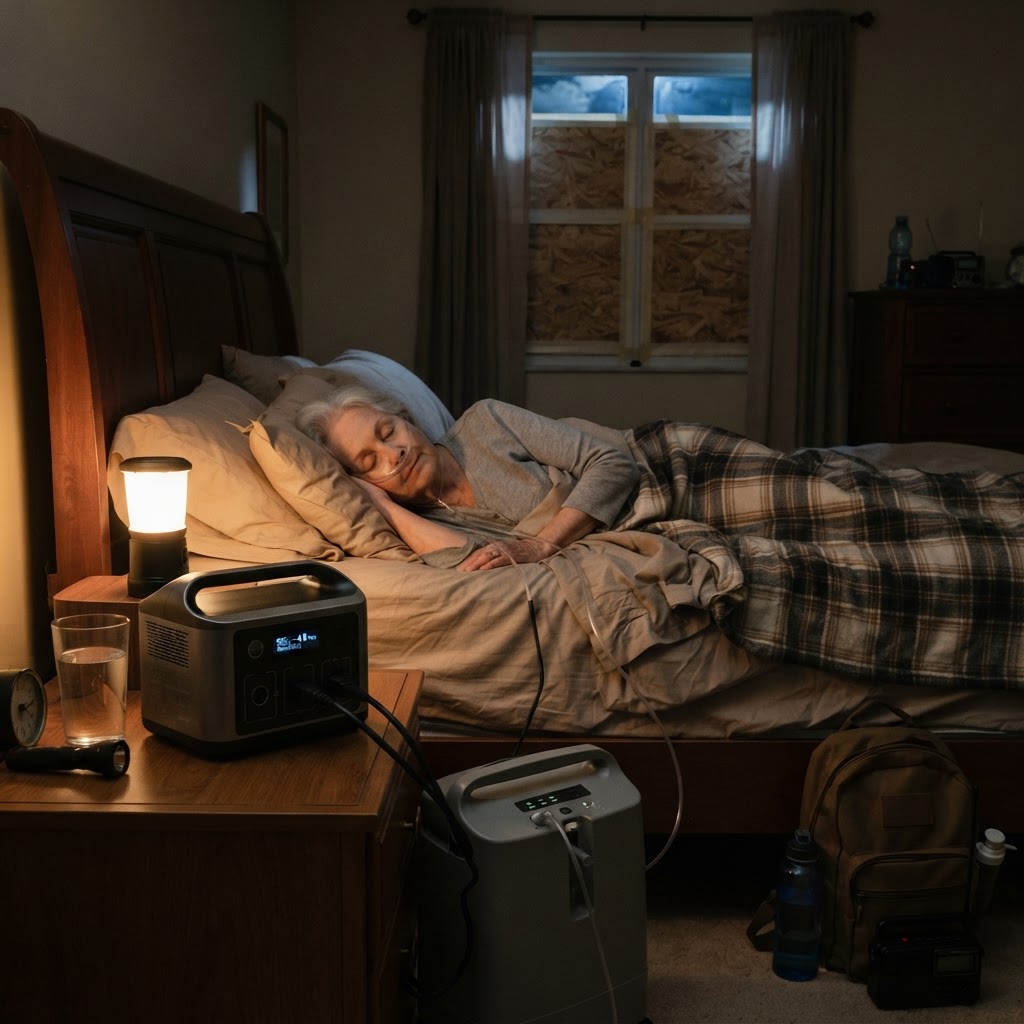
Top Picks This Round
Jackery Explorer 3000 Pro Solar Generator
Offering a massive 3024Wh capacity, this unit is exceptionally quiet during operation, making it the perfect bedside companion for 24/7 oxygen needs.
- +Quiet Canyon cooling for silent nights
- +Built-in pull handle and wheels
- +Massive capacity for long runtimes
EcoFlow DELTA 3 Max Portable Power Station
A top-tier 2048Wh unit featuring a lightning-fast 10ms UPS switchover, ensuring medical oxygen concentrators never skip a beat during a power failure.
- +Ultra-fast 10ms UPS switching time
- +Expandable capacity up to 6144Wh
- +80% charge in just 43 minutes
BLUETTI AC300 + B300 Modular Power System
A modular powerhouse that can be expanded up to 12.2kWh, offering peace of mind for multi-day emergency backup during natural disasters.
- +Limitless expansion for multi-day use
- +3000W pure sine wave inverter
- +Supports dual charging (Solar + AC)
Anker SOLIX F2000 (GaNPrime 767)
Utilizing GaN technology for cooler and more efficient operation, this unit includes suitcase-style wheels for moving power between rooms.
- +Energy-efficient GaNPrime technology
- +Ultra-durable suitcase-style wheels
- +10-year full-device warranty
The short answer: the best portable power station for oxygen concentrator backup in 2026 is the EcoFlow DELTA 3 Max Portable Power Station for most people, because it balances solid 2048Wh capacity with a fast 10ms UPS switchover that matters when the grid drops unexpectedly.
If you rely on home oxygen, I think about this a little differently than I would for camping or tailgating. This is not just convenience power. This is backup power for medical devices at home, and during hurricane season that means runtime, switchover speed, noise, and ease of use all matter at the same time.
I also want to be clear about how I built this list. I have not hands-on tested these units for this article. These picks are based on manufacturer specs, official product documentation, and verified customer-review patterns, with the focus on what actually helps someone build a reliable battery backup for home oxygen.
One more thing before the list: oxygen concentrators vary a lot. A small portable pulse-dose unit may sip power, while a home continuous-flow machine with a humidifier can draw several times more. That is why the right pick is less about brand loyalty and more about matching watt draw, runtime needs, and whether you need a true UPS-style handoff.
Quick Comparison
| Product | Best For | Key Spec | value tiers |
|---|---|---|---|
| Jackery Explorer 3000 Pro Solar Generator | Best premium | 3024Wh capacity with very quiet cooling | Premium |
| EcoFlow DELTA 3 Max Portable Power Station | Best overall | 2048Wh with 10ms UPS and expansion to 6144Wh | Premium |
| BLUETTI AC300 + B300 Modular Power System | Best for home backup | 3000W inverter with expansion up to 12.2kWh | Premium |
| Anker SOLIX F2000 (GaNPrime 767) | Best for mobility | 2kWh-class power with durable suitcase wheels | Premium |
| BLUETTI AC200L Portable Power Station | Best for heavy-duty concentrators | 2048Wh with 2400W AC output | Mid-range |
| Jackery Explorer 1000 v2 Portable Power Station | Best ultra-portable | 1070Wh in a lightweight travel-friendly body | Mid-range |
| EcoFlow DELTA 2 Portable Power Station | Best budget | 1024Wh with 30ms UPS mode | Budget |
1. Jackery Explorer 3000 Pro Solar Generator — Best premium
If your first priority is long runtime with as little bedside annoyance as possible, the Jackery Explorer 3000 Pro Solar Generator makes a strong case. Its 3024Wh capacity gives you more stored energy than the 2kWh-class units here, and the quiet cooling design is a real advantage when an oxygen setup is running overnight in the same room.
I especially like where this fits for people who do not want to mess with modular add-ons right away. Compared with the EcoFlow DELTA 3 Max Portable Power Station, you get more capacity out of the box. Compared with the BLUETTI AC300 + B300 Modular Power System, it stays much simpler as one integrated unit with wheels and a pull handle.
The trade-off is the one I would not gloss over for medical use: there is no dedicated UPS mode here, only bypass behavior. So if seamless switchover is your number-one requirement, I would rank the EcoFlow ahead of it. But if you want premium runtime, quiet operation, and a setup that is easy to roll where you need it, this is one of the best premium buys in the category.
Pros:
- Quiet Canyon cooling keeps nighttime noise down.
- Built-in handle and wheels make the big battery easier to move.
- Large capacity gives you longer runtimes than most all-in-one rivals.
Cons:
- No dedicated UPS mode, only bypass operation.
- It is one of the pricier choices on this list.
2. EcoFlow DELTA 3 Max Portable Power Station — Best overall
For most households, this is the easiest recommendation. The EcoFlow DELTA 3 Max Portable Power Station hits the sweet spot between capacity, backup behavior, and future flexibility. With 2048Wh on board and a 10ms UPS switchover, it is the most balanced pick for someone who wants a portable power station with UPS for medical use without jumping all the way into a big modular home system.
If you are specifically researching the EcoFlow DELTA 3 Max for oxygen concentrator backup, the appeal is simple: when the power cuts, the handoff is fast enough to help prevent interruptions, and if your runtime needs grow, you can expand to 6144Wh instead of replacing the whole unit. That is a big advantage over the Jackery Explorer 1000 v2 Portable Power Station and the EcoFlow DELTA 2 Portable Power Station, which are more limited for long outages.
The downsides are what you would expect. It is not cheap, and at around 50 pounds it is not the easiest carry. Still, if you want one power station that can cover daily peace of mind, storm outages, and a serious home oxygen backup role better than most, this is the overall winner.
Pros:
- Very fast 10ms UPS switching helps keep equipment running through outages.
- Expandable design lets you grow capacity up to 6144Wh.
- Fast charging gets it back to 80% in about 43 minutes.
Cons:
- The advanced feature set comes with premium pricing.
- It is fairly heavy for a 2kWh-class unit.
3. BLUETTI AC300 + B300 Modular Power System — Best for home backup
If your concern is not a short outage but a multi-day grid failure during hurricane season, the BLUETTI AC300 + B300 Modular Power System deserves a hard look. This is the most home-focused option here, with a 3000W pure sine wave inverter and expansion up to 12.2kWh. That is a completely different scale from a travel-friendly station.
Where it stands out is staying power. A lot of buyers focus on a single overnight run, but the more realistic question is what happens on day two or day three if roads are blocked and power restoration drags on. Compared with the Jackery Explorer 3000 Pro Solar Generator, the BLUETTI can grow much further. Compared with the EcoFlow DELTA 3 Max Portable Power Station, it is less about portability and more about turning your oxygen backup into a serious home resilience plan.
The downside is that this is not a grab-and-go box. It needs multiple components, and once assembled it is not what I would call portable in normal life. But if your main goal is reliable battery backup for home oxygen across extended outages, this is the strongest whole-home-style option in the list.
Pros:
- Expansion potential is huge for multi-day backup.
- 3000W pure sine wave inverter leaves plenty of headroom.
- Dual charging support helps refill faster with solar and AC together.
Cons:
- You need both the AC300 and B300 to get started.
- Once set up, it is not truly portable.
4. Anker SOLIX F2000 (GaNPrime 767) — Best for mobility
The Anker SOLIX F2000 (GaNPrime 767) is the pick I would look at if you need to move backup power around the house often. Some people only need one room covered. Others may want power in the bedroom at night, then roll it to the living room, another family member, or even into a vehicle during an evacuation. The rugged suitcase-style wheel setup makes that easier than on most heavy 2kWh units.
Its efficiency-focused GaNPrime design is another plus, especially if you are thinking about heat and noise in tighter indoor spaces. Compared with the BLUETTI AC200L Portable Power Station, it gives up some brute-output appeal but feels more mobility-oriented. Compared with the Jackery Explorer 3000 Pro Solar Generator, you get less battery capacity but a more practical room-to-room form factor for some homes.
The trade-off is size and heft. It still takes up a decent chunk of floor space, and in a cramped bedroom that matters. But if your backup plan involves physically moving the power station instead of parking it in one place forever, this is the mobility-focused choice I would put near the top.
Pros:
- GaNPrime design aims for cooler, more efficient operation.
- The wheel design is durable and easy to live with.
- A 10-year full-device warranty adds peace of mind.
Cons:
- The footprint can feel big in smaller rooms.
- It is still heavier than many other 2kWh-class models.
5. BLUETTI AC200L Portable Power Station — Best for heavy-duty concentrators
Not every oxygen concentrator is an easy load. Some continuous-flow home units pull a lot more power than portable machines, and startup surges can trip weaker stations. That is where the BLUETTI AC200L Portable Power Station makes sense. With 2400W AC output and 3600W Power Lifting, it is the most reassuring pick here for harder-starting, higher-draw equipment.
I would put this ahead of the EcoFlow DELTA 2 Portable Power Station and the Jackery Explorer 1000 v2 Portable Power Station if your concentrator is full-size and non-negotiable. Its 2048Wh battery is in the same broad capacity class as the EcoFlow DELTA 3 Max Portable Power Station, but the BLUETTI leans more toward raw output confidence than UPS-first convenience.
The main catches are bulk and a somewhat rougher app experience from what owners commonly report. Still, for buyers asking less about mobility and more about whether the station can comfortably handle a demanding medical-grade machine, this is the safest fit in the lineup.
Pros:
- Strong 2400W AC output gives more headroom for power-hungry gear.
- LiFePO4 battery chemistry is built for long service life.
- Fast 2400W AC charging gets it ready quickly.
Cons:
- It is bulkier than some similarly sized competitors.
- The app experience can be inconsistent.
6. Jackery Explorer 1000 v2 Portable Power Station — Best ultra-portable
If you need something for travel, car backup, hotel stays, or a smaller portable oxygen concentrator, the Jackery Explorer 1000 v2 Portable Power Station is the practical lightweight option. At 1070Wh, it is clearly not built for multi-day home backup, but it is much easier to lift, store, and carry than the big 2kWh and 3kWh machines above.
This is the one I would consider for people who split time between home and the road. Compared with the Anker SOLIX F2000 (GaNPrime 767), it is far easier to pick up outright instead of rolling. Compared with the EcoFlow DELTA 2 Portable Power Station, it gives you a similarly compact role but with a very straightforward interface that a lot of buyers appreciate when they are stressed and just need power now.
The obvious limit is runtime. For a small portable concentrator, fine. For a larger home unit, maybe not enough unless the outage is short or the machine is low draw. So I see this as a travel and emergency transport backup, not the first answer for whole-night continuous-flow home oxygen.
Pros:
- Lightweight enough to carry without a struggle.
- The controls are simple and easy to understand.
- Solar recharge performance is very strong for its size.
Cons:
- 1070Wh limits runtime with bigger machines.
- There is no internal expansion path later.
7. EcoFlow DELTA 2 Portable Power Station — Best budget
The EcoFlow DELTA 2 Portable Power Station is the budget pick because it covers the basics better than most lower-cost options. You get 1024Wh, LiFePO4 battery chemistry, and a 30ms UPS mode in a body small enough for many nightstands or bedroom corners. For short outages, that combination makes a lot of sense.
I would choose this over the Jackery Explorer 1000 v2 Portable Power Station if budget and UPS behavior matter more than shaving weight. I would choose it over the larger premium units if the goal is simply affordable coverage for a few hours rather than all-night or multi-day backup. For many hurricane-season households, that is the real need.
You do give up runtime, and that matters. A budget station can still be a smart buy, but only if your concentrator's actual watt draw lines up with it. If your machine is larger, or if you want margin for long overnight outages, step up to the EcoFlow DELTA 3 Max Portable Power Station or BLUETTI AC200L Portable Power Station instead.
Pros:
- Strong value for the money.
- The 30ms UPS mode is useful for outage protection.
- Compact enough to fit in tighter spaces.
Cons:
- Runtime will be limited with larger concentrators.
- Extra capacity requires separate expansion batteries.
How I Picked These
I did not build this list around camping features or flashy app extras. I narrowed it down around the stuff that matters when someone depends on oxygen during a storm outage: usable battery capacity, honest AC output, whether the unit has a UPS-style mode, and whether it is realistic to move and charge in a normal home.
Capacity in watt-hours matters because that tells you roughly how long the machine can run. Rated watts matter because some concentrators, especially continuous-flow home units, need more startup and operating headroom than people expect. I also paid attention to battery chemistry when brands clearly specify it. LiFePO4 tends to be a strong fit for home backup because of cycle life and thermal stability, while other chemistries may prioritize energy density or weight.
Solar input was part of the picture too, especially for hurricane season when the grid may stay down. A station that can recharge meaningfully from panels is more useful than one that technically supports solar but takes forever. Last, I looked at value per watt-hour and what buyers consistently report in verified reviews, while staying grounded in official specs and documentation rather than guesswork.
Things to Watch Out For
- Confusing Wh with W. Watt-hours tell you runtime. Watts tell you whether the station can actually power the concentrator at all. You need both numbers to make a smart choice.
- Ignoring startup surge and continuous draw. Some machines pull more power when they first kick on. A power station that looks fine on paper can still shut down if the inverter ceiling is too low.
- Overestimating advertised runtime. Real-world runtime is always lower than the simple battery number because of inverter losses and the device's actual cycling behavior. A rough rule is to use 80% to 90% of stated capacity for realistic planning.
- Assuming any UPS mode is equal. A fast switchover helps, but not every bypass or UPS feature behaves the same. For medical use, quicker handoff is better, and you should still confirm compatibility with your oxygen equipment provider.
- Forgetting solar limits. A unit may accept solar, but the input ceiling determines how fast it really recharges. During bad weather, low solar input can turn a big battery into a slow-recovering one.
Frequently Asked Questions
What size portable power station do I need for an oxygen concentrator?
The direct answer: most people should start by checking the concentrator's actual watt draw, then choose the biggest battery they can reasonably afford and handle. For short outages, around 1000Wh may work with lower-draw units, while full-size continuous-flow machines are usually better matched with 2000Wh or more.
How long will a 2000Wh power station run an oxygen concentrator?
The direct answer: a 2000Wh power station will often run an oxygen concentrator for roughly several hours to well over a full night, depending on the machine's watt draw. A simple estimate is usable watt-hours divided by device watts, and I would use about 1700 to 1800Wh as a realistic usable figure after conversion losses.
Is a portable power station with UPS safe for medical use?
The direct answer: it can be helpful, but it is not a substitute for following your equipment provider's guidance. A UPS feature reduces interruption risk during outages, but you should confirm your concentrator works properly with that station and maintain a broader emergency backup plan.
Can I recharge these power stations with solar during a hurricane outage?
The direct answer: yes, many of them support solar recharging, but the speed depends on both weather and the station's solar input limits. Solar is most useful as a way to extend runtime over multiple days, not as a guarantee during dark storm conditions.
Are portable oxygen concentrators easier to back up than home continuous-flow units?
The direct answer: yes, usually by a wide margin. Portable oxygen concentrators often draw much less power, so smaller stations like the Jackery Explorer 1000 v2 Portable Power Station or EcoFlow DELTA 2 Portable Power Station can make sense where a larger home unit would really need a 2kWh-plus class station.
The Verdict
Best overall: EcoFlow DELTA 3 Max Portable Power Station. It gives most buyers the right mix of 2048Wh capacity, fast 10ms UPS switching, and room to expand later.
Best budget: EcoFlow DELTA 2 Portable Power Station. It is the value play for short outages, especially if your concentrator is lower draw and you want UPS capability without spending premium money.
Best premium: Jackery Explorer 3000 Pro Solar Generator. If quiet operation and long runtime matter more than price, its 3024Wh battery and low-noise design are hard to beat.
If you already know your machine's watt draw, the right choice gets a lot clearer. Check today's prices on Amazon →
Related Guides
- Best 1000Wh Power Stations for Home Backup
- LiFePO4 vs NMC Batteries: Which Lasts Longer in a Power Station?
- How to Size a Solar Generator for Multi-Day Hurricane Outages
- Best Portable Power Stations with UPS for Sensitive Electronics and Medical Gear
All Featured Products
Jackery Explorer 3000 Pro Solar Generator
Offering a massive 3024Wh capacity, this unit is exceptionally quiet during operation, making it the perfect bedside companion for 24/7 oxygen needs.
- +Quiet Canyon cooling for silent nights
- +Built-in pull handle and wheels
- +Massive capacity for long runtimes
EcoFlow DELTA 3 Max Portable Power Station
A top-tier 2048Wh unit featuring a lightning-fast 10ms UPS switchover, ensuring medical oxygen concentrators never skip a beat during a power failure.
- +Ultra-fast 10ms UPS switching time
- +Expandable capacity up to 6144Wh
- +80% charge in just 43 minutes
BLUETTI AC300 + B300 Modular Power System
A modular powerhouse that can be expanded up to 12.2kWh, offering peace of mind for multi-day emergency backup during natural disasters.
- +Limitless expansion for multi-day use
- +3000W pure sine wave inverter
- +Supports dual charging (Solar + AC)
Anker SOLIX F2000 (GaNPrime 767)
Utilizing GaN technology for cooler and more efficient operation, this unit includes suitcase-style wheels for moving power between rooms.
- +Energy-efficient GaNPrime technology
- +Ultra-durable suitcase-style wheels
- +10-year full-device warranty
BLUETTI AC200L Portable Power Station
A high-performance 2048Wh LFP station that can handle the high startup surge of medical-grade continuous flow oxygen concentrators with ease.
- +2400W AC output (3600W Power Lifting)
- +LiFePO4 battery lasts 10+ years
- +Very fast 2400W AC input charging
Jackery Explorer 1000 v2 Portable Power Station
An upgraded classic that fits perfectly in a car or RV, providing reliable backup power for portable oxygen concentrators during travel.
- +Extremely lightweight and easy to carry
- +Simple, user-friendly interface
- +Very fast solar recharging rates
EcoFlow DELTA 2 Portable Power Station
The most reliable budget-friendly option for short-term outages, providing a 1024Wh capacity and essential LiFePO4 safety for medical use.
- +Incredible value for the capacity
- +Includes a reliable 30ms UPS mode
- +Compact enough for most nightstands
Frequently Asked Questions
What size portable power station do I need for an oxygen concentrator?
Most people should check the concentrator's actual watt draw first, then buy as much battery capacity as they can reasonably afford and move. Around 1000Wh may work for lower-draw units and short outages, while full-size continuous-flow machines are usually better matched with 2000Wh or more.
How long will a 2000Wh power station run an oxygen concentrator?
A 2000Wh power station will often run an oxygen concentrator for several hours to well over a full night, depending on watt draw. A practical estimate is usable watt-hours divided by device watts, using about 1700 to 1800Wh as realistic usable capacity after losses.
Is a portable power station with UPS safe for medical use?
It can be helpful, but it does not replace your equipment provider's guidance. A UPS feature reduces interruption risk during outages, but you should confirm concentrator compatibility and keep a broader emergency backup plan.
Can I recharge these power stations with solar during a hurricane outage?
Yes, many of them support solar charging, but real recharge speed depends on sunlight and the station's input limits. Solar is best treated as a way to extend backup over multiple days, not a guarantee during dark storm weather.
Are portable oxygen concentrators easier to back up than home continuous-flow units?
Yes, usually by a lot. Portable oxygen concentrators tend to draw less power, so smaller stations can work where a full-size home unit would need a much larger battery and inverter.