Best Portable Power Station for Portable Induction Cooktop
Discover the best portable power station for induction cooktops. Compare 2000W+ solar generators for high-surge cooking and reliable off-grid power.
Affiliate disclosure: As an Amazon Associate I earn from qualifying purchases. We may earn a commission from purchases made through our links, at no extra cost to you.
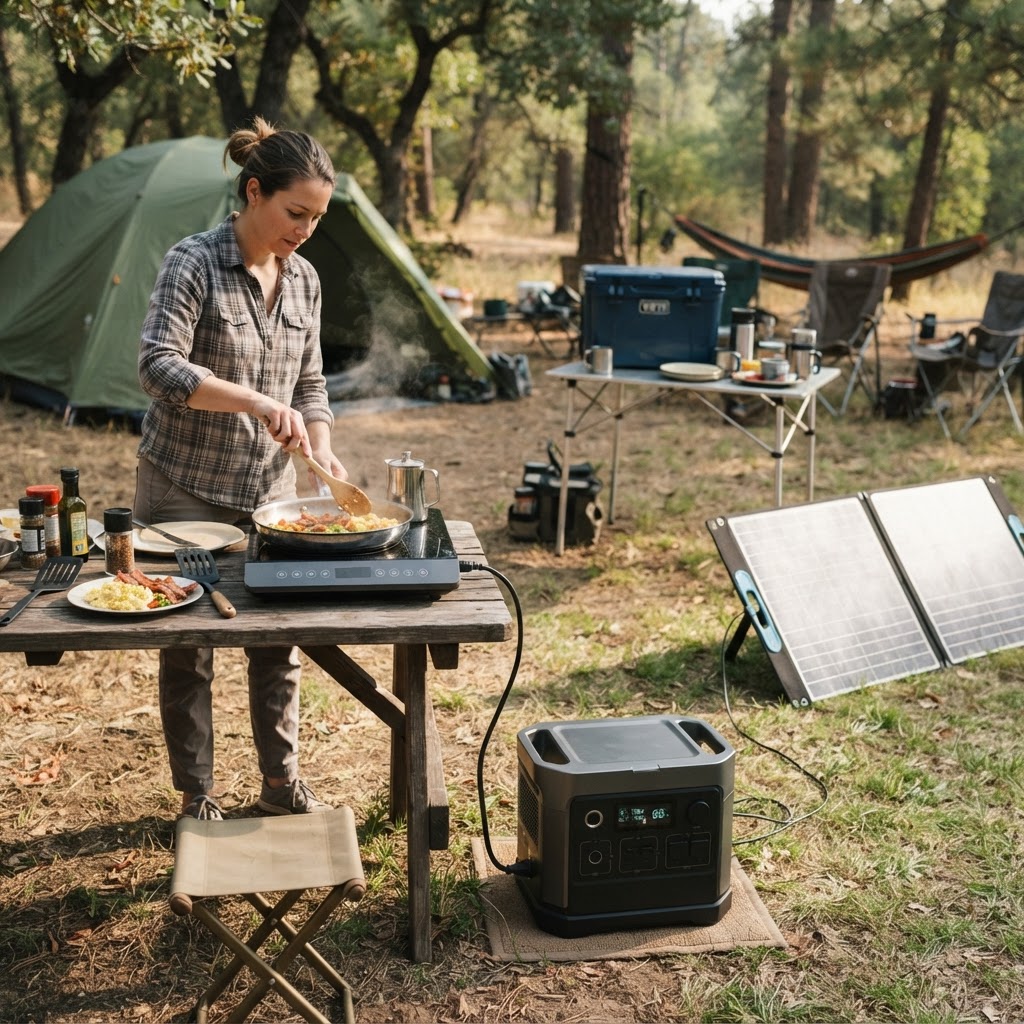
Top Picks This Round
EcoFlow DELTA Pro Portable Power Station
The industry standard for high-wattage needs, offering 3600W output and a massive expandable ecosystem for serious off-grid cooking.
- +Unmatched 3600W AC output
- +Expandable up to 25kWh capacity
- +EV station charging support
Jackery Explorer 2000 Plus Portable Power Station
A robust LiFePO4 flagship featuring 3000W output power and 2kWh capacity, capable of running heavy-duty induction burners with ease.
- +Massive 3000W continuous output
- +Ultra-fast AC charging in 2 hours
- +LiFePO4 battery lasts 10+ years
Anker SOLIX F2000 (PowerHouse 767)
Engineered with GaNPrime technology and a durable suitcase-style design, making it the most mobile high-capacity station for outdoor chefs.
- +Retractable handle and rugged wheels
- +Highly efficient GaN technology
- +TT-30 port for RV connectivity
EcoFlow DELTA 2 Max
A perfect balance of weight and performance, this unit delivers 2400W output in a frame that is significantly lighter than the Pro model.
- +Lightweight for 2000Wh class
- +X-Stream fast charging tech
- +Excellent mobile app control
The short answer: the Jackery Explorer 2000 Plus Portable Power Station is the best portable power station for portable induction cooktop use for most people because it combines a strong 3000W continuous inverter, a practical 2kWh class battery, and LiFePO4 longevity without jumping all the way to oversized home-backup territory.
If you are planning on running induction cooktop on battery power, the big thing to understand is that induction is easy on some power stations and a complete non-starter on others. A lot of compact units can run lights, a fridge, or a laptop all day, but a portable burner that pulls 1500W to 1800W will expose weak inverters fast. That is why the best portable power station for portable induction cooktop use usually starts around the 2000W continuous mark, and why a portable power station 2000W continuous is the real entry point if you want reliable cooking power instead of guesswork.
I put this list together by looking at manufacturer specs, official documentation, and consistent customer-review patterns from people using these bigger stations in the real world. I am not treating every model here as equal, either. Some are better for home backup, some make more sense in an RV, and some are simply the least painful way to get into high surge power station for cooking duty without spending a fortune.
With Labor Day sales usually bringing the better pricing of the season, this is also a smart time to buy if you have been waiting on a serious battery setup for camping, van life, outage prep, or portable power station for off-grid cooking around the backyard and cabin.
Quick Comparison
| Product | Best For | Key Spec | value tiers |
|---|---|---|---|
| EcoFlow DELTA Pro Portable Power Station | Best for home backup | 3600W AC output | Premium |
| Jackery Explorer 2000 Plus Portable Power Station | Best overall | 3000W continuous output | Premium |
| Anker SOLIX F2000 (PowerHouse 767) | Best for RV / van life | Rugged wheeled design with TT-30 port | Premium |
| EcoFlow DELTA 2 Max | Best mid-range | 2400W output in a lighter 2kWh class body | Mid-range |
| Bluetti AC200L Portable Power Station | Best premium | 2400W pure sine wave inverter | Mid-range |
| Pecron E2000LFP Solar Generator | Best value | 2000W inverter with 2000Wh class capacity | Mid-range |
| Bluetti AC180 Portable Power Station | Best budget | 1800W output with power lifting mode | Budget |
1. EcoFlow DELTA Pro Portable Power Station — Best for home backup
If your induction cooktop is part of a bigger emergency-power plan, the EcoFlow DELTA Pro Portable Power Station is the one that makes the most sense. Its 3600W AC output is in another class from the smaller 2kWh stations here, and that matters if you want to cook while also running a refrigerator, lights, or a few other household essentials. For a best solar generator for induction stove setup that can pull double duty during outages, this is the heavy hitter.
The real reason I would choose it over something like the Jackery Explorer 2000 Plus Portable Power Station is expansion. If you know your cooking load is just one burner for quick meals, the Jackery is easier to live with. But if you want a battery ecosystem that can grow into serious home backup, the DELTA Pro has the stronger long-term argument. It is also one of the few options here that feels built around large-load planning instead of just portable convenience.
The trade-off is obvious: this thing is big. It is less of a carry-it-to-the-picnic-table station and more of a roll-it-where-you-need-it station. The cooling fans can also get noisy when you are pulling real wattage, which is worth knowing if you are using it indoors during an outage.
Pros:
- Class-leading 3600W AC output for heavy cooking loads
- Expandable capacity up to 25kWh for serious backup use
- Can charge at EV stations, which adds flexibility on the road
Cons:
- Very large and awkward to move compared with other stations here
- Cooling fans can get loud under sustained load
2. Jackery Explorer 2000 Plus Portable Power Station — Best overall
This is the model I would point most people to first. The Jackery Explorer 2000 Plus Portable Power Station hits the sweet spot for running induction cooktop on battery power because 3000W continuous output gives you plenty of inverter headroom, while the 2kWh class capacity is large enough for real cooking sessions without turning into an absolute monster to store.
Compared with the EcoFlow DELTA 2 Max and Bluetti AC200L Portable Power Station, the Jackery gives you more output margin for burners that spike near their top setting. That extra headroom matters because induction cooktops are not all equally honest about their watt draw. If you are shopping for a high surge power station for cooking and do not want to second-guess whether your station will trip, this one is a safer all-around pick than a 2400W unit.
It is still a premium station, and at over 60 pounds it is not exactly light. But for someone who wants one battery that can handle camping, tailgates, outages, and portable power station for off-grid cooking without feeling undersized, this is the most balanced choice in the group.
Pros:
- Strong 3000W continuous output for demanding burners
- Very fast AC charging, roughly two hours to refill
- LiFePO4 battery chemistry is built for long service life
Cons:
- Heavy at 61.5 pounds
- Usually priced in the premium tier
3. Anker SOLIX F2000 (PowerHouse 767) — Best for RV / van life
The Anker SOLIX F2000 (PowerHouse 767) stands out because it is easier to move than most big power stations. That may sound like a small thing until you are dragging a 2kWh battery in and out of a van, across a campsite, or around an RV pad. The retractable handle and wheel setup make it more realistic to use often, instead of leaving it parked because it is a chore.
It also has an RV-friendly angle that some of the others do not. The TT-30 port is genuinely useful for RV setups, and that makes this one easier to fit into van life or travel trailer use than the Bluetti AC200L Portable Power Station or Pecron E2000LFP Solar Generator. If your induction cooking happens alongside RV power chores, that matters more than a spec-sheet battle over a few hundred watts.
The downside is value. Expansion batteries are not cheap, and its footprint is still bulky if you drive a smaller vehicle. I would take this over the EcoFlow DELTA Pro for mobility, but if your priority is pure output-per-dollar for one burner, the Jackery or Pecron make a stronger case.
Pros:
- Retractable handle and rugged wheels make transport much easier
- GaN-based design helps with efficiency and thermal performance
- Built-in TT-30 port is handy for RV connectivity
Cons:
- Expansion batteries cost quite a bit
- Still takes up a lot of space in smaller cars or vans
4. EcoFlow DELTA 2 Max — Best mid-range
If you want enough power for a typical single-burner induction plate without jumping into the heavier premium class, the EcoFlow DELTA 2 Max is a very sensible middle ground. Its 2400W output is enough for a lot of portable cooktops, and it does that in a lighter package than the DELTA Pro or the big Jackery. For people who will move their station often, that difference adds up quickly.
This is the model I like for buyers who know they want a portable power station 2000W continuous or better, but do not necessarily need 3000W. Against the Bluetti AC200L Portable Power Station, it wins on weight and app experience. Against the Pecron E2000LFP Solar Generator, it costs more, but the faster charging and more polished control setup are part of what you are paying for.
The main compromise is ecosystem flexibility. EcoFlow leans on proprietary expansion hardware, and DC output options are not as broad as some rivals. If you are mostly focused on AC cooking loads, that may not matter much. If you want a more all-purpose station for a bunch of odd accessories, it is worth noting.
Pros:
- Lighter than many other stations in the 2000Wh class
- Fast X-Stream AC charging saves time between uses
- App control is polished and genuinely useful
Cons:
- Uses proprietary expansion connections
- DC output selection is a bit limited
5. Bluetti AC200L Portable Power Station — Best premium
The Bluetti AC200L Portable Power Station is the pick for someone who wants a refined, high-capacity platform with strong solar potential and a reputation for serious battery-focused design. Its 2400W pure sine wave inverter is well suited to induction cooking, and the support for up to 1200W of solar input gives it a real edge for people building a best solar generator for induction stove setup around regular recharging off-grid.
Compared with the EcoFlow DELTA 2 Max, the Bluetti feels more solar-forward. Compared with the Jackery Explorer 2000 Plus Portable Power Station, it gives up some inverter headroom but may appeal more to buyers who care about charging flexibility and LiFePO4 cell chemistry above all else. If your idea of portable power station for off-grid cooking includes staying out longer and refilling from panels aggressively, that is where this model shines.
Its interface can take some getting used to, though, and it is not unusually light for the class. So while I like it a lot on paper, I would still send a less technical buyer to the Jackery first.
Pros:
- Strong 2400W pure sine wave inverter for stable AC cooking power
- Up to 1200W solar input is a big plus for off-grid use
- LiFePO4 battery chemistry is dependable and long-lived
Cons:
- User interface is not the simplest in this group
- Still fairly heavy for its size
6. Pecron E2000LFP Solar Generator — Best value
The Pecron E2000LFP Solar Generator is here for one reason: watt-hours per dollar. If you need a battery big enough to run a single-burner induction unit and you do not care about fancy app control, this is the cheapest practical entry into serious cooking power on this list. A stable 2000W inverter and 2000Wh class battery give it a believable use case for meal prep, not just coffee or quick boiling.
This is where I would look before the Bluetti AC180 Portable Power Station if your cooktop runs near 1800W and you want more breathing room. The AC180 is cheaper, but its smaller capacity and lower continuous output make it more of a short-session option. The Pecron, by contrast, is more of a real-use platform for regular camp cooking or backup meal duty at home.
You do give up polish. No Bluetooth, no WiFi, and slower AC charging than the pricier brands. But if you want a no-nonsense portable power station for off-grid cooking and care more about function than features, it earns its spot.
Pros:
- One of the most affordable ways into a 2000Wh class station
- Lots of output ports for general versatility
- Simple interface without much clutter
Cons:
- No Bluetooth or WiFi app control
- AC recharging is slower than many competitors
7. Bluetti AC180 Portable Power Station — Best budget
The Bluetti AC180 Portable Power Station is the budget pick because it is one of the few lower-cost units that still has a real shot at running a portable induction plate. Its 1800W output puts it right on the line for many single-burner cooktops, and the power lifting mode gives it extra flexibility with certain loads. For quick meals, simmering, or lower-power cooking settings, it can work surprisingly well.
I would not call it the safe answer for every induction setup, though. Compared with the Pecron E2000LFP Solar Generator, you get less battery and less inverter room. Compared with the EcoFlow DELTA 2 Max, you save a lot of money but also step down meaningfully in endurance. This is the pick for someone who cooks lightly, needs portability, and wants to spend as little as possible while still staying in the conversation.
The smaller 1152Wh capacity is the real limiter. If your plan is long cooking sessions at higher burner levels, you will outgrow it quickly. But for a budget-friendly backup to boil water, cook breakfast, or handle short campsite meals, it is one of the better small-unit bets.
Pros:
- Compact size makes it easier to carry and store
- Power lifting mode can help with tougher loads
- Silent mode is nice in camp or at night
Cons:
- 1152Wh capacity is limited for longer cooking jobs
- Not the best fit for repeated high-draw meal prep
How I Picked These
I did not build this list around marketing buzzwords. For induction cooking, I care first about continuous AC output, because that tells you whether the station can actually sustain a burner instead of just surviving a startup moment. A unit with 2000W to 3000W continuous output is the realistic zone for most portable induction cooktops.
Then I look at battery capacity in watt-hours. A big inverter is only half the story. If a station can run a burner but only for a short stretch, that changes how useful it is. For cooking, the jump from roughly 1000Wh to roughly 2000Wh is huge in day-to-day practicality.
I also give weight to battery chemistry. LiFePO4 generally lasts longer and makes more sense for people who will cycle the station often, whether that is weekend camp cooking, van life, or regular backup use at home. Solar input matters too, especially if you are building a best solar generator for induction stove setup and expect to recharge from panels instead of wall power.
Finally, I compare portability and value per watt-hour. A giant battery is not always the best buy if you will hate moving it. And a cheap station is not really a deal if it sits right at your cooktop's power limit with no headroom.
Things to Watch Out For
- Confusing Wh with W. Watt-hours tell you how long the battery can run. Watts tell you how much load the inverter can support right now. For induction cooking, you need both numbers to make sense together.
- Looking at peak output instead of continuous output. Some brands advertise surge or boost numbers loudly. Your cooktop cares about the continuous rating when it is actually heating.
- Ignoring the cooktop's real draw. A burner labeled 1800W may cycle below that, but some units still push hard at startup or on high settings. A little inverter headroom is better than running right at the edge.
- Overestimating solar charging. A station may support high solar input on paper, but panel angle, clouds, heat, and daylight hours can cut real charging hard. Do not assume you will fully replace a cooking session every afternoon.
- Assuming advertised runtime equals real runtime. Inverter losses and power cycling matter. If you are cooking at high heat, actual usable time will usually be lower than simple battery-capacity math suggests.
Frequently Asked Questions
Can a portable power station run an induction cooktop?
Yes, if the power station has enough continuous AC output. In practice, I would look for at least 1800W for smaller burners and preferably 2000W to 3000W continuous for easier compatibility.
How big a battery do I need for off-grid induction cooking?
About 2000Wh is the comfortable starting point for real use. Smaller batteries can handle short cooking sessions, but a 2kWh class station is much more practical for actual meals instead of quick heating tasks.
Is a 2000W power station enough for a portable induction burner?
Usually yes, but it depends on the cooktop's actual draw. A portable power station 2000W continuous can run many single-burner units, while 2400W to 3000W gives you more margin and fewer surprises.
What is better for induction cooking, more watts or more watt-hours?
Both matter, but watts come first. If the inverter cannot support the burner, extra battery capacity does not help; once the output is sufficient, more watt-hours simply means longer cooking time.
Can I recharge these with solar and keep cooking daily?
Yes, but only if your solar input and sunlight are strong enough. Models like the Bluetti AC200L Portable Power Station are better suited to regular solar recharging than smaller stations with modest panel input limits.
The Verdict
Best overall: Jackery Explorer 2000 Plus Portable Power Station — the best balance of inverter headroom, usable capacity, and long-life battery chemistry for most induction-cooking setups. Check today's prices on Amazon →
Best budget: Bluetti AC180 Portable Power Station — the cheapest realistic entry point if your cooktop is modest and your cooking sessions are short. Check today's prices on Amazon →
Premium pick: EcoFlow DELTA Pro Portable Power Station — the one to buy when induction cooking is part of a larger outage or whole-home backup plan. Check today's prices on Amazon →
If I were narrowing it down fast, I would start with the Jackery for general use, move to the DELTA Pro if home backup is the real mission, and drop to the AC180 only if price is the deciding factor and I understand the runtime limits.
Related Guides
- Best 2000Wh Power Stations for Home Backup
- LiFePO4 vs NMC Batteries: Which Lasts Longer in a Power Station?
- How to Size a Solar Generator for an RV Kitchen Setup
- Best Portable Power Stations for Camping Appliances Over 1500W
All Featured Products
EcoFlow DELTA Pro Portable Power Station
The industry standard for high-wattage needs, offering 3600W output and a massive expandable ecosystem for serious off-grid cooking.
- +Unmatched 3600W AC output
- +Expandable up to 25kWh capacity
- +EV station charging support
Jackery Explorer 2000 Plus Portable Power Station
A robust LiFePO4 flagship featuring 3000W output power and 2kWh capacity, capable of running heavy-duty induction burners with ease.
- +Massive 3000W continuous output
- +Ultra-fast AC charging in 2 hours
- +LiFePO4 battery lasts 10+ years
Anker SOLIX F2000 (PowerHouse 767)
Engineered with GaNPrime technology and a durable suitcase-style design, making it the most mobile high-capacity station for outdoor chefs.
- +Retractable handle and rugged wheels
- +Highly efficient GaN technology
- +TT-30 port for RV connectivity
EcoFlow DELTA 2 Max
A perfect balance of weight and performance, this unit delivers 2400W output in a frame that is significantly lighter than the Pro model.
- +Lightweight for 2000Wh class
- +X-Stream fast charging tech
- +Excellent mobile app control
Bluetti AC200L Portable Power Station
The successor to the legendary AC200MAX, providing 2400W continuous power and high-speed dual charging for uninterrupted cooking sessions.
- +Excellent 2400W pure sine wave inverter
- +Supports 1200W solar input
- +Reliable LiFePO4 cell chemistry
Pecron E2000LFP Solar Generator
Offers incredible watt-hours per dollar with a stable 2000W inverter that handles single-burner induction cooktops without breaking the bank.
- +Most affordable 2000Wh unit
- +16 output ports for versatility
- +Simple, no-nonsense interface
Bluetti AC180 Portable Power Station
A compact powerhouse with 1800W output and a unique Lifting Mode to handle resistive loads like induction plates on a budget.
- +Compact and highly portable
- +Power lifting mode up to 2700W
- +Silent operation mode
Frequently Asked Questions
Can a portable power station run an induction cooktop?
Yes, if the power station has enough continuous AC output. In practice, at least 1800W works for some smaller burners, but 2000W to 3000W continuous is the safer range for most portable induction cooktops.
How big a battery do I need for off-grid induction cooking?
About 2000Wh is the comfortable starting point for real cooking use. Smaller batteries can handle quick tasks, but a 2kWh class station is much more practical for full meals.
Is a 2000W power station enough for a portable induction burner?
Usually yes, but it depends on the burner’s actual draw. A 2000W continuous unit can run many single-burner cooktops, while 2400W to 3000W gives more headroom.
What matters more for induction cooking, watts or watt-hours?
Watts matter first because the inverter has to support the cooktop. Once output is sufficient, watt-hours determine how long you can keep cooking.
Can I recharge a power station with solar and cook every day?
Yes, but only if your solar input and weather support it. Higher solar-input models are better suited to daily off-grid cooking than smaller stations with limited charging rates.