Anker Solix F3800 vs EcoFlow Delta Pro 3 Comparison
Compare Anker Solix F3800 vs EcoFlow Delta Pro 3. Find the best 240V home backup battery for EV charging and reliability. See which system wins for 2026.
Affiliate disclosure: As an Amazon Associate I earn from qualifying purchases. We may earn a commission from purchases made through our links, at no extra cost to you.
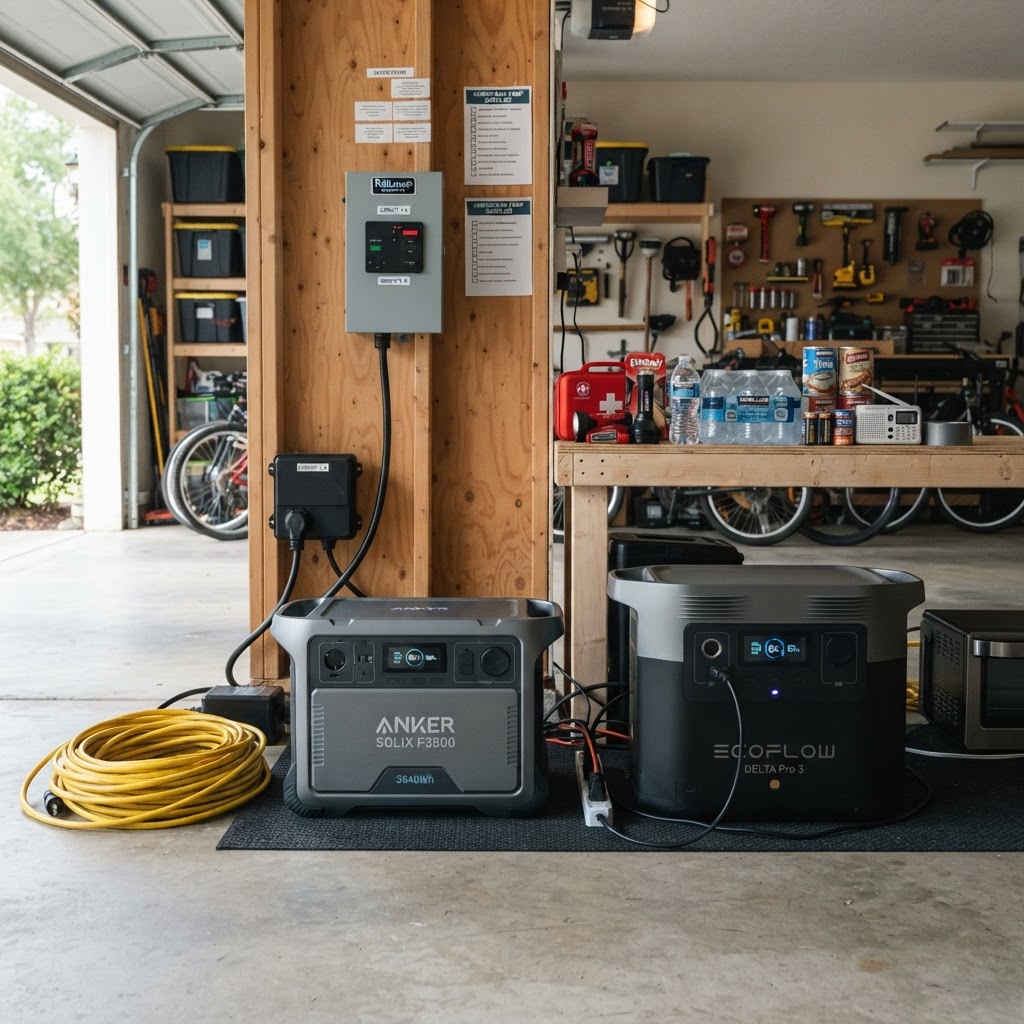
Top Picks This Round
Bluetti AC500 + B300S
A massive modular system delivering up to 5,000W of power, designed for extreme cold and heavy industrial loads.
- +5,000W continuous pure sine wave
- +Self-heating battery for winter
- +Massive 3,000W solar input
Anker Solix F3800
The ultimate solution for high-demand users, featuring direct EV charging and a clean, vertical space-saving design.
- +Direct EV charging port (NEMA 14-50)
- +Easy expansion to 26.9kWh
- +6,000W dual-voltage output
EcoFlow Delta Pro 3
A cutting-edge whole-home backup solution featuring 4000W output and ultra-quiet operation for seamless residential integration.
- +120V/240V output in one unit
- +Extremely quiet 30dB operation
- +Stackable up to 48kWh capacity
EcoFlow Delta Pro (Original)
The battle-tested predecessor that remains a top choice for high-capacity backup at a significantly reduced price.
- +Excellent price-to-performance ratio
- +Massive ecosystem of accessories
- +Fast X-Stream charging technology
The short answer: for most people comparing Anker Solix F3800 vs EcoFlow Delta Pro 3, I’d give the edge to EcoFlow Delta Pro 3 as the better all-around whole-home backup pick, while Anker Solix F3800 makes more sense if EV support and higher-output 240V use are your top priorities.
When I look at a big backup unit for hurricane season, I’m not thinking about marketing claims first. I’m thinking about what keeps the fridge cold, the sump pump alive, the lights on, and maybe a well pump or mini-split running without turning the house into a science project. In that context, the EcoFlow vs Anker whole house debate really comes down to simplicity versus muscle.
The Delta Pro 3 feels like the cleaner fit for most households because it gives you 120V and 240V output in one unit, runs very quietly, and scales into a serious home backup setup. The Solix F3800 fights back with a bigger 6,000W dual-voltage output and one feature a lot of people care about more every year: direct EV charging. If you’ve been hunting for the best 240v portable power station and you want something that can also support a vehicle, Anker makes a very real case.
One important note before I get into the lineup: this article is based on manufacturer specs, official product documentation, and verified customer-review patterns. I’m not claiming hands-on testing here. My goal is just to help you make a smart buy, especially if you’re doing a home backup battery comparison 2026 style and trying to avoid expensive mistakes.
Quick Comparison
| Product | Best For | Key Spec | value tiers |
|---|---|---|---|
| Bluetti AC500 + B300S | Best modular system | 5,000W output and 3,000W solar input | Premium |
| Anker Solix F3800 | Best for EV charging | 6,000W dual-voltage output with NEMA 14-50 | Premium |
| EcoFlow Delta Pro 3 | Best overall | 120V/240V output in one unit with 4,000W output | Premium |
| EcoFlow Delta Pro (Original) | Best value whole-home | Lower-cost entry with broad accessory ecosystem | Mid-range |
| Jackery Explorer 3000 Pro | Best for job sites | 3024Wh capacity with very fast solar charging | Mid-range |
| Anker Solix F2000 (767) | Best for RV / van life | TT-30 RV port and durable LiFePO4 battery | Budget |
| EcoFlow Delta 2 Max | Best for partial backup | 2,400W output at about 50 lbs with dual solar ports | Budget |
1. Bluetti AC500 + B300S — Best modular system
If your idea of backup power is starting with one battery and building a much larger system over time, the Bluetti AC500 + B300S is the most modular-minded option here. Its big appeal is not portability in the normal sense. It’s that you get a serious 5,000W inverter, strong 3,000W solar input, and a platform that’s meant to grow as your needs grow.
Compared with the Anker Solix F3800 and EcoFlow Delta Pro 3, Bluetti’s approach feels more like a home energy building block than a grab-and-go power station. That can be a plus if you want flexibility, especially in colder climates where the self-heating battery matters. It can also be a downside if you just want one box you can wheel into place before a storm.
I’d point this one toward buyers with bigger long-term plans: workshop loads, cabin use, or a backup setup that may expand well beyond the basics. The trade-off is complexity. The F3800 and Delta Pro 3 are easier to understand at a glance, while the Bluetti system asks you to think more carefully about layout, cable routing, and expansion from day one.
Pros:
- Strong 5,000W continuous pure sine wave output
- Self-heating battery helps in winter conditions
- Very high 3,000W solar input for faster replenishment
Cons:
- The multi-box setup takes up more space and is harder to move
- The interface and system layout can feel more complicated than simpler all-in-one units
2. Anker Solix F3800 — Best for EV charging
The Solix F3800 earns its spot because it does something most big power stations still dance around: solix f3800 ev charging is a real selling point, not a footnote. The built-in NEMA 14-50 port is a practical feature for people who already think in terms of EV circuits, RV hookups, and heavier 240V loads. Add in 6,000W dual-voltage output, and this is one of the more serious portable whole-home platforms you can buy.
Against the EcoFlow Delta Pro 3, the F3800 looks stronger if your priority is raw output and flexibility around EV or heavy appliance use. If you want to run tougher 240V equipment or you already know a 14-50 connection matters in your life, I think Anker’s layout is the more compelling one. It also expands easily to a much larger capacity, which matters if a one-day outage in your area can turn into three or four days during hurricane season.
The trade-off is that the F3800 asks for more money up front, and its solar charging isn’t the standout in this class. That matters in an off-grid or slow-recharge scenario. If the delta pro 3 solar input discussion is what pulled you here, that’s exactly where the EcoFlow tends to look more attractive on paper. So for me, the F3800 wins when output and EV utility matter more than recharge speed and low-noise living-room friendliness.
Pros:
- Direct EV charging port with NEMA 14-50 is genuinely useful
- Expansion is straightforward, up to 26.9kWh
- High 6,000W dual-voltage output gives it real whole-home muscle
Cons:
- The starting cost is high
- Solar charging is slower than some direct rivals
3. EcoFlow Delta Pro 3 — Best overall
If someone asked me for the safest recommendation for a big home backup unit without making me explain a bunch of caveats, I’d pick the EcoFlow Delta Pro 3. It’s the most balanced machine in this group: built-in 120V and 240V output, very quiet operation, and room to scale far beyond a single-box setup. That combination is why it wins the “best overall” slot for me.
In the direct Anker Solix F3800 vs EcoFlow Delta Pro 3 matchup, EcoFlow wins on ease and polish for mainstream home use. A lot of people do not need the F3800’s higher 6,000W ceiling or EV-first angle. They need a unit that can sit in the house, integrate cleanly into a backup plan, and not sound like a shop vac when it’s working. The Delta Pro 3’s low-noise operation matters more than people think, especially in overnight outages.
Where I’d still steer someone to the Anker instead is if they know they’ll use that extra power headroom or direct EV charging. But for everyone else, the Delta Pro 3 is easier to recommend. It also feels like the better answer for shoppers asking about the best 240v portable power station for everyday whole-home backup rather than specialty use. The main compromises are weight and price. It’s not cheap, and it’s still a heavy piece of gear.
Pros:
- 120V and 240V output are available in one unit
- Very quiet operation, around 30dB
- Can stack up to a very large 48kWh system
Cons:
- It’s heavy at over 110 lbs
- You’re still paying premium-tier money
4. EcoFlow Delta Pro (Original) — Best value whole-home
The original EcoFlow Delta Pro still deserves a hard look because it sits in a sweet spot between serious capability and a lower buy-in. If the Delta Pro 3 feels just a little too expensive, this older model gives you a way into the EcoFlow ecosystem without jumping straight to the newest premium unit.
What keeps it relevant is value. You get fast X-Stream charging, a broad accessory ecosystem, and a platform that’s already well known in the home backup world. Compared with the Delta Pro 3, you give up some refinement. Compared with the Anker Solix F3800, you give up the direct EV angle and simpler all-in-one 240V story.
The biggest catch is the one I think budget shoppers sometimes miss: there’s no built-in 240V output the way the Delta Pro 3 provides it, so you need extra hardware for that path. If your goal is a cheaper backup system for essentials and future expansion, it’s still a smart buy. If you want a cleaner whole-home setup from day one, the newer Delta Pro 3 or the F3800 will feel less fiddly.
Pros:
- Strong price-to-performance for a large backup platform
- One of the broadest accessory ecosystems in this space
- Fast X-Stream charging is still a real advantage
Cons:
- No built-in 240V output without adding extra gear
- Cooling fans are louder than on the Delta Pro 3
5. Jackery Explorer 3000 Pro — Best for job sites
The Jackery Explorer 3000 Pro makes the list because not everyone shopping this category actually needs a whole-home battery. Some people need a reliable, high-capacity station they can roll onto a job site, use for tools and charging, and still redeploy at home for outage duty. That’s where the Jackery fits best.
Compared with the big whole-home units above, this one is simpler and more portable in spirit. It’s not really trying to beat the Solix F3800 or Delta Pro 3 for 240V house integration. Instead, it wins on usability: app control, strong cooling, and fast solar charging. If you move gear often, that matters more than a fancy expansion ecosystem.
The drawback is obvious: no internal 240V capability. So if your search is truly about whole-home backup, this is not your answer. I’d only choose it over the larger Anker or EcoFlow systems if you need something more mobile and your loads are mostly 120V tools, chargers, and temporary backup appliances rather than permanent home circuits.
Pros:
- App control with Bluetooth adds convenience on the go
- Solar charging is among the fastest in its class
- Strong heat management helps during tougher work use
Cons:
- Cycle life trails LiFePO4-based rivals
- There’s no built-in 240V capability
6. Anker Solix F2000 (767) — Best for RV / van life
The Anker Solix F2000 feels like the practical sweet spot for RV and van setups that need decent capacity, quiet running, and an RV-ready outlet without stepping up to a giant whole-home box. The built-in TT-30 port matters. It saves people from the adapter headache that often turns simple trips into unnecessary troubleshooting.
Compared with the F3800, this is a much easier station to justify if your power life is mobile first and house backup second. It won’t replace a whole-home platform, but it covers a lot of real travel use: lights, small kitchen gear, electronics, and short bursts of heavier AC loads. Against the Delta 2 Max, the Anker feels more RV-specific, while EcoFlow’s smaller unit feels more home-backup flexible.
I’d buy this one for movement, not maximum runtime. It’s durable, quiet, and built around LiFePO4 longevity, but it simply does not play in the same class as the F3800 or Delta Pro 3 for 240V home resilience. Think road life first, outages second.
Pros:
- Durable LiFePO4 battery chemistry
- Built-in TT-30 port is genuinely useful for RV users
- Runs very quietly under load
Cons:
- Capacity is much lower than the F3800
- Solar panels are not included
7. EcoFlow Delta 2 Max — Best for partial backup
The Delta 2 Max is the one I’d point to for people who know they do not need full whole-house backup. If your real goal is to keep the fridge, internet, lights, CPAP, and a few kitchen basics alive through shorter outages, this is a much easier buy than a 100-plus-pound premium station.
What I like about it on paper is the balance. At roughly 50 lbs, it’s far easier to move than the Delta Pro 3 or Solix F3800. It also gives you dual solar charging ports and solid cycle life from its LFP battery setup. Compared with the Anker Solix F2000, it feels more tuned for partial home backup. Compared with the full-size Delta Pro 3, it’s the lighter and cheaper compromise.
The limit is output. At 2,400W, this is not where you go for central AC, big 240V loads, or a whole-home panel strategy. But if you’re realistic about your essentials, it’s one of the smartest smaller picks here.
Pros:
- Light for the amount of power it offers, around 50 lbs
- 3000+ cycles to 80% capacity gives it good long-term value
- Dual solar charging ports add flexibility
Cons:
- 2,400W AC output limits what it can run
- Not suitable for central AC units
How I Picked These
I kept this simple and practical. I looked at the stuff that actually changes your experience during an outage or off-grid stretch: battery capacity in Wh, inverter output in continuous watts, battery chemistry, solar input potential, physical weight, expansion path, and overall value for the size of system you’re getting.
I also separate capacity from power. A big Wh number tells me how long the battery may last. The watt rating tells me whether it can even start and run the appliance in the first place. For chemistry, LiFePO4 gets extra credit for cycle life and long-term durability, while NMC can still make sense in lighter, more compact systems.
And because this site has not hands-on tested these units, I leaned on manufacturer specs, official documentation, and verified customer-review patterns rather than pretending otherwise. That won’t tell me everything, but it does help surface where products clearly differ in output, expandability, noise, and charging behavior.
Things to Watch Out For
- Confusing Wh with W. A 3,000Wh battery can still disappoint if the inverter cannot handle your appliance’s startup or running wattage.
- Falling for peak output numbers. Peak or surge specs sound impressive, but continuous output is what matters for pumps, fridges, heaters, and tools.
- Ignoring solar input limits. Panel wattage on the roof means less if the station itself cannot accept that much power. This is a big reason delta pro 3 solar input questions come up so often.
- Assuming every “whole-home” unit runs every 240V load. Some systems support 240V more cleanly than others, and some need extra hardware. Always check how that power is delivered, not just whether 240V appears in the ad copy.
- Expecting advertised runtime in the real world. Inverter losses, cycling appliances, and weather all eat into runtime. Real use is almost always less generous than the headline number.
Frequently Asked Questions
Is the Anker Solix F3800 or EcoFlow Delta Pro 3 better for whole-home backup?
Yes: the EcoFlow Delta Pro 3 is better for most whole-home backup shoppers, while the Anker Solix F3800 is better for higher-output needs and EV-related use. The Delta Pro 3 is the easier all-around recommendation because it balances 240V support, quiet operation, and expandability well.
Which one is better for EV charging?
Yes: the Anker Solix F3800 is the better pick for EV charging. Its built-in NEMA 14-50 port makes it the more direct and practical option for that use case.
Is the Delta Pro 3 a true 240V portable power station?
Yes: the EcoFlow Delta Pro 3 offers 120V and 240V output in one unit. That makes it one of the cleaner options for buyers specifically shopping for a 240V-capable backup station.
What matters more, battery size or inverter wattage?
Both matter, but inverter wattage comes first. If the unit cannot run the appliance, the battery size does not help no matter how big the Wh number looks.
Are these good for hurricane season outages?
Yes: these larger power stations can be very useful for hurricane season, especially for refrigeration, lighting, communications, and selective appliance backup. The key is sizing for your real loads rather than assuming one box can run the entire house indefinitely.
The Verdict
Top overall pick: EcoFlow Delta Pro 3. It’s the most balanced whole-home option here, with built-in 120V/240V output, quiet operation, and strong expansion potential. Check today’s prices on Amazon →
Best-budget pick: EcoFlow Delta Pro (Original). It’s still the best value entry into serious home backup if you can live with extra hardware for some 240V setups. Check today’s prices on Amazon →
Premium pick: Anker Solix F3800. If you want more output headroom and direct EV charging, this is the premium choice that makes the strongest case against the Delta Pro 3. Check today’s prices on Amazon →
Related Guides
- Best 240V Portable Power Stations for Home Backup
- LiFePO4 vs NMC Batteries: Which Lasts Longer in a Solar Generator?
- How to Size a Solar Generator for Hurricane Season
- Best Expansion Battery Systems for Whole-Home Backup
All Featured Products
Bluetti AC500 + B300S
A massive modular system delivering up to 5,000W of power, designed for extreme cold and heavy industrial loads.
- +5,000W continuous pure sine wave
- +Self-heating battery for winter
- +Massive 3,000W solar input
Anker Solix F3800
The ultimate solution for high-demand users, featuring direct EV charging and a clean, vertical space-saving design.
- +Direct EV charging port (NEMA 14-50)
- +Easy expansion to 26.9kWh
- +6,000W dual-voltage output
EcoFlow Delta Pro 3
A cutting-edge whole-home backup solution featuring 4000W output and ultra-quiet operation for seamless residential integration.
- +120V/240V output in one unit
- +Extremely quiet 30dB operation
- +Stackable up to 48kWh capacity
EcoFlow Delta Pro (Original)
The battle-tested predecessor that remains a top choice for high-capacity backup at a significantly reduced price.
- +Excellent price-to-performance ratio
- +Massive ecosystem of accessories
- +Fast X-Stream charging technology
Jackery Explorer 3000 Pro
Known for its reliability and fast solar setup, this unit provides 3024Wh of capacity in a user-friendly, portable package.
- +Smart App control with Bluetooth
- +Fastest solar charging in class
- +Superior heat dissipation system
Anker Solix F2000 (767)
A mobile powerhouse with InfiniPower technology and rugged wheels, perfect for nomadic lifestyles and off-grid adventures.
- +Ultra-durable LiFePO4 batteries
- +Built-in RV-ready TT-30 port
- +Very quiet operation under load
EcoFlow Delta 2 Max
A high-performance LFP power station that balances weight and power for essential appliance backup during short outages.
- +Lightweight for its power (50 lbs)
- +3000+ cycles to 80% capacity
- +Dual solar charging ports
Frequently Asked Questions
Is the Anker Solix F3800 or EcoFlow Delta Pro 3 better for whole-home backup?
For most people, the EcoFlow Delta Pro 3 is the better whole-home backup pick because it balances built-in 120V/240V output, quiet operation, and expansion more cleanly. The Anker Solix F3800 is the better choice if you need higher output and EV-focused utility.
Which one is better for EV charging?
The Anker Solix F3800 is better for EV charging because it includes a built-in NEMA 14-50 port. That makes it the more direct fit for people who want vehicle-related backup flexibility.
Is the Delta Pro 3 a true 240V portable power station?
Yes. The EcoFlow Delta Pro 3 provides 120V and 240V output in one unit, which is a big reason it stands out for home backup use.
What matters more, battery size or inverter wattage?
Inverter wattage matters first. A large battery is only useful if the power station can actually start and run the appliances you care about.
Are these good for hurricane season outages?
Yes, especially the larger whole-home models. They work best when you size them for essentials like refrigeration, lighting, communications, and selective appliance backup rather than expecting unlimited runtime.