3000Wh Solar Generator Buying Guide: Best 2026 Cabin Picks
3000Wh solar generator buying guide for off-grid cabins. Compare EcoFlow, Bluetti, and Anker for reliable power. Find the best system for your needs!
Affiliate disclosure: As an Amazon Associate I earn from qualifying purchases. We may earn a commission from purchases made through our links, at no extra cost to you.
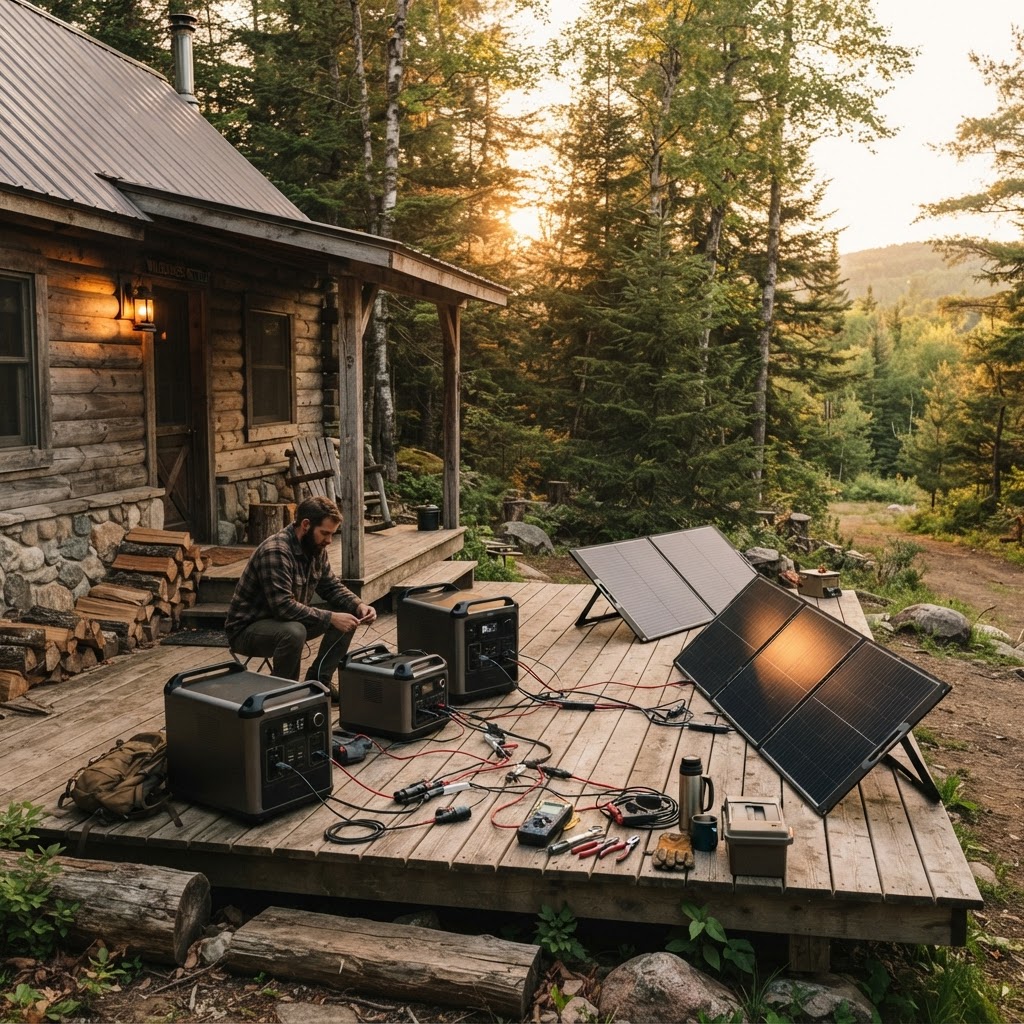
Top Picks This Round
Anker SOLIX F3800
The ultimate cabin companion with 3840Wh capacity and direct 240V output, capable of powering heavy-duty pumps and dryers.
- +NEMA 14-50 port for EVs/RVs
- +Direct 240V split-phase output
- +10-year product lifespan
EcoFlow DELTA Pro
A powerhouse 3600Wh station that sets the industry standard with its massive 3600W AC output and rapid X-Stream charging technology.
- +Industry-leading 3600W output
- +EV station charging support
- +Expandable up to 25kWh
Zendure SuperBase V4600
A next-generation 4608Wh station featuring semi-solid state batteries and motorized wheels for effortless relocation around the cabin.
- +Semi-solid state safety tech
- +Motorized rear wheels
- +Dual voltage 120V/240V support
BLUETTI AC300 & B300 Combo
A unique modular 3072Wh system that allows users to swap batteries and scale capacity up to 12.2kWh for long-term off-grid stays.
- +LFP battery with 3500+ cycles
- +Modular design for easy transport
- +Dual charging up to 5400W
The short answer: if you want the safest all-around bet in a 3000Wh solar generator buying guide for an off-grid cabin, I’d start with the EcoFlow DELTA Pro for its strong balance of capacity, 3600W output, and expansion options. If your cabin needs true 240V power for heavier loads, the Anker SOLIX F3800 stands out fast.
A 3000Wh-class power station sits in a sweet spot for a lot of cabin setups. It’s big enough to handle the real stuff people care about off-grid, like refrigerators, lights, routers, CPAP machines, kitchen gear, and short bursts from tools, but it’s still a lot simpler than building a full fixed battery room. For weekend cabins, hunting camps, and small off-grid places, this size often makes more sense than either a tiny backup box or a huge whole-home system.
I want to be clear about how I put this list together. I’m not pretending these picks come from lab testing or hands-on teardown work. This guide is based on manufacturer specs, official product documentation, and verified customer-review patterns, then filtered through what actually matters when you’re trying to keep a cabin running: usable capacity, inverter strength, solar charging limits, battery chemistry, portability, and whether a unit can grow with your setup later.
If you’ve been reading 3000Wh solar generator reviews and they all start sounding the same, that’s because a lot of them blur together products that are actually built for different jobs. Some are better as the best large capacity power station for mixed home-and-cabin backup, some are better as an expandable solar generator for cabins, and some only really make sense if budget is the first priority. That’s the difference I’ll focus on here.
Quick Comparison
| Product | Best For | Key Spec | value tiers |
|---|---|---|---|
| Anker SOLIX F3800 | Best for Home Backup | 3840Wh with direct 240V split-phase output | Premium |
| EcoFlow DELTA Pro | Best overall | 3600Wh with 3600W AC output | Premium |
| Zendure SuperBase V4600 | Best tech features | 4608Wh with 120V/240V support | Premium |
| BLUETTI AC300 & B300 Combo | Best for Expandability | 3072Wh modular system expandable to 12.2kWh | Premium |
| Jackery Explorer 3000 Pro | Best for RV / Off-Grid Living | 3024Wh with fast solar recharge | Mid-range |
| Goal Zero Yeti 3000X | Best premium | 2982Wh with 2000W inverter | Premium |
| Pecron E3000 | Best budget | 3108Wh capacity with 16 output ports | Budget |
1. Anker SOLIX F3800 — Best for Home Backup
The Anker SOLIX F3800 earns its spot here because it does something a lot of 3kWh-class stations only dance around: it gives you direct 240V split-phase output in a self-contained unit. For cabin owners, that matters if you’re trying to run a well pump, a larger pressure pump, certain shop tools, or other loads that a standard 120V-only box may not handle cleanly. At 3840Wh, it also lands slightly above the usual “3000Wh” class, which gives you a little more breathing room overnight.
Compared with the EcoFlow DELTA Pro, the Anker feels more purpose-built for serious backup duty instead of just big portable power. If your cabin setup is drifting closer to a small home-energy system than a weekend battery box, I’d look hard at this one first. It also makes more sense than the Jackery Explorer 3000 Pro if your loads include heavy-duty gear rather than just the usual appliances and electronics.
The trade-off is simple: size and price. This is one of the most expensive options in the category, and it’s not something I’d call casually portable. If you want one station that can act more like an off-grid backbone, that’s a fair compromise. If you mainly need lights, a fridge, and device charging, it may be more machine than you need.
Pros:
- NEMA 14-50 port is genuinely useful for RV and EV-style applications
- Direct 240V split-phase output opens the door for heavier cabin loads
- Long claimed 10-year product lifespan is reassuring for long-term use
Cons:
- Usually the most expensive pick in this group
- Takes up a lot of floor space compared with simpler 3kWh units
2. EcoFlow DELTA Pro — Best overall
If most people asked me for one safe recommendation without overexplaining their whole cabin layout, I’d point them to the EcoFlow DELTA Pro. It has the broadest mix of things buyers usually want: 3600Wh of capacity, a strong 3600W inverter, fast charging, and the ability to scale far beyond a single box. That combination is why it still sets the pace in a lot of EcoFlow Delta Pro vs Bluetti AC300 conversations.
What I like here is balance. The Anker SOLIX F3800 is stronger if direct 240V output is the make-or-break feature, but the DELTA Pro is easier to recommend to more people because it covers everyday cabin power so well. It has enough inverter headroom for a microwave, coffee maker, fridge, power tools in short bursts, and the normal stack of lights and electronics. For a mixed-use cabin that doubles as storm backup at home, it’s one of the least risky picks on paper.
The biggest downsides are the 99-pound weight and the fan noise under load. That matters if your cabin is small and quiet, or if you expect to move the unit up steps often. Still, for buyers who want the best large capacity power station without jumping straight to a more specialized unit, this is the strongest overall package in the list.
Pros:
- Industry-leading 3600W output gives it real appliance-running confidence
- EV station charging support adds flexibility on the road and at home
- Expandable design can grow all the way to 25kWh
Cons:
- Heavy enough that moving it often gets old fast
- Cooling fans can get loud when the inverter is working hard
3. Zendure SuperBase V4600 — Best tech features
The Zendure SuperBase V4600 is the one I’d point to if you care as much about design and system features as raw specs. With 4608Wh on board, it’s actually the biggest-capacity unit in this lineup, and the 120V/240V support gives it broader cabin use than many stations in the same general class. The motorized rear wheels also make more sense than they may sound on paper, because at 121 pounds, this thing needs help moving.
Compared with the Anker SOLIX F3800, the Zendure feels more futuristic and a little more ambitious. Compared with the EcoFlow DELTA Pro, it leans more heavily into premium feature design. If your cabin setup involves moving the station from storage to porch to utility corner, the wheeled design is a real lifestyle feature, not just a gimmick.
The hesitation point is ecosystem maturity. BLUETTI and EcoFlow feel more established when it comes to accessory confidence and broader buyer familiarity. So while the Zendure is impressive on paper, I’d call it a better fit for buyers who like newer platform ideas and don’t mind a bit more risk than the category leaders carry.
Pros:
- Semi-solid state battery tech is a standout safety-focused feature
- Motorized rear wheels help with relocation around a cabin or shop
- Dual-voltage 120V/240V support adds flexibility for mixed loads
Cons:
- Extremely heavy, even by large power station standards
- The brand ecosystem still feels less developed than bigger rivals
4. BLUETTI AC300 & B300 Combo — Best for Expandability
If you already know your cabin power needs are going to grow, the BLUETTI AC300 & B300 Combo is one of the smartest places to start. This isn’t a typical all-in-one box. It’s a modular system, which means you’re buying into a platform rather than a single sealed station. The included combo gives you 3072Wh, and the system can scale up to 12.2kWh, which is why it deserves the “expandable solar generator for cabins” label more than anything else here.
This is the model I keep coming back to in EcoFlow Delta Pro vs Bluetti AC300 debates. The DELTA Pro is simpler: one main unit, strong output, easy pitch. The BLUETTI AC300 route is more modular and more customizable. If your cabin power plan is going from occasional weekend use to longer stays, more solar, and more battery over time, BLUETTI’s structure makes a lot of sense.
The downside is complexity. Because the AC300 requires an external battery to function, you’re dealing with more pieces and more cable management than with an all-in-one station like the Jackery Explorer 3000 Pro or Goal Zero Yeti 3000X. For tinkerers and long-term off-grid planners, that’s fine. For someone who wants plug-and-play simplicity, it can be frustrating.
Pros:
- LFP battery design and 3500-plus cycle claim are strong for long service life
- Modular layout makes transport easier than one giant monolithic box
- Dual charging up to 5400W is serious if you want fast turnaround
Cons:
- It will not run by itself without the external battery connected
- Cable management is messier than on all-in-one competitors
5. Jackery Explorer 3000 Pro — Best for RV / Off-Grid Living
The Jackery Explorer 3000 Pro is the pick I’d show someone who wants a big station without wanting a big project. It has 3024Wh of capacity, a more travel-friendly form factor than most of the list, and a built-in pull handle that makes a lot more difference in day-to-day use than spec sheets usually admit. For moving between a vehicle, cabin, and campsite, it’s one of the easiest 3kWh units to live with.
Compared with the BLUETTI AC300 & B300 Combo, Jackery is much simpler. Compared with the EcoFlow DELTA Pro, it’s less expandable and less aggressive on raw system capability, but easier for buyers who mainly want one self-contained unit. Fast solar recharge is another real plus for off-grid living, especially if you’re trying to refill during shorter daylight windows instead of babying the system all day.
The main trade-off is battery chemistry. Because it uses NMC rather than LFP, it’s not my first pick for someone who expects years of frequent deep cycling in a fixed cabin setup. It’s better for people who value portability and convenience over maximum cycle-life longevity. If you want an easy-going RV-and-cabin crossover, though, it’s still a strong candidate.
Pros:
- Very fast solar recharge for a unit in this capacity class
- Suitcase-style pull handle makes transport more manageable
- Whisper mode helps keep noise down in tight living spaces
Cons:
- NMC chemistry is a weaker long-cycle value than LFP alternatives
- You cannot expand the internal capacity later
6. Goal Zero Yeti 3000X — Best premium
The Goal Zero Yeti 3000X is a little different from the others here because its value is less about chasing the biggest numbers and more about a premium build approach. With 2982Wh and a 2000W inverter, it doesn’t win the spec-sheet race against the EcoFlow DELTA Pro or Anker SOLIX F3800. What it offers instead is a reputation for solid component choices, a rugged steel chassis, and a cleaner fit for buyers who prefer a more established premium brand feel.
I’d consider this one for a cabin owner who mostly powers electronics, lighting, routers, fans, small kitchen gear, and maybe a fridge, but doesn’t need high-wattage tool use or large 240V loads. Compared with the Jackery Explorer 3000 Pro, it feels more industrial and less travel-oriented. Compared with the Pecron E3000, it gives up value-per-dollar but aims higher on perceived build confidence.
The catch is that you’re paying premium money without getting the battery-cycle advantages of many newer LFP rivals. There are also no built-in wheels or a pull handle, which feels like a real miss in a unit this size. So I’d call it premium in construction style, not premium in raw value.
Pros:
- Tier 1 lithium cells should appeal to buyers focused on component quality
- 2000W inverter is solid for sensitive electronics and moderate loads
- Rugged steel chassis looks better suited to hard use than many plastic-heavy rivals
Cons:
- Cycle life is shorter than LFP-based competitors in this guide
- No built-in wheels or handle makes portability harder than it should be
7. Pecron E3000 — Best budget
If cost is the first filter and you still want real 3kWh-class capacity, the Pecron E3000 is the one that jumps out. At 3108Wh, it gives you more watt-hours than some pricier rivals, and that alone makes it worth a serious look for a basic cabin setup. For lights, a fridge, charging gear, and modest appliance use, it covers a lot of ground for less money than the premium names.
Compared with the Goal Zero Yeti 3000X or Jackery Explorer 3000 Pro, this is much more about practical capacity-per-dollar than polish. You’re not paying for a fancy interface, a mature app ecosystem, or top-tier charging speed. You’re paying for a big battery and a useful spread of ports. For some people, that’s the right trade every time.
The reason it doesn’t rank higher overall is that the savings come with compromises. Slower AC charging and a more basic interface matter if you use the station often or expect refined controls. Still, as a budget entry in 3000Wh solar generator reviews, it fills a real gap that a lot of lists ignore.
Pros:
- Strong value-to-capacity ratio for budget-focused buyers
- Sixteen output ports give you plenty of connection flexibility
- Relatively compact footprint for a unit above 3kWh
Cons:
- AC charging is slower than faster-moving premium rivals
- Interface and app features are fairly basic
How I Picked These
I looked at the stuff that actually changes your day at a cabin, not just the headline number on the box. First was capacity versus inverter power: 3000Wh sounds big, but if the inverter can’t support the loads you care about, that battery size doesn’t help much. A fridge and lights are one thing; a microwave, pump, or power tool is another.
I also weighed battery chemistry pretty heavily. In general, I lean toward LiFePO4 for cabin duty because longer cycle life matters when a unit may be charged and discharged for years. NMC can still make sense when portability and weight-saving design are priorities, which is why the Jackery Explorer 3000 Pro still has a place here.
Solar input matters more than many buyers think, so I gave extra credit to units that can recharge fast enough to be practical in real off-grid use. After that came portability, expandability, and value per watt-hour. A big station is only helpful if you can move it, grow it, or justify what you’re paying for the energy it stores.
And again, to keep this honest: these picks are based on manufacturer specs, official documentation, and verified customer-review patterns. This site has not hands-on tested these units, and I’m not going to pretend otherwise.
Things to Watch Out For
1. Confusing watt-hours with watts. Watt-hours tell you how much energy is stored. Watts tell you how much power the inverter can deliver at once. You need both numbers to make a smart choice.
2. Mixing up peak output and continuous output. A station may handle a startup surge briefly, but that doesn’t mean it can run that load continuously. For pumps, tools, and kitchen appliances, continuous inverter rating is the number I watch first.
3. Ignoring solar input limits. A big battery that charges slowly can be frustrating off-grid. If your cabin depends on solar most days, make sure the unit can accept enough panel input to refill in a useful amount of time.
4. Overestimating what a 3kWh station can run. These systems are powerful, but they’re not magic. High-draw heaters, electric ranges, and long runtimes on air conditioning can drain even a large station quickly.
5. Believing advertised runtime without losses. Real-world runtime is always lower than the simple math because inverter losses and appliance cycling eat into stored energy. I always leave a comfort margin instead of sizing right to the edge.
Frequently Asked Questions
Is a 3000Wh solar generator enough for an off-grid cabin?
Yes, for many small cabins it is enough for basics like a fridge, lights, device charging, a router, and occasional kitchen use. No, it is usually not enough for heavy all-day electric heating, large air conditioning, or multiple big appliances at once.
Which is better for cabins: EcoFlow DELTA Pro or BLUETTI AC300 & B300 Combo?
EcoFlow DELTA Pro is better if you want a simpler all-in-one system, while BLUETTI AC300 & B300 Combo is better if expandability is your main goal. The real choice comes down to plug-and-play convenience versus a more modular long-term setup.
Should I choose LiFePO4 or NMC for a cabin power station?
LiFePO4 is usually the better cabin choice because it tends to offer longer cycle life for regular use. NMC still makes sense when a unit’s portability, compactness, or design convenience matters more than maximum lifespan.
Can a 3000Wh power station run a well pump?
Sometimes, but only if the inverter output and startup surge support the pump. For that reason, units like the Anker SOLIX F3800 are better candidates than lower-output stations.
What size solar panel setup makes sense with a 3000Wh station?
A few hundred watts can work for light topping off, but a larger solar array is better if the station is your main cabin battery. The right size depends on the unit’s solar input limit and how much energy you use each day.
The Verdict
Top overall pick: EcoFlow DELTA Pro. It hits the best balance of capacity, inverter strength, recharge speed, and room to grow for most cabin owners. Check today's prices on Amazon →
Best budget pick: Pecron E3000. It gives budget-minded buyers real 3kWh-class capacity without forcing them into premium pricing. Check today's prices on Amazon →
Premium pick: Anker SOLIX F3800. If your cabin needs serious 240V capability and heavier-duty backup performance, this is the most purpose-built option here. Check today's prices on Amazon →
Related Guides
- Best 1000Wh Power Stations for Home Backup
- LiFePO4 vs NMC Batteries: Which Lasts Longer in a Solar Generator?
- How to Size a Solar Generator for an RV or Small Cabin
- Best Expandable Power Stations for Long Off-Grid Stays
All Featured Products
Anker SOLIX F3800
The ultimate cabin companion with 3840Wh capacity and direct 240V output, capable of powering heavy-duty pumps and dryers.
- +NEMA 14-50 port for EVs/RVs
- +Direct 240V split-phase output
- +10-year product lifespan
EcoFlow DELTA Pro
A powerhouse 3600Wh station that sets the industry standard with its massive 3600W AC output and rapid X-Stream charging technology.
- +Industry-leading 3600W output
- +EV station charging support
- +Expandable up to 25kWh
Zendure SuperBase V4600
A next-generation 4608Wh station featuring semi-solid state batteries and motorized wheels for effortless relocation around the cabin.
- +Semi-solid state safety tech
- +Motorized rear wheels
- +Dual voltage 120V/240V support
BLUETTI AC300 & B300 Combo
A unique modular 3072Wh system that allows users to swap batteries and scale capacity up to 12.2kWh for long-term off-grid stays.
- +LFP battery with 3500+ cycles
- +Modular design for easy transport
- +Dual charging up to 5400W
Jackery Explorer 3000 Pro
Optimized for simplicity and portability, this 3024Wh unit features a pull-handle design and ultra-fast solar charging for cabin life.
- +Fast 2.4-hour solar recharge
- +Integrated suitcase-style handle
- +Quiet operation in 'Whisper' mode
Goal Zero Yeti 3000X
A professional-grade 2982Wh station built with premium components and a high-surge inverter for sensitive electronics.
- +Tier 1 lithium battery cells
- +High-quality 2000W AC inverter
- +Rugged steel chassis
Pecron E3000
A high-capacity 3108Wh workhorse that offers the most watt-hours per dollar for budget-conscious cabin owners.
- +Excellent value-to-capacity ratio
- +16 different output ports
- +Compact for a 3kWh unit
Frequently Asked Questions
Is a 3000Wh solar generator enough for an off-grid cabin?
Yes, for many small cabins it is enough for basics like a fridge, lights, device charging, a router, and occasional kitchen use. It is usually not enough for heavy all-day electric heating, large air conditioning, or multiple big appliances at once.
Which is better for cabins: EcoFlow DELTA Pro or BLUETTI AC300 & B300 Combo?
EcoFlow DELTA Pro is better if you want a simpler all-in-one system, while BLUETTI AC300 & B300 Combo is better if expandability is your main goal. The choice is really convenience versus modular growth.
Should I choose LiFePO4 or NMC for a cabin power station?
LiFePO4 is usually the better cabin choice because it tends to offer longer cycle life for regular use. NMC still makes sense when portability, compactness, or design convenience matters more than maximum lifespan.
Can a 3000Wh power station run a well pump?
Sometimes, but only if the inverter output and startup surge support the pump. That is why stronger units like the Anker SOLIX F3800 are better candidates than lower-output stations.
What size solar panel setup makes sense with a 3000Wh station?
A few hundred watts can work for light topping off, but a larger array is better if the station is your main cabin battery. The right setup depends on the station’s solar input limit and your daily energy use.